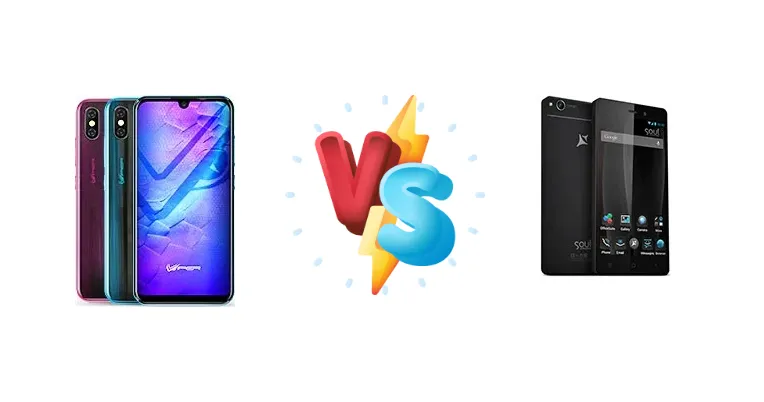
The Allview V4 Viper and X1 Soul represent Allview's offerings in the ultra-budget smartphone segment. While both aim to provide essential smartphone functionality at a low price point, they differ significantly in their underlying hardware. This comparison dissects those differences, focusing on the impact of their respective chipsets on real-world performance and usability.
🏆 Quick Verdict
For the average user prioritizing responsiveness and future-proofing, the Allview V4 Viper is the better choice. Its newer Mediatek Helio A22 chipset, built on a 12nm process, offers a noticeable performance advantage and improved efficiency over the older, 28nm MT6589T in the X1 Soul.
| Network |
|---|
| 2G bands | GSM 850 / 900 / 1800 / 1900 | GSM 850 / 900 / 1800 / 1900 |
| 3G bands | HSDPA 900 / 2100 | HSDPA 900 / 2100 |
| 4G bands | 1, 3, 7, 8, 20, 38 | - |
| Speed | HSPA 42.2/11.5 Mbps, LTE Cat4 150/50 Mbps | HSPA |
| Technology | GSM / HSPA / LTE | GSM / HSPA |
| Launch |
|---|
| Announced | 2019, September. Released 2019, September | 2013, November. Released 2013, November |
| Status | Discontinued | Discontinued |
| Body |
|---|
| Dimensions | 145.8 x 70.9 x 8.5 mm (5.74 x 2.79 x 0.33 in) | 143 x 69 x 7.9 mm (5.63 x 2.72 x 0.31 in) |
| SIM | Nano-SIM + Nano-SIM | Micro-SIM |
| Weight | 138 g (4.87 oz) | 129.4 g (4.55 oz) |
| Display |
|---|
| Protection | - | Corning Gorilla Glass 3 |
| Resolution | 720 x 1520 pixels, 19:9 ratio (~295 ppi density) | 1080 x 1920 pixels, 16:9 ratio (~441 ppi density) |
| Size | 5.7 inches, 81.1 cm2 (~78.4% screen-to-body ratio) | 5.0 inches, 68.9 cm2 (~69.8% screen-to-body ratio) |
| Type | IPS LCD | IPS LCD |
| Platform |
|---|
| CPU | Quad-core 2.0 GHz Cortex-A53 | Quad-core 1.5 GHz Cortex-A7 |
| Chipset | Mediatek MT6761 Helio A22 (12 nm) | Mediatek MT6589T (28 nm) |
| GPU | PowerVR GE8320 | PowerVR SGX544MP2 |
| OS | Android 9.0 (Pie) | Android 4.2 (Jelly Bean) |
| Memory |
|---|
| Card slot | microSDXC (uses shared SIM slot) | No |
| Internal | 16GB 2GB RAM | 32GB 2GB RAM |
| | eMMC 5.1 | - |
| Main Camera |
|---|
| Dual | 8 MP, AF
Auxiliary lens | - |
| Features | LED flash | LED flash, HDR, panorama |
| Single | - | 13 MP, AF |
| Video | 1080p@30fps | 1080p@30fps |
| Selfie camera |
|---|
| Single | 5 MP | 5 MP |
| Sound |
|---|
| 3.5mm jack | Yes | Yes |
| 35mm jack | Yes | Yes |
| Loudspeaker | Yes | Yes, built-in amplifier |
| | - | Yamaha audio amplifier |
| Comms |
|---|
| Bluetooth | 4.1, A2DP, LE | 4.0, A2DP, EDR |
| NFC | No | No |
| Positioning | GPS, GLONASS | GPS |
| Radio | FM radio | FM radio |
| USB | microUSB 2.0 | microUSB 2.0 |
| WLAN | Wi-Fi 802.11 b/g/n | Wi-Fi 802.11 b/g/n, hotspot, Wi-Fi Direct |
| Features |
|---|
| Sensors | Fingerprint (rear-mounted), accelerometer, proximity | Accelerometer, proximity, compass |
| Battery |
|---|
| Stand-by | - | Up to 250 h |
| Talk time | - | Up to 6 h (2G) / Up to 5 h (3G) |
| Type | Li-Po 2700 mAh, non-removable | Li-Po 2000 mAh, non-removable |
| Misc |
|---|
| Colors | Blue, Red | Black |
| Price | About 100 EUR | About 360 EUR |
| SAR EU | 1.13 W/kg (head) | - |
Allview V4 Viper
- More powerful and efficient chipset (Helio A22)
- Likely better software support and future updates
- Improved power efficiency for longer battery life
- Still an entry-level device with limited performance
- Likely lacks advanced features like fast charging
Allview X1 Soul
- Potentially lower price point
- Simple and straightforward user experience
- May be suitable for users with extremely basic needs
- Outdated and inefficient chipset (MT6589T)
- Poor performance and responsiveness
- Limited software support and potential security vulnerabilities
Display Comparison
Neither Allview provides display specifications beyond size, so a direct comparison is limited. However, given the target market, both likely utilize IPS LCD panels. The age difference suggests the V4 Viper *may* benefit from slightly improved color accuracy and viewing angles. The older X1 Soul's panel is likely to have lower peak brightness and wider bezels, impacting outdoor visibility. The absence of any mention of protective glass on either device suggests both are susceptible to scratches.
Camera Comparison
Without detailed camera specifications, a meaningful comparison is difficult. Both phones likely feature basic camera setups geared towards casual snapshots. It's reasonable to assume the V4 Viper benefits from slightly improved image processing capabilities due to its newer chipset. However, the image quality on both devices will be limited by sensor size and lens quality, which are unknown. The inclusion of a 2MP macro lens on either device is largely a marketing gimmick and unlikely to produce usable results.
Performance
The core difference lies in the chipsets. The Allview V4 Viper’s Mediatek MT6761 Helio A22 (12nm) features a quad-core 2.0 GHz Cortex-A53 CPU. This is a significant upgrade over the Allview X1 Soul’s Mediatek MT6589T (28nm) with its quad-core 1.5 GHz Cortex-A7 CPU. The 12nm fabrication process of the Helio A22 is far more efficient, resulting in lower power consumption and less heat generation. The Cortex-A53 cores, while still entry-level, offer a performance improvement over the older Cortex-A7 cores in the X1 Soul. This translates to faster app loading times, smoother scrolling, and a more responsive user interface on the V4 Viper. The X1 Soul will struggle with even moderately demanding tasks.
Battery Life
Battery capacity is not specified for either device. However, the Helio A22’s improved power efficiency in the V4 Viper will likely result in longer battery life compared to the X1 Soul, despite potentially having a similar capacity. The older 28nm process of the MT6589T is inherently less efficient. Charging wattage is also unknown, but given the price point, both phones likely support slow charging speeds.
Buying Guide
Buy the Allview V4 Viper if you need a phone capable of handling basic multitasking, running modern (though lightweight) apps, and benefiting from potential future Android updates. It's ideal for users who want a slightly smoother experience and a longer software lifespan. Buy the Allview X1 Soul if your needs are extremely basic – primarily calls, texts, and very light web browsing – and you're looking for the absolute lowest possible price point. Be prepared for noticeable slowdowns with even moderate use.
Frequently Asked Questions
❓ Will the Allview X1 Soul struggle with popular apps like WhatsApp or Facebook?
Yes, the MT6589T chipset in the X1 Soul is quite limited. While it can technically run these apps, you'll likely experience significant lag, slow loading times, and potential crashes, especially when multitasking. The V4 Viper's Helio A22 will provide a much smoother experience.
❓ Is the Allview V4 Viper suitable for playing mobile games?
The V4 Viper is not a gaming phone. While it can handle very basic 2D games, it will struggle with most modern 3D titles. Expect low frame rates and significant lag. The Helio A22 is designed for basic tasks, not demanding gaming.
❓ Which phone is more likely to receive Android updates?
The Allview V4 Viper is significantly more likely to receive updates. The MT6761 chipset is newer and has better software support from Mediatek. The MT6589T is an older chipset and is unlikely to receive further updates, potentially leaving the X1 Soul vulnerable to security risks.
❓ Does either phone support 4G LTE?
The context data does not explicitly state 4G LTE support. However, the Helio A22 chipset in the V4 Viper *typically* includes 4G LTE connectivity. The older MT6589T in the X1 Soul is more likely to be limited to 3G, resulting in slower data speeds.