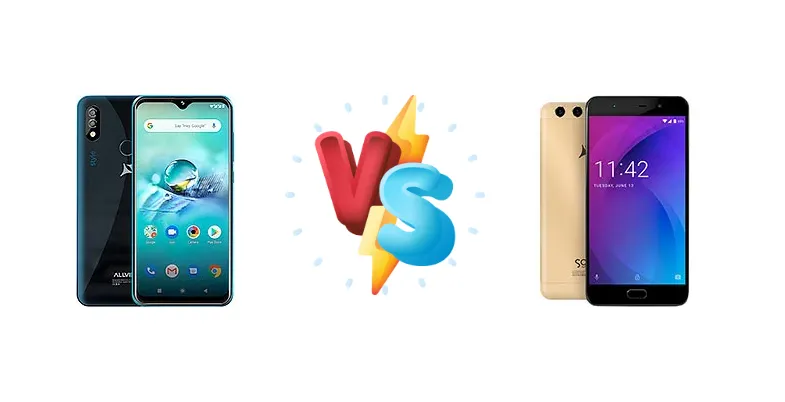
Allview targets the budget-conscious smartphone user, and the Soul X7 Style and X4 Soul Lite represent two distinct approaches within that segment. The X7 Style aims for a slight performance boost, while the X4 Soul Lite prioritizes affordability. This comparison dissects the key differences between these two devices, focusing on their chipsets and how those impact the overall user experience.
🏆 Quick Verdict
For most users, the Allview Soul X7 Style is the better choice. Its Mediatek Helio P23 chipset, built on a smaller 16nm process, delivers noticeably improved performance over the X4 Soul Lite’s older 28nm MT6750. While both phones cater to basic needs, the X7 Style offers a smoother experience for multitasking and app loading.
| Network |
|---|
| 2G bands | GSM 850 / 900 / 1800 / 1900 | GSM 850 / 900 / 1800 / 1900 - SIM 1 & SIM 2 |
| 3G bands | HSDPA 900 / 2100 | HSDPA 900 / 2100 |
| 4G bands | 1, 3, 5, 7, 8, 20, 38, 40 | 1, 3, 7, 8, 20, 38 |
| Speed | HSPA, LTE | HSPA 21.1/5.76 Mbps, LTE (2CA) Cat6 300/50 Mbps |
| Technology | GSM / HSPA / LTE | GSM / HSPA / LTE |
| Launch |
|---|
| Announced | 2020, May 26. Released 2020, May 26 | 2017, June. Released 2017, June |
| Status | Discontinued | Discontinued |
| Body |
|---|
| Build | - | Glass front, glass back |
| Dimensions | 157.6 x 75.2 x 8.3 mm (6.20 x 2.96 x 0.33 in) | 155.4 x 75.9 x 7.8 mm (6.12 x 2.99 x 0.31 in) |
| SIM | Nano-SIM + Nano-SIM | Nano-SIM + Micro-SIM |
| Weight | 184.7 g (6.53 oz) | 150.4 g (5.29 oz) |
| Display |
|---|
| Protection | Corning Gorilla Glass | - |
| Resolution | 720 x 1520 pixels, 19:9 ratio (~271 ppi density) | 1080 x 1920 pixels, 16:9 ratio (~401 ppi density) |
| Size | 6.21 inches, 96.3 cm2 (~81.2% screen-to-body ratio) | 5.5 inches, 83.4 cm2 (~70.7% screen-to-body ratio) |
| Type | IPS LCD | IPS LCD |
| Platform |
|---|
| CPU | Octa-core (4x2.0 GHz Cortex-A53 & 4x1.5 GHz Cortex-A53) | Octa-core (4x1.5 GHz Cortex-A53 & 4x1.0 GHz Cortex-A53) |
| Chipset | Mediatek MT6763 Helio P23 (16 nm) | Mediatek MT6750 (28 nm) |
| GPU | Mali-G71 MP2 | Mali-T860MP2 |
| OS | Android 9.0 (Pie) | Android 7.0 (Nougat) |
| Memory |
|---|
| Card slot | microSDXC (uses shared SIM slot) | microSDXC (uses shared SIM slot) |
| Internal | 64GB 4GB RAM | 16GB 3GB RAM, 32GB 4GB RAM |
| | eMMC 5.1 | eMMC 5.1 |
| Main Camera |
|---|
| Dual | 13 MP, f/2.2, AF
Auxiliary lens | 13 MP, 1/3.1", 1.12µm, PDAF
Auxiliary lens |
| Features | LED flash, HDR | LED flash, panorama, HDR |
| Single | 5 MP | - |
| Triple | - | 13 MP, f/1.8, 26mm (wide), 1/3.1", 1.12µm, PDAF
2 MP, (depth)
QVGA (Low light sensor) |
| Video | 1080p@30fps | 1080p@30fps |
| Selfie camera |
|---|
| Features | - | LED flash |
| Single | 5 MP | 8 MP |
| Sound |
|---|
| 3.5mm jack | Yes | Yes |
| 35mm jack | Yes | Yes |
| Loudspeaker | Yes | Yes |
| Comms |
|---|
| Bluetooth | 4.0, A2DP | 4.0, A2DP, EDR, LE |
| NFC | No | No |
| Positioning | GPS, GLONASS | GPS |
| Radio | FM radio | FM radio |
| USB | USB Type-C 2.0 | microUSB 2.0 |
| WLAN | Wi-Fi 802.11 b/g/n | Wi-Fi 802.11 a/b/g/n |
| Features |
|---|
| Sensors | Fingerprint (rear-mounted), accelerometer, proximity, compass | Fingerprint (front-mounted), accelerometer, proximity, compass |
| Battery |
|---|
| Music play | Up to 34 h | - |
| Stand-by | Up to 840 h (2G) / Up to 840 h (3G) | Up to 500 h (3G) |
| Talk time | Up to 12 h (2G) / Up to 4 h 30 min (3G) | Up to 23 h (3G) |
| Type | Li-Po 3400 mAh battery | Li-Po 3000 mAh, non-removable |
| Misc |
|---|
| Colors | Turcoise | Black, Gold |
| Models | - | X650C, X650B, X650D |
| Price | About 130 EUR | About 7000 INR |
| SAR EU | 0.87 W/kg (head) | - |
| Tests |
|---|
| Audio quality |
Noise -88.3dB / Crosstalk -82.1dB | - |
| Camera |
Photo | - |
| Display |
Contrast ratio: 635:1 (nominal), 1.281 (sunlight) | - |
| Loudspeaker |
Voice 75dB / Noise 72dB / Ring 75dB
| - |
Allview Soul X7 Style
- Faster and more efficient processor (Helio P23)
- Potentially better display contrast
- Likely improved battery life due to chipset efficiency
- Limited camera information
- May be slightly more expensive than the X4 Soul Lite
Allview X4 Soul Lite
- Lower price point
- Sufficient for basic smartphone tasks
- Potentially longer battery life if usage is extremely light
- Older and less efficient processor (MT6750)
- Likely slower performance and more lag
- Potentially poorer display quality
Display Comparison
Detailed display specifications are limited, but the provided contrast ratios suggest the Soul X7 Style offers a marginally better viewing experience. A nominal contrast ratio of 635:1 versus the X4 Soul Lite’s unspecified ratio indicates deeper blacks and more vibrant colors. The X7 Style’s sunlight contrast ratio of 1.281 further suggests improved visibility in bright outdoor conditions. Without knowing panel type or resolution, it’s difficult to assess further, but the contrast data favors the X7 Style.
Camera Comparison
Camera details are sparse, with only 'Photo' listed for the Soul X7 Style. Given the market segment, it’s safe to assume both phones feature basic camera setups. Without sensor size, aperture, or image processing details, a direct comparison is impossible. However, the X7 Style’s slightly higher positioning suggests a potentially better camera module, even if only marginally. It's likely both phones will struggle in low-light conditions.
Performance
The core difference lies in the chipsets. The Allview Soul X7 Style’s Mediatek MT6763 Helio P23 (16nm) is a significant upgrade over the X4 Soul Lite’s MT6750 (28nm). The P23 features an octa-core CPU with a faster clock speed configuration (2.0 GHz vs 1.5 GHz for the faster cores, and 1.5 GHz vs 1.0 GHz for the slower cores). The smaller 16nm fabrication process of the P23 also translates to improved power efficiency and reduced heat generation, potentially leading to sustained performance during prolonged use. This means the X7 Style will handle app launches, multitasking, and light gaming more smoothly.
Battery Life
Battery capacity isn’t specified for either device. However, the more efficient 16nm process of the Helio P23 in the Soul X7 Style will likely result in better battery life, even if both phones have similar battery capacities. The X4 Soul Lite’s older 28nm chipset will consume more power under load, leading to faster battery drain. Without knowing charging wattage, it’s impossible to compare charging speeds.
Buying Guide
Buy the Allview Soul X7 Style if you need a phone capable of handling more demanding apps and multitasking without significant slowdown. It’s ideal for users who occasionally play mobile games or frequently switch between applications. Buy the Allview X4 Soul Lite if your primary needs are basic communication – calls, texts, and light social media – and you prioritize the lowest possible price point. It’s a suitable option for first-time smartphone users or those on a very tight budget.
Frequently Asked Questions
❓ Will the Allview Soul X7 Style handle popular social media apps like TikTok and Instagram smoothly?
Yes, the Helio P23 chipset in the Soul X7 Style is capable of running social media apps like TikTok and Instagram without significant lag. The improved processing power and efficiency compared to the X4 Soul Lite’s MT6750 will provide a smoother user experience, especially when scrolling through feeds or recording videos.
❓ Is the Allview X4 Soul Lite suitable for someone who primarily uses their phone for calls and texts?
Absolutely. The X4 Soul Lite is perfectly adequate for basic communication tasks like making calls and sending texts. Its MT6750 chipset is sufficient for these functions, and its lower price point makes it an attractive option for users who don’t require advanced features or performance.
❓ Can I expect to play demanding mobile games on either of these phones?
While both phones can technically run some mobile games, neither is ideal for demanding titles. The Soul X7 Style will offer a slightly better gaming experience due to its more powerful chipset, but you’ll likely need to lower graphics settings and accept occasional frame drops. The X4 Soul Lite will struggle with most modern games.