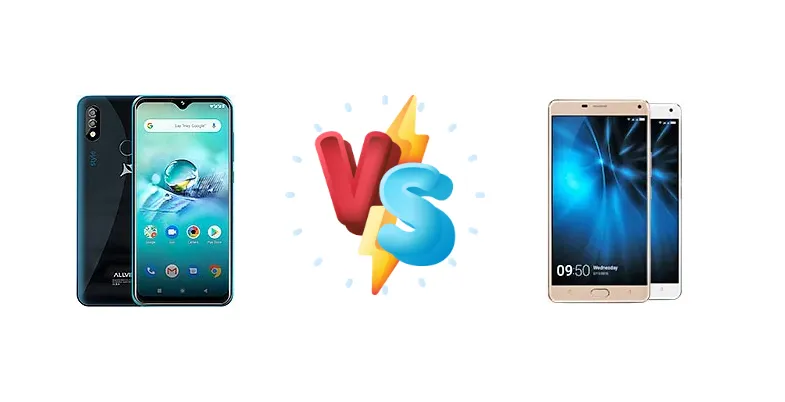
Allview targets the budget-conscious smartphone user, and the Soul X7 Style and P8 Energy Pro represent two distinct approaches within that segment. The X7 Style prioritizes processing power with a newer chipset, while the P8 Energy Pro seemingly focuses on maximizing battery life with an older, more efficient processor. This comparison dissects these choices to determine which device delivers the best overall experience.
🏆 Quick Verdict
For the average user prioritizing responsiveness and app performance, the Allview Soul X7 Style is the clear winner. Its Mediatek Helio P23 chipset offers a substantial performance advantage over the P8 Energy Pro’s MT6753, making it better suited for multitasking and modern applications. While the P8 Energy Pro may offer slightly better battery endurance, the performance trade-off is significant.
| Network |
|---|
| 2G bands | GSM 850 / 900 / 1800 / 1900 | GSM 850 / 900 / 1800 / 1900 - SIM 1 & SIM 2 |
| 3G bands | HSDPA 900 / 2100 | HSDPA 900 / 1900 / 2100 |
| 4G bands | 1, 3, 5, 7, 8, 20, 38, 40 | 1, 3, 7, 38, 39, 40 |
| Speed | HSPA, LTE | HSPA 21.1/5.76 Mbps, LTE Cat4 150/50 Mbps |
| Technology | GSM / HSPA / LTE | GSM / HSPA / LTE |
| Launch |
|---|
| Announced | 2020, May 26. Released 2020, May 26 | 2016, February. Released 2016, February |
| Status | Discontinued | Discontinued |
| Body |
|---|
| Dimensions | 157.6 x 75.2 x 8.3 mm (6.20 x 2.96 x 0.33 in) | 160.9 x 81.2 x 8.4 mm (6.33 x 3.20 x 0.33 in) |
| SIM | Nano-SIM + Nano-SIM | Dual SIM (Micro-SIM, dual stand-by) |
| Weight | 184.7 g (6.53 oz) | 209.8 g (7.37 oz) |
| Display |
|---|
| Protection | Corning Gorilla Glass | Corning Gorilla Glass 3 |
| Resolution | 720 x 1520 pixels, 19:9 ratio (~271 ppi density) | 1080 x 1920 pixels, 16:9 ratio (~367 ppi density) |
| Size | 6.21 inches, 96.3 cm2 (~81.2% screen-to-body ratio) | 6.0 inches, 99.2 cm2 (~76.0% screen-to-body ratio) |
| Type | IPS LCD | AMOLED |
| Platform |
|---|
| CPU | Octa-core (4x2.0 GHz Cortex-A53 & 4x1.5 GHz Cortex-A53) | Octa-core 1.3 GHz Cortex-A53 |
| Chipset | Mediatek MT6763 Helio P23 (16 nm) | Mediatek MT6753 (28 nm) |
| GPU | Mali-G71 MP2 | Mali-T720MP2 |
| OS | Android 9.0 (Pie) | Android 5.1 (Lollipop) |
| Memory |
|---|
| Card slot | microSDXC (uses shared SIM slot) | microSDXC |
| Internal | 64GB 4GB RAM | 64GB 3GB RAM |
| | eMMC 5.1 | - |
| Main Camera |
|---|
| Dual | 13 MP, f/2.2, AF
Auxiliary lens | - |
| Features | LED flash, HDR | LED flash, HDR, panorama |
| Single | 5 MP | 13 MP, f/2.0, AF |
| Video | 1080p@30fps | 1080p@30fps |
| Selfie camera |
|---|
| Single | 5 MP | 5 MP |
| Sound |
|---|
| 3.5mm jack | Yes | Yes |
| 35mm jack | Yes | Yes |
| Loudspeaker | Yes | Yes |
| Comms |
|---|
| Bluetooth | 4.0, A2DP | 4.0, A2DP, EDR |
| NFC | No | No |
| Positioning | GPS, GLONASS | GPS |
| Radio | FM radio | FM radio |
| USB | USB Type-C 2.0 | USB Type-C 3.0 |
| WLAN | Wi-Fi 802.11 b/g/n | Wi-Fi 802.11 b/g/n |
| Features |
|---|
| Sensors | Fingerprint (rear-mounted), accelerometer, proximity, compass | Fingerprint (front-mounted), accelerometer, proximity, compass |
| Battery |
|---|
| Music play | Up to 34 h | - |
| Stand-by | Up to 840 h (2G) / Up to 840 h (3G) | Up to 450 h |
| Talk time | Up to 12 h (2G) / Up to 4 h 30 min (3G) | Up to 22 h 30 min |
| Type | Li-Po 3400 mAh battery | Li-Po 5020 mAh, non-removable |
| Misc |
|---|
| Colors | Turcoise | Gold/Silver |
| Price | About 130 EUR | About 420 EUR |
| SAR EU | 0.87 W/kg (head) | 0.40 W/kg (head) |
| Tests |
|---|
| Audio quality |
Noise -88.3dB / Crosstalk -82.1dB | - |
| Camera |
Photo | - |
| Display |
Contrast ratio: 635:1 (nominal), 1.281 (sunlight) | - |
| Loudspeaker |
Voice 75dB / Noise 72dB / Ring 75dB
| - |
Allview Soul X7 Style
- Significantly faster processor for smoother performance
- More efficient 16nm chipset
- Potentially better outdoor visibility due to higher contrast ratio
- Likely shorter battery life compared to P8 Energy Pro
- Camera specifications are unknown
Allview P8 Energy Pro
- Potentially longer battery life due to more efficient chipset
- Lower price point (likely, given the older chipset)
- Suitable for basic smartphone tasks
- Significantly slower processor, impacting performance
- Older 28nm chipset
- Camera specifications are unknown
Display Comparison
The provided data only offers contrast ratios for the Soul X7 Style: 635:1 nominal and 1.281 in sunlight. This suggests a reasonably viewable display, particularly outdoors. The P8 Energy Pro’s display specifications are absent, making a direct comparison impossible. However, given the P8 Energy Pro’s focus on efficiency, it’s likely to utilize a lower-cost panel. The X7 Style’s higher sunlight contrast ratio indicates better visibility under direct sunlight, a crucial factor for outdoor use.
Camera Comparison
The context data only states 'Photo' for the Soul X7 Style’s camera, offering no specifics. The P8 Energy Pro’s camera is similarly undefined. Without sensor size, aperture, or image processing details, a meaningful comparison is impossible. It’s reasonable to assume both phones feature entry-level camera systems, likely prioritizing quantity of lenses over quality. Users shouldn’t expect flagship-level photography from either device.
Performance
The core difference lies in the chipsets. The Allview Soul X7 Style’s Mediatek MT6763 Helio P23 (16nm) features an octa-core CPU with a split configuration – 4x2.0 GHz Cortex-A53 and 4x1.5 GHz Cortex-A53. This contrasts sharply with the P8 Energy Pro’s MT6753 (28nm) with a uniform octa-core 1.3 GHz Cortex-A53 configuration. The 16nm process node of the Helio P23 is significantly more efficient than the 28nm node of the MT6753, but more importantly, the higher clock speeds and architectural improvements translate to a noticeable performance boost in the X7 Style. The P8 Energy Pro will likely struggle with demanding applications and multitasking.
Battery Life
Battery capacity data is missing for both devices. However, the MT6753 in the P8 Energy Pro, built on a 28nm process, is inherently more power-efficient than the MT6763 in the X7 Style. This suggests the P8 Energy Pro *could* offer longer battery life, even with a smaller battery capacity. However, the X7 Style’s more efficient usage of resources when idle, coupled with potential software optimizations, could mitigate this difference. Without concrete battery capacity and charging wattage figures, it’s difficult to definitively declare a winner.
Buying Guide
Buy the Allview Soul X7 Style if you need a phone capable of handling everyday tasks smoothly, enjoy occasional gaming, and value a more responsive user experience. Buy the Allview P8 Energy Pro if your primary concern is maximizing battery life above all else, and your usage consists mainly of basic communication and light web browsing. The P8 Energy Pro is best suited for users who prioritize longevity over speed.
Frequently Asked Questions
❓ Will the Allview Soul X7 Style struggle with demanding games like PUBG Mobile?
While the Helio P23 can handle some gaming, PUBG Mobile will likely require reduced graphics settings and may still experience occasional frame drops. The P8 Energy Pro’s MT6753 is even less capable, making it unsuitable for most modern games.
❓ Is the difference in chipset performance noticeable in everyday tasks like browsing and social media?
Yes, the difference is quite noticeable. The Helio P23 in the Soul X7 Style will result in faster app loading times, smoother scrolling, and a more responsive overall experience compared to the P8 Energy Pro’s MT6753. Multitasking will also be significantly improved.
❓ Given the lack of battery capacity information, how can I estimate real-world battery life for each phone?
Consider your usage patterns. If you primarily use your phone for calls, texts, and light browsing, the P8 Energy Pro might suffice. However, if you stream videos, play games, or frequently use data-intensive apps, the Soul X7 Style’s more efficient chipset usage will likely provide a comparable, if not better, experience despite potentially having a smaller battery.