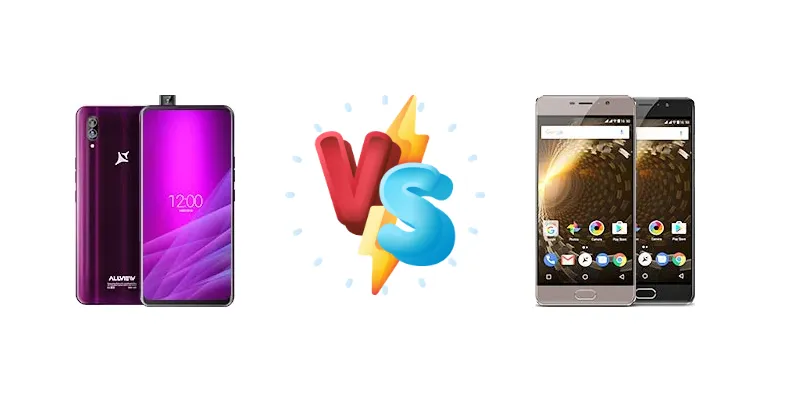
The Allview Soul X6 Xtreme and P9 Energy Lite represent different eras of Allview's smartphone strategy. The P9 Energy Lite (2017) prioritized battery life in a budget segment, while the X6 Xtreme, released later, aims for a more balanced experience with a significantly upgraded processor. This comparison will dissect the core differences to help you determine which device best suits your needs.
🏆 Quick Verdict
For the vast majority of users, the Allview Soul X6 Xtreme is the clear winner. Its Helio P70 chipset delivers a substantial performance boost over the P9 Energy Lite’s MT6753, making it far more capable for multitasking, gaming, and demanding applications. While the P9 Energy Lite may offer slightly longer battery life due to its older, less powerful processor, the X6 Xtreme’s 18W charging mitigates this difference.
| Network |
|---|
| 2G bands | GSM 850 / 900 / 1800 / 1900 | GSM 850 / 900 / 1800 / 1900 - SIM 1 & SIM 2 |
| 3G bands | HSDPA 900 / 2100 | HSDPA 900 / 2100 |
| 4G bands | 1, 3, 5, 7, 8, 20, 38 | 1, 3, 7, 20, 38 |
| Speed | HSPA 21.1/5.76 Mbps, LTE (2CA) Cat7 300/150 Mbps | HSPA 21.1/5.76 Mbps, LTE Cat4 150/50 Mbps |
| Technology | GSM / HSPA / LTE | GSM / HSPA / LTE |
| Launch |
|---|
| Announced | 2019, April. Released 2019, April | 2017, June. Released 2017, June |
| Status | Discontinued | Discontinued |
| Body |
|---|
| Dimensions | 157 x 74.3 x 8.9 mm (6.18 x 2.93 x 0.35 in) | 148.7 x 72.4 x 9.1 mm (5.85 x 2.85 x 0.36 in) |
| SIM | Nano-SIM + Nano-SIM | Nano-SIM + Micro-SIM |
| Weight | 176.6 g (6.24 oz) | 161 g (5.68 oz) |
| Display |
|---|
| Protection | Corning Gorilla Glass 5 | - |
| Resolution | 1080 x 2340 pixels, 19.5:9 ratio (~403 ppi density) | 720 x 1280 pixels, 16:9 ratio (~282 ppi density) |
| Size | 6.39 inches, 100.2 cm2 (~85.9% screen-to-body ratio) | 5.2 inches, 74.5 cm2 (~69.2% screen-to-body ratio) |
| Type | AMOLED | IPS LCD |
| Platform |
|---|
| CPU | Octa-core (4x2.1 GHz Cortex-A73 & 4x1.9 GHz Cortex-A53) | Octa-core 1.3 GHz Cortex-A53 |
| Chipset | Mediatek MT6771 Helio P70 (12 nm) | Mediatek MT6753 (28 nm) |
| GPU | Mali-G72 MP3 | Mali-T720 |
| OS | Android 9.0 (Pie) | Android 7.0 (Nougat) |
| Memory |
|---|
| Card slot | microSDXC (uses shared SIM slot) | microSDXC (uses shared SIM slot) |
| Internal | 64GB 4GB RAM | 32GB 3GB RAM |
| | eMMC 5.1 | - |
| Main Camera |
|---|
| Dual | 16 MP, f/1.8, PDAF
Auxiliary lens | - |
| Features | LED flash, HDR, panorama | LED flash, HDR, panorama |
| Single | - | 13 MP, AF |
| Video | 1080p@30fps | 1080p@30fps |
| Selfie camera |
|---|
| Single | Motorized pop-up 8 MP | 8 MP |
| Sound |
|---|
| 3.5mm jack | Yes | Yes |
| 35mm jack | Yes | Yes |
| Loudspeaker | Yes | Yes |
| Comms |
|---|
| Bluetooth | 4.2, A2DP, LE | 4.0, A2DP, EDR |
| NFC | No | No |
| Positioning | GPS, GLONASS | GPS |
| Radio | FM radio | FM radio |
| USB | USB Type-C 2.0 | microUSB 2.0 |
| WLAN | Wi-Fi 802.11 b/g/n/ac, Wi-Fi Direct | Wi-Fi 802.11 b/g/n |
| Features |
|---|
| Sensors | Fingerprint (under display, optical), accelerometer, gyro, proximity, compass | Fingerprint (front-mounted), accelerometer, proximity |
| Battery |
|---|
| Charging | 18W wired, 20% in 15 min
Wireless | - |
| Stand-by | - | Up to 286 h |
| Talk time | - | Up to 16 h |
| Type | Li-Po 3450 mAh, non-removable | Li-Po 4000 mAh, non-removable |
| Misc |
|---|
| Colors | Urban Violet | Black, Gold |
| Price | About 360 EUR | - |
| SAR EU | 0.97 W/kg (head) | 0.72 W/kg (head) |
Allview Soul X6 Xtreme
- Significantly faster processor (Helio P70)
- More efficient 12nm process
- Faster 18W charging
- Potentially better camera performance
- May have a shorter battery life than the P9 Lite (though mitigated by efficiency)
- Price is likely higher than the P9 Lite
Allview P9 Energy Lite (2017)
- Potentially longer battery life (depending on capacity)
- Lower price point
- Simpler user experience
- Functional for basic tasks
- Slow and outdated processor (MT6753)
- Inefficient 28nm process
- Slow charging speeds
- Poor performance with modern apps
Display Comparison
Unfortunately, display specifications are not provided for either device. However, given the P9 Energy Lite’s 2017 release, it likely features an IPS LCD panel with a 720p resolution. The X6 Xtreme, being a later model, *may* have a 1080p display, offering sharper visuals. The difference in processing power suggests the X6 Xtreme could support a higher refresh rate, though this is speculative. Bezels are likely larger on the P9 Energy Lite, reflecting design trends of its time.
Camera Comparison
Camera details are limited. It’s safe to assume both phones feature multiple rear cameras, but the quality will vary significantly. The X6 Xtreme, benefiting from its more powerful ISP (Image Signal Processor) within the Helio P70, will likely produce sharper, more detailed images with better dynamic range. The P9 Energy Lite’s camera will likely perform adequately in good lighting conditions but struggle in low light. Any 2MP macro or depth sensors on either device should be considered marketing features rather than significant improvements to image quality.
Performance
The core difference lies in the chipsets. The Allview Soul X6 Xtreme’s Mediatek Helio P70 (MT6771), built on a 12nm process, is a significant leap forward from the P9 Energy Lite’s Mediatek MT6753 (28nm). The P70’s octa-core CPU, featuring four Cortex-A73 cores clocked at 2.1 GHz and four Cortex-A53 cores at 1.9 GHz, provides substantially more processing power than the P9 Lite’s all-Cortex-A53 setup running at 1.3 GHz. The 12nm fabrication process also translates to improved power efficiency and reduced heat generation. This means the X6 Xtreme will handle multitasking, demanding apps, and even light gaming with far greater ease and responsiveness. The P9 Energy Lite will struggle with anything beyond basic tasks.
Battery Life
Battery capacity isn’t specified for either device. However, the P9 Energy Lite’s name suggests a focus on battery life. While it *may* have a larger battery, the X6 Xtreme’s more efficient 12nm Helio P70 chipset will likely offset any capacity difference. Furthermore, the X6 Xtreme’s 18W wired charging (capable of adding 20% charge in 15 minutes) is a significant advantage over the P9 Energy Lite, which likely supports slower charging speeds. This faster charging capability minimizes any potential battery life disadvantage.
Buying Guide
Buy the Allview Soul X6 Xtreme if you need a phone that can handle modern apps, occasional gaming, and faster overall performance. It’s ideal for users who want a responsive experience and aren’t willing to compromise on speed. Buy the Allview P9 Energy Lite (2017) if you prioritize absolute simplicity and are on an extremely tight budget, and your usage is limited to basic tasks like calls, texts, and light web browsing. It’s a functional device for those who need a reliable, no-frills phone.
Frequently Asked Questions
❓ Will the Allview Soul X6 Xtreme run demanding games like PUBG Mobile smoothly?
The Helio P70 in the X6 Xtreme is capable of running PUBG Mobile, but likely at medium settings to maintain a stable frame rate. The P9 Energy Lite’s MT6753 would struggle significantly, even at the lowest settings.
❓ Is the 18W charging on the X6 Xtreme a significant improvement over the P9 Energy Lite’s charging speed?
Yes, 18W charging is considerably faster than the charging speeds typically found on phones from 2017 like the P9 Energy Lite. The X6 Xtreme’s ability to gain 20% charge in 15 minutes will save you a substantial amount of time compared to the P9 Lite.
❓ Does the Allview Soul X6 Xtreme have enough RAM for multitasking?
While the RAM capacity isn't specified, the Helio P70 chipset is designed to work efficiently with a reasonable amount of RAM (likely 3GB or 4GB). This will provide a noticeably smoother multitasking experience compared to the P9 Energy Lite.