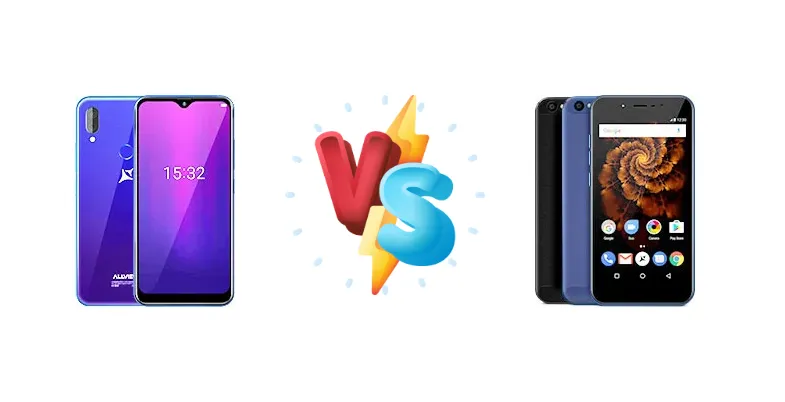
Allview targets the ultra-budget segment with the Soul X6 Mini and X4 Soul Mini S. While both aim to provide smartphone functionality at a low price, they differ significantly in their core processing power. This comparison dissects those differences, focusing on how the chipset impacts everyday use and long-term performance.
🏆 Quick Verdict
For most users, the Allview Soul X6 Mini is the superior choice. Its Mediatek Helio P22 chipset offers a substantial performance uplift over the X4 Soul Mini S’s MT6737, resulting in a smoother user experience and better app responsiveness. While both phones are entry-level, the X6 Mini provides a more future-proof platform.
| Network |
|---|
| 2G bands | GSM 850 / 900 / 1800 / 1900 | GSM 850 / 900 / 1800 / 1900 - SIM 1 & SIM 2 |
| 3G bands | HSDPA 900 / 2100 | HSDPA 900 / 2100 |
| 4G bands | 1, 3, 7, 8, 20, 38 | 1, 3, 7, 20, 38 |
| Speed | HSPA 42.2/11.5 Mbps, LTE Cat4 150/50 Mbps | HSPA 21.1/5.76 Mbps, LTE Cat4 150/50 Mbps |
| Technology | GSM / HSPA / LTE | GSM / HSPA / LTE |
| Launch |
|---|
| Announced | 2019, May. Released 2019, May | 2017, June. Released 2017, June |
| Status | Discontinued | Discontinued |
| Body |
|---|
| Dimensions | 158.3 x 76.4 x 8.3 mm (6.23 x 3.01 x 0.33 in) | 142 x 72 x 8.4 mm (5.59 x 2.83 x 0.33 in) |
| SIM | Nano-SIM + Nano-SIM | Nano-SIM + Nano-SIM |
| Weight | 175.7 g (6.21 oz) | 145 g (5.11 oz) |
| Display |
|---|
| Protection | - | Scratch-resistant glass |
| Resolution | 720 x 1520 pixels, 19:9 ratio (~271 ppi density) | 720 x 1280 pixels, 16:9 ratio (~294 ppi density) |
| Size | 6.2 inches, 95.9 cm2 (~79.3% screen-to-body ratio) | 5.0 inches, 68.9 cm2 (~67.4% screen-to-body ratio) |
| Type | IPS LCD | IPS LCD |
| Platform |
|---|
| CPU | Octa-core 2.0 GHz Cortex-A53 | Quad-core 1.25 GHz Cortex-A53 |
| Chipset | Mediatek MT6762 Helio P22 (12 nm) | Mediatek MT6737 (28 nm) |
| GPU | PowerVR GE8320 | Mali-T720MP2 |
| OS | Android 9.0 (Pie) | Android 7.0 (Nougat) |
| Memory |
|---|
| Card slot | microSDXC (dedicated slot) | microSDXC (uses shared SIM slot) |
| Internal | 16GB 2GB RAM | 16GB 1GB RAM |
| | eMMC 5.1 | eMMC 5.0 |
| Main Camera |
|---|
| Dual | 13 MP, AF
Auxiliary lens | - |
| Features | Dual-LED dual-tone flash, panorama, HDR | LED flash, HDR |
| Single | - | 8 MP, AF |
| Video | 1080p@30fps | 720p@30fps |
| Selfie camera |
|---|
| Single | 13 MP | 8 MP |
| Sound |
|---|
| 3.5mm jack | Yes | Yes |
| 35mm jack | Yes | Yes |
| Loudspeaker | Yes | Yes |
| Comms |
|---|
| Bluetooth | 4.1, A2DP, LE | 4.0, A2DP, EDR |
| NFC | No | No |
| Positioning | GPS, GLONASS | GPS |
| Radio | FM radio | FM radio |
| USB | microUSB 2.0 | microUSB 2.0 |
| WLAN | Wi-Fi 802.11 b/g/n | Wi-Fi 802.11 b/g/n |
| Features |
|---|
| Sensors | Fingerprint (rear-mounted), accelerometer, proximity | Fingerprint (rear-mounted), accelerometer, proximity |
| Battery |
|---|
| Charging | 10W wired | - |
| Stand-by | - | Up to 312 h (3G) |
| Talk time | - | Up to 15 h (3G) |
| Type | Li-Po 4000 mAh, non-removable | Li-Po 2500 mAh, non-removable |
| Misc |
|---|
| Colors | Indigo Blue | Black, Gold, Blue |
| Models | - | X4_Soul_Mini_S_TM |
| Price | - | About 150 EUR |
| SAR EU | 0.98 W/kg (head) | 1.48 W/kg (head) |
Allview Soul X6 Mini
- Significantly faster processor (Helio P22)
- More power-efficient chipset (12nm process)
- Better multitasking capabilities
- Potentially smoother user experience
- May be slightly more expensive
- Likely similar display quality to the X4 Soul Mini S
Allview X4 Soul Mini S
- Lower price point
- Sufficient for basic tasks (calls, texts)
- Potentially longer standby time (due to less usage)
- Simple and straightforward operation
- Slow processor (MT6737)
- Less power-efficient chipset (28nm process)
- Poor performance with multiple apps
- May struggle with modern applications
Display Comparison
Neither Allview provides detailed display specifications. However, given their market positioning, both likely utilize IPS LCD panels. The key difference lies in the processing power available to drive the display. The X6 Mini’s Helio P22 has a more capable GPU, potentially allowing for smoother animations and faster refresh rates, even if the panels themselves are similar. Bezels are likely substantial on both devices, reflecting their budget nature.
Camera Comparison
Without detailed camera specifications, a direct comparison is difficult. Both phones likely feature basic camera setups geared towards casual photography. The X6 Mini’s more powerful processor could offer slightly better image processing capabilities, potentially resulting in improved noise reduction and dynamic range. However, the quality will ultimately be limited by the sensor and lens quality, which are unknown. It's safe to assume neither phone will excel in low-light conditions.
Performance
The core differentiator is the chipset. The Allview Soul X6 Mini’s Mediatek MT6762 Helio P22, built on a 12nm process, features an octa-core CPU clocked at 2.0 GHz. This contrasts sharply with the X4 Soul Mini S’s Mediatek MT6737, a quad-core processor fabricated on a larger 28nm node and clocked at 1.25 GHz. The 12nm process of the P22 translates to improved power efficiency and reduced heat generation compared to the 28nm MT6737. This means the X6 Mini will likely exhibit less throttling under sustained load. The octa-core configuration also provides a significant advantage in multitasking and handling demanding applications.
Battery Life
Both devices feature 10W wired charging. While the battery capacities are not specified, the X6 Mini’s more efficient Helio P22 chipset will likely result in longer battery life despite potentially having a similar capacity to the X4 Soul Mini S. The 28nm MT6737 is known for its higher power consumption, meaning the X4 Soul Mini S will likely require more frequent charging. The 10W charging speed on both devices is relatively slow, so expect several hours to reach a full charge.
Buying Guide
Buy the Allview Soul X6 Mini if you prioritize a responsive user experience, plan to use multiple apps simultaneously, or anticipate needing a phone that will remain usable for longer. Buy the Allview X4 Soul Mini S if your needs are extremely basic – primarily calls, texts, and light web browsing – and you are on the tightest possible budget. The X4 Soul Mini S represents a minimal viable product, while the X6 Mini offers a more complete experience.
Frequently Asked Questions
❓ Will the Allview X4 Soul Mini S struggle with popular apps like WhatsApp or Facebook?
The MT6737 chipset in the X4 Soul Mini S is quite limited. While it can run these apps, you may experience noticeable lag, slow loading times, and occasional crashes, especially when multitasking. The X6 Mini’s Helio P22 will provide a much smoother experience with these applications.
❓ Is the difference in processor speed noticeable in everyday use?
Yes, the difference between the 2.0 GHz octa-core Helio P22 and the 1.25 GHz quad-core MT6737 is significant. The X6 Mini will feel much more responsive when opening apps, scrolling through web pages, and switching between tasks. The X4 Soul Mini S will feel sluggish in comparison.
❓ Does the Allview Soul X6 Mini support any form of fast charging?
Unfortunately, both the Allview Soul X6 Mini and the X4 Soul Mini S are limited to 10W wired charging. This is a relatively slow charging speed, so expect a full charge to take several hours.
❓ Which phone is better for playing mobile games?
The Allview Soul X6 Mini is the clear choice for gaming, albeit still limited. The Helio P22’s GPU is significantly more capable than the MT6737’s, allowing for playable frame rates in less demanding games. The X4 Soul Mini S will struggle with even basic mobile games.