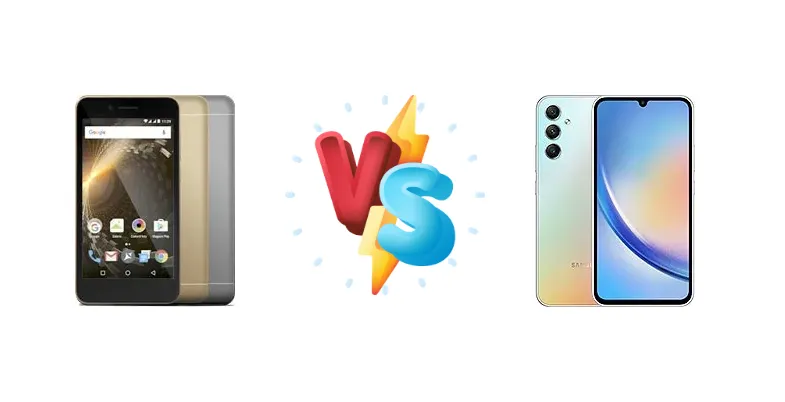
Looking for an affordable smartphone? The Allview P6 Energy Mini promises long battery life on a budget. But how does it stack up against a modern mid-ranger like the Samsung Galaxy A34? This comparison dives deep into specs, performance, and features to help you decide.
🏆 Quick Verdict
The Samsung Galaxy A34 is the clear winner, offering significantly better performance, a superior display, and a more advanced camera system. While the Allview P6 Energy Mini excels in battery life and affordability, the A34's overall package makes it the more compelling choice for most users.
| Network |
|---|
| 2G bands | GSM 850 / 900 / 1800 / 1900 - SIM 1 & SIM 2 | GSM 850 / 900 / 1800 / 1900 |
| 3G bands | HSDPA 900 / 2100 | HSDPA 850 / 900 / 1700(AWS) / 1900 / 2100 |
| 4G bands | 1, 3, 7, 20, 38 | 1, 2, 3, 4, 5, 7, 8, 12, 17, 20, 26, 28, 32, 38, 40, 41, 66 |
| 5G bands | - | 1, 3, 7, 8, 20, 28, 38, 40, 41, 77, 78 SA/NSA/Sub6 |
| Speed | HSPA 21.1/5.76 Mbps, LTE Cat4 150/50 Mbps | HSPA, LTE, 5G |
| Technology | GSM / HSPA / LTE | GSM / HSPA / LTE / 5G |
| Launch |
|---|
| Announced | 2017, March. Released 2017, March | 2023, March 14 |
| Status | Discontinued | Available. Released 2023, March 24 |
| Body |
|---|
| Build | - | Glass front (Gorilla Glass 5), plastic frame, plastic back |
| Dimensions | 143 x 72.4 x 10.3 mm (5.63 x 2.85 x 0.41 in) | 161.3 x 78.1 x 8.2 mm (6.35 x 3.07 x 0.32 in) |
| SIM | Dual SIM (Micro-SIM, dual stand-by) | · Nano-SIM· Nano-SIM + Nano-SIM |
| Weight | 175 g (6.17 oz) | 199 g (7.02 oz) |
| | - | IP67 dust/water resistant (up to 1m for 30 min) |
| Display |
|---|
| Protection | - | Corning Gorilla Glass 5 |
| Resolution | 480 x 854 pixels, 16:9 ratio (~196 ppi density) | 1080 x 2340 pixels, 19.5:9 ratio (~390 ppi density) |
| Size | 5.0 inches, 68.9 cm2 (~66.5% screen-to-body ratio) | 6.6 inches, 106.9 cm2 (~84.9% screen-to-body ratio) |
| Type | IPS LCD | Super AMOLED, 120Hz, 1000 nits (HBM) |
| Platform |
|---|
| CPU | Quad-core 1.1 GHz Cortex-A53 | Octa-core (2x2.6 GHz Cortex-A78 & 6x2.0 GHz Cortex-A55) |
| Chipset | Mediatek MT6737 (28 nm) | Mediatek Dimensity 1080 (6 nm) |
| GPU | Mali-T720 | Mali-G68 MC4 |
| OS | Android 6.0 (Marshmallow) | Android 13, up to 4 major Android upgrades, One UI 6.1 |
| Memory |
|---|
| Card slot | microSDXC | microSDXC (uses shared SIM slot) |
| Internal | 8GB 1GB RAM | 128GB 4GB RAM, 128GB 6GB RAM, 128GB 8GB RAM, 256GB 6GB RAM, 256GB 8GB RAM |
| | eMMC 5.0 | - |
| Main Camera |
|---|
| Features | LED flash, HDR | LED flash, panorama, HDR |
| Single | 5 MP | - |
| Triple | - | 48 MP, f/1.8, 26mm (wide), 1/2.0", 0.8µm, PDAF, OIS
8 MP, f/2.2, 123˚, (ultrawide), 1/4.0", 1.12µm
5 MP (macro) |
| Video | 720p@30fps | 4K@30fps, 1080p@30/60fps, 720p@480fps |
| Selfie camera |
|---|
| Single | 2 MP | 13 MP, f/2.2, 26mm (wide), 1/3.1", 1.12µm |
| Video | - | 4K@30fps, 1080p@30fps |
| Sound |
|---|
| 3.5mm jack | Yes | No |
| 35mm jack | Yes | No |
| Loudspeaker | Yes | Yes, with stereo speakers |
| Comms |
|---|
| Bluetooth | 4.0, A2DP, EDR | 5.3, A2DP, LE |
| NFC | No | Yes (market/region dependent) |
| Positioning | GPS | GPS, GLONASS, GALILEO, BDS |
| Radio | FM radio | No |
| USB | microUSB 2.0 | USB Type-C 2.0, OTG |
| WLAN | Wi-Fi 802.11 b/g/n | Wi-Fi 802.11 a/b/g/n/ac, dual-band, Wi-Fi Direct |
| Features |
|---|
| Sensors | Accelerometer, proximity | Fingerprint (under display, optical), accelerometer, gyro, compass |
| | - | Virtual proximity sensing |
| Battery |
|---|
| Charging | - | 25W wired |
| Type | Li-Ion 2950 mAh battery | Li-Ion 5000 mAh |
| Misc |
|---|
| Colors | Gray, Gold | Lime, Graphite, Violet, Silver |
| Models | - | SM-A346E, SM-A346B, SM-A346B/DS, SM-A346B/DSN, SM-A346E/DS, SM-A346E/DSN, SM-A346M, SM-A346M/N, SM-A346M/DSN, SM-A3460 |
| Price | - | € 169.99 / $ 175.00 / £ 164.99 / ₹ 23,999 |
| SAR EU | 1.18 W/kg (head) | 0.55 W/kg (head) 1.49 W/kg (body) |
| Tests |
|---|
| Battery life | - |
Endurance rating 133h
|
| Camera | - |
Photo / Video |
| Display | - |
Contrast ratio: Infinite (nominal) |
| Loudspeaker | - |
-26.1 LUFS (Good)
|
| Performance | - |
AnTuTu: 472126 (v9)
GeekBench: 2316 (v5.5), 2518 (v6)
GFXBench: 23fps (ES 3.1 onscreen) |
Allview P6 Energy Mini
- Extremely Affordable
- Long Battery Life
- Lightweight
- Outdated Chipset
- Low-Resolution Display
- Basic Camera
- Limited Storage
Samsung Galaxy A34
- Powerful Performance
- Excellent Display
- Versatile Camera
- Modern Design
- Fast Charging (25W)
- Higher Price
- Can be bulky
Display Comparison
The Samsung Galaxy A34 boasts a significantly brighter and higher-quality display with a contrast ratio approaching infinity. Its 1009 nits peak brightness ensures excellent visibility even in direct sunlight. The Allview P6 Energy Mini likely has a more basic LCD panel with lower resolution and brightness, resulting in a less immersive viewing experience.
Camera Comparison
Samsung's Galaxy A34 camera system is expected to be far superior, offering better image quality, more features, and improved video recording capabilities. The Allview P6 Energy Mini likely has a basic camera setup suitable for casual snapshots but lacking the advanced features and image processing of the A34.
Performance
The Galaxy A34's Mediatek Dimensity 1080 chipset and octa-core CPU provide a substantial performance advantage over the Allview P6 Energy Mini's older, less powerful Mediatek MT6737 and quad-core CPU. Expect smoother multitasking, faster app loading times, and better gaming performance on the A34.
Battery Life
While the Allview P6 Energy Mini is marketed for its 'Energy Mini' branding, the Samsung Galaxy A34's endurance rating of 133h is impressive and likely reflects optimized power management and a larger battery capacity. Both phones should offer all-day battery life, but the A34's efficiency is noteworthy.
Buying Guide
The Allview P6 Energy Mini is ideal for users on a very tight budget who prioritize battery life above all else. The Samsung Galaxy A34 is perfect for those seeking a well-rounded smartphone experience with a good camera, fast performance, and a vibrant display, even if it means spending a bit more.
Frequently Asked Questions
❓ Is the Allview P6 Energy Mini worth buying in 2024?
Only if you're on an extremely tight budget and prioritize battery life above all else. Otherwise, there are better options available for a slightly higher price.
❓ What is the biggest difference between these two phones?
The biggest difference is performance. The Samsung Galaxy A34 offers significantly faster processing power and a more modern chipset, resulting in a smoother and more responsive user experience.