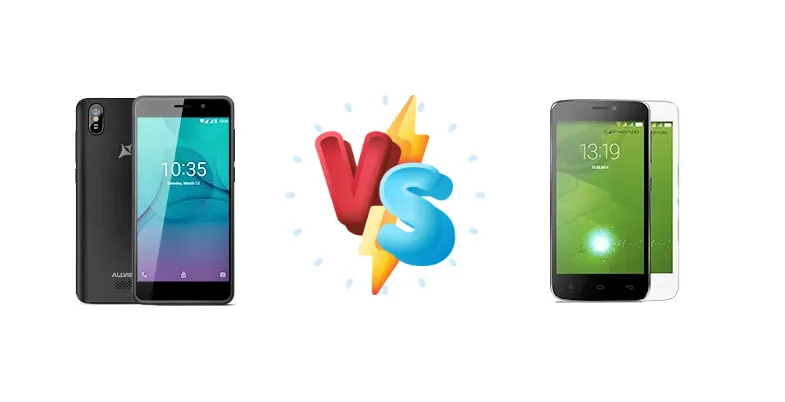
The Allview P10 Mini and V1 Viper i4G represent Allview’s entry into the highly competitive budget smartphone market. While both aim to deliver essential smartphone functionality at a low price point, they differ significantly in their underlying hardware. This comparison dissects those differences, focusing on how the processor choices impact real-world performance and user experience.
🏆 Quick Verdict
For the average user prioritizing responsiveness and a slightly more modern architecture, the Allview V1 Viper i4G is the better choice. Its Mediatek MT6582, featuring Cortex-A7 cores, offers a performance edge over the P10 Mini’s Cortex-A53, despite both being quad-core 1.3 GHz processors. However, the P10 Mini may appeal to those seeking the absolute lowest price.
| Network |
|---|
| 2G bands | GSM 850 / 900 / 1800 / 1900 | GSM 850 / 900 / 1800 / 1900 - SIM 1 & SIM 2 |
| 3G bands | HSDPA 900 / 2100 | HSDPA 900 / 2100 |
| 4G bands | 1, 3, 7, 20, 38 | 1, 3, 7, 20 |
| Speed | HSPA 21.1/5.76 Mbps, LTE Cat4 150/50 Mbps | HSPA 42.2/11.5 Mbps, LTE Cat4 150/50 Mbps |
| Technology | GSM / HSPA / LTE | GSM / HSPA / LTE |
| Launch |
|---|
| Announced | 2019, April. Released 2019, April | 2015. Released 2015 |
| Status | Discontinued | Discontinued |
| Body |
|---|
| Dimensions | 144.2 x 72 x 9.9 mm (5.68 x 2.83 x 0.39 in) | 137.3 x 68.3 x 9.6 mm (5.41 x 2.69 x 0.38 in) |
| SIM | Dual SIM (Micro-SIM, dual stand-by) | Dual SIM (Micro-SIM, dual stand-by) |
| Weight | 152.6 g (5.40 oz) | 149.9 g (5.29 oz) |
| Display |
|---|
| Protection | - | Asahi Dragontrail Glass |
| Resolution | 720 x 1280 pixels, 16:9 ratio (~294 ppi density) | 480 x 854 pixels, 16:9 ratio (~208 ppi density) |
| Size | 5.0 inches, 68.9 cm2 (~66.4% screen-to-body ratio) | 4.7 inches, 60.9 cm2 (~64.9% screen-to-body ratio) |
| Type | IPS LCD | TFT |
| Platform |
|---|
| CPU | Quad-core 1.3 GHz Cortex-A53 | Quad-core 1.3 GHz Cortex-A7 |
| Chipset | - | Mediatek MT6582 (28 nm) |
| GPU | - | Mali-400MP2 |
| OS | Android 8.1 Oreo (Go edition) | Android 4.4.2 (KitKat) |
| Memory |
|---|
| Card slot | microSDXC | microSDHC |
| Internal | 8GB 1GB RAM | 8GB 1GB RAM |
| Main Camera |
|---|
| Features | LED flash, HDR | LED flash, HDR |
| Single | 8 MP, AF | 5 MP, AF |
| Video | 1080p@30fps | 1080p@30fps |
| Selfie camera |
|---|
| Single | 2 MP | 2 MP |
| Sound |
|---|
| 3.5mm jack | Yes | Yes |
| 35mm jack | Yes | Yes |
| Loudspeaker | Yes | Yes |
| Comms |
|---|
| Bluetooth | 4.2, A2DP, LE | 4.0, A2DP, EDR |
| NFC | No | No |
| Positioning | GPS | GPS |
| Radio | FM radio | FM radio |
| USB | microUSB 2.0 | microUSB 2.0 |
| WLAN | Wi-Fi 802.11 b/g/n | Wi-Fi 802.11 b/g/n |
| Features |
|---|
| Sensors | Accelerometer | Accelerometer, proximity, compass |
| Battery |
|---|
| Stand-by | - | Up to 180 h |
| Talk time | - | Up to 8 h 20 min |
| Type | Li-Po 2400 mAh battery | Li-Po 1800 mAh, removable |
| Misc |
|---|
| Colors | Black | Black, White |
| SAR EU | 0.72 W/kg (head) | 0.44 W/kg (head) |
Allview P10 Mini
- Potentially lower price point
- May offer slightly better battery life due to less powerful processor
- Compact size (implied by 'Mini' designation)
- Less powerful Cortex-A53 processor
- Likely slower performance in all tasks
- Potentially lower quality display
Allview V1 Viper i4G
- More powerful Cortex-A7 processor
- Improved performance for multitasking and app usage
- More efficient 28nm process
- Potentially shorter battery life
- May be slightly more expensive
- Larger size (potentially)
Display Comparison
Unfortunately, display specifications are absent from the provided data. Given both phones target the budget segment, it’s reasonable to assume both utilize LCD panels with resolutions around 480x854. The P10 Mini’s ‘Mini’ designation suggests a smaller screen size, potentially offering higher pixel density. However, without knowing panel technology (IPS vs. TN) or brightness levels, a definitive comparison is impossible. Expect both displays to be adequate for basic viewing but lacking in vibrancy and viewing angles compared to higher-end devices.
Camera Comparison
Camera specifications are not provided for either device. Given their price point, it’s safe to assume both feature basic camera setups with low-resolution sensors. Image quality will likely be subpar, especially in low-light conditions. Without knowing sensor sizes, apertures, or the presence of features like autofocus, a meaningful comparison is impossible. Expect both cameras to be suitable for casual snapshots but not for serious photography.
Performance
The core difference lies in the processors. The Allview V1 Viper i4G utilizes the Mediatek MT6582, built on a 28nm process and featuring Cortex-A7 cores. The Allview P10 Mini employs a quad-core 1.3 GHz Cortex-A53 processor. While both are quad-core and clocked at the same speed, the Cortex-A7 architecture is significantly more efficient and offers approximately 20% higher performance per clock cycle than the Cortex-A53. This translates to snappier app launches, smoother scrolling, and better multitasking on the V1 Viper i4G. The 28nm process of the MT6582 also contributes to potentially better thermal management, reducing the likelihood of performance throttling under sustained load. The P10 Mini will be adequate for basic tasks, but will likely struggle with more demanding applications.
Battery Life
Battery capacity is not specified for either device. However, given the less powerful processor in the P10 Mini, it *may* achieve slightly better battery life under similar usage scenarios. The MT6582 in the V1 Viper i4G, while more performant, will consume more power. Without knowing battery sizes or charging wattage, it’s difficult to predict real-world battery performance. Expect both phones to require daily charging with moderate use.
Buying Guide
Buy the Allview P10 Mini if you need a basic smartphone for essential tasks like calls, texts, and light social media browsing, and your budget is extremely limited. Buy the Allview V1 Viper i4G if you prefer a slightly smoother experience for multitasking, web browsing, and running slightly more demanding apps, and are willing to spend a little more for the improved processor architecture.
Frequently Asked Questions
❓ Will the Allview V1 Viper i4G handle basic games like Candy Crush or Subway Surfers?
Yes, the Mediatek MT6582 with its Cortex-A7 cores should handle casual games like Candy Crush and Subway Surfers without significant issues. While it won’t be capable of running graphically demanding titles, it provides a smoother experience than the P10 Mini for these types of games.
❓ Is the difference in processor architecture (Cortex-A53 vs Cortex-A7) noticeable in everyday use?
Yes, the Cortex-A7 architecture in the V1 Viper i4G is approximately 20% more efficient than the Cortex-A53 in the P10 Mini. This translates to faster app loading times, smoother scrolling through web pages, and a more responsive overall user experience. While both phones can perform basic tasks, the V1 Viper i4G will feel noticeably snappier.
❓ Which phone is better for someone who primarily uses WhatsApp and Facebook?
The Allview V1 Viper i4G is the better choice for WhatsApp and Facebook. The more powerful processor will ensure these apps load quickly and run smoothly, even with multiple chats and media files. The P10 Mini will function, but may exhibit occasional lag or slowdowns.