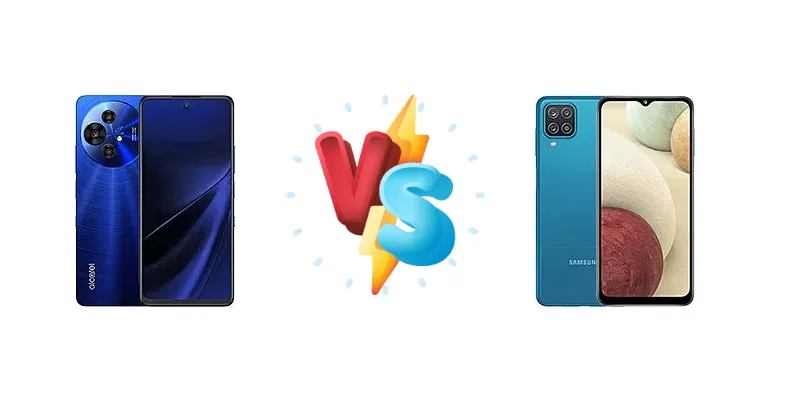
The Alcatel V3 Ultra and Samsung Galaxy A12 (India) represent distinct approaches to the budget smartphone market. The V3 Ultra aims for a performance edge with its newer chipset, while the A12 focuses on Samsung’s established brand recognition and software ecosystem. This comparison dissects their key differences to determine which device delivers the best value.
🏆 Quick Verdict
For users prioritizing performance and faster charging, the Alcatel V3 Ultra is the clear winner. Its Mediatek Dimensity 6300 chipset offers a substantial upgrade over the Samsung Galaxy A12’s Exynos 850, translating to smoother multitasking and gaming. While the A12 benefits from Samsung’s software, the V3 Ultra’s superior endurance and charging speed make it the better overall choice.
| Network |
|---|
| 2G bands | GSM 850 / 900 / 1800 / 1900 | GSM 850 / 900 / 1800 / 1900 |
| 3G bands | HSDPA 850 / 900 / 1700(AWS) / 1900 / 2100 | HSDPA 850 / 900 / 2100 |
| 4G bands | 1, 2, 3, 4, 5, 7, 8, 17, 20, 26, 28, 32, 38, 40, 41, 42 | 1, 3, 5, 7, 8, 20, 28, 38, 40, 41 |
| 5G bands | 1, 3, 5, 7, 8, 20, 26, 28, 38, 40, 41, 48, 77, 78 SA/NSA | - |
| Speed | HSPA, LTE, 5G | HSPA 42.2/5.76 Mbps, LTE Cat4 150/50 Mbps |
| Technology | GSM / HSPA / LTE / 5G | GSM / HSPA / LTE |
| Launch |
|---|
| Announced | 2025, May 27 | 2021, August 12 |
| Status | Available. Released 2025, June 02 | Available. Released 2021, August 12 |
| Body |
|---|
| Build | - | Glass front, plastic back, plastic frame |
| Dimensions | 167.6 x 75.5 x 8 mm (6.60 x 2.97 x 0.31 in) | 164 x 75.8 x 8.9 mm (6.46 x 2.98 x 0.35 in) |
| SIM | Nano-SIM + eSIM | · Nano-SIM· Nano-SIM + Nano-SIM |
| Weight | 196 g (6.91 oz) | 205 g (7.23 oz) |
| Display |
|---|
| Protection | Mohs level 7 | - |
| Resolution | 1080 x 2460 pixels (~395 ppi density) | 720 x 1600 pixels, 20:9 ratio (~270 ppi density) |
| Size | 6.8 inches, 109.8 cm2 (~86.8% screen-to-body ratio) | 6.5 inches, 102.0 cm2 (~82.1% screen-to-body ratio) |
| Type | IPS LCD, 120Hz, 650 nits | PLS LCD |
| Platform |
|---|
| CPU | Octa-core (2x2.4 GHz Cortex-A76 & 6x2.0 GHz Cortex-A55) | Octa-core (4x2.0 GHz Cortex-A55 & 4x2.0 GHz Cortex-A55) |
| Chipset | Mediatek Dimensity 6300 (6 nm) | Exynos 850 (8 nm) |
| GPU | Mali-G57 MC2 | Mali-G52 |
| OS | Android 14, up to 3 major Android upgrades | Android 11, upgradable to Android 13, One UI 5.1 |
| Memory |
|---|
| Card slot | microSDXC (dedicated slot) | microSDXC (dedicated slot) |
| Internal | 128GB 6GB RAM, 128GB 8GB RAM | 64GB 4GB RAM, 128GB 4GB RAM, 128GB 6GB RAM |
| | - | eMMC 5.1 |
| Main Camera |
|---|
| Features | LED flash, HDR | LED flash, panorama, HDR |
| Quad | - | 48 MP, f/2.0, 26mm (wide), AF
5 MP, f/2.2, 123˚ (ultrawide)
2 MP (macro)
Auxiliary lens |
| Triple | 108 MP, f/1.8, (wide), 1/1.67", 0.64µm, PDAF
8 MP, f/2.2, 120˚ (ultrawide), 1/4.0", 1.12µm
2 MP (macro) | - |
| Video | 1080p@30fps | 1080p@30fps |
| Selfie camera |
|---|
| Features | HDR | - |
| Single | 32 MP, f/2.0, (wide), 1/3.45", 0.64µm | 8 MP, f/2.2 |
| Video | 1080p@30fps | 1080p@30fps |
| Sound |
|---|
| 3.5mm jack | - | Yes |
| 35mm jack | Yes | Yes |
| Loudspeaker | Yes, with stereo speakers | Yes |
| Comms |
|---|
| Bluetooth | 5.3, A2DP, LE | 5.0, A2DP, LE |
| NFC | Yes | No |
| Positioning | GPS, GLONASS, BDS, GALILEO | GPS, GLONASS, GALILEO, BDS |
| Radio | FM radio | FM radio, RDS, recording |
| USB | USB Type-C 2.0 | USB Type-C 2.0 |
| WLAN | Wi-Fi 802.11 a/b/g/n/ac, dual-band, Wi-Fi Direct | Wi-Fi 802.11 b/g/n, Wi-Fi Direct |
| Features |
|---|
| Sensors | Fingerprint (side-mounted), accelerometer, gyro, proximity, compass, barometer | Fingerprint (side-mounted), accelerometer |
| | - | Virtual proximity sensing |
| Battery |
|---|
| Charging | 33W wired | 15W wired |
| Type | 5010 mAh | Li-Po 5000 mAh |
| Misc |
|---|
| Colors | Hyper Blue, Champagne Gold, Ocean Grey | Black, Blue, White |
| Models | T803D | SM-A127F, SM-A127F/DS |
| Price | About 210 EUR | About 160 EUR |
| SAR | - | 0.79 W/kg (head) |
| EU LABEL |
|---|
| Battery | 44:33h endurance, 1000 cycles | - |
| Energy | Class B | - |
| Free fall | Class B (180 falls) | - |
| Repairability | Class B | - |
alcatel V3 Ultra
- Significantly faster processor (Dimensity 6300)
- Faster 33W charging
- Excellent battery endurance (44:33h)
- Brand recognition is lower than Samsung
- Camera specifications unknown
Samsung Galaxy A12 (India)
- Established Samsung brand and software
- Potentially better color calibration (Samsung display)
- Wider availability of accessories
- Slower processor (Exynos 850)
- Slow 15W charging
- Lower performance for demanding tasks
Display Comparison
Display specifications are not provided, so a direct comparison is limited. However, given the price points, both devices likely utilize LCD panels. The A12, being a Samsung, may benefit from slightly better color calibration. The V3 Ultra’s value proposition hinges on internal performance, not display quality.
Camera Comparison
Camera details are absent, but we can infer that both phones feature entry-level camera systems. The absence of information suggests neither device will excel in photography. The A12 may benefit from Samsung’s image processing algorithms, but the V3 Ultra’s chipset could offer faster image processing speeds. Without sensor size or aperture data, a definitive comparison is impossible.
Performance
The core difference lies in the chipsets. The Alcatel V3 Ultra’s Mediatek Dimensity 6300 (6nm) is a significant leap ahead of the Samsung Galaxy A12’s Exynos 850 (8nm). The Dimensity 6300’s Cortex-A76 cores, clocked at 2.4 GHz, provide substantially more processing power than the A12’s all-Cortex-A55 configuration, maxing out at 2.0 GHz. This translates to faster app loading times, smoother multitasking, and a more responsive user experience. The 6nm process node further enhances efficiency, potentially leading to better thermal management. The A12’s Exynos 850 is adequate for basic tasks, but will struggle with more demanding applications.
Battery Life
The Alcatel V3 Ultra boasts a remarkable 44:33h endurance rating, suggesting excellent battery life. Coupled with its 33W wired charging, it offers a compelling combination of longevity and quick replenishment. The Samsung Galaxy A12’s 15W charging is significantly slower, meaning longer downtime between charges. While the A12’s battery capacity isn’t specified, the V3 Ultra’s endurance rating indicates a more efficient power management system, even if the capacities were similar.
Buying Guide
Buy the Alcatel V3 Ultra if you need a phone capable of handling demanding apps and games without significant slowdown, and if fast charging is a priority. You’ll benefit from the more modern chipset and longer battery life. Buy the Samsung Galaxy A12 (India) if you prefer a familiar Samsung user experience, prioritize brand trust, and are willing to compromise on raw processing power and charging speed for a potentially more refined software experience.
Frequently Asked Questions
❓ Does the Exynos 850 in the Galaxy A12 struggle with graphically intensive games like PUBG?
Yes, the Exynos 850 is a relatively low-powered chipset. While it can run PUBG, you’ll likely need to lower graphics settings to achieve a playable frame rate. The Alcatel V3 Ultra’s Dimensity 6300 offers a much smoother gaming experience, even at higher settings.
❓ How long does it take to fully charge the Alcatel V3 Ultra with the 33W charger?
While a precise 0-100% time isn't provided, 33W charging is significantly faster than the A12’s 15W. Expect a full charge in approximately 60-90 minutes, a substantial improvement over the A12’s likely 2+ hour charge time.
❓ Is the Mediatek Dimensity 6300 prone to overheating during prolonged use?
The Dimensity 6300’s 6nm process node is designed for efficiency, which helps mitigate heat generation. While any chipset can warm up under heavy load, the 6nm process and the V3 Ultra’s likely thermal design should prevent significant throttling during extended gaming or video recording sessions.