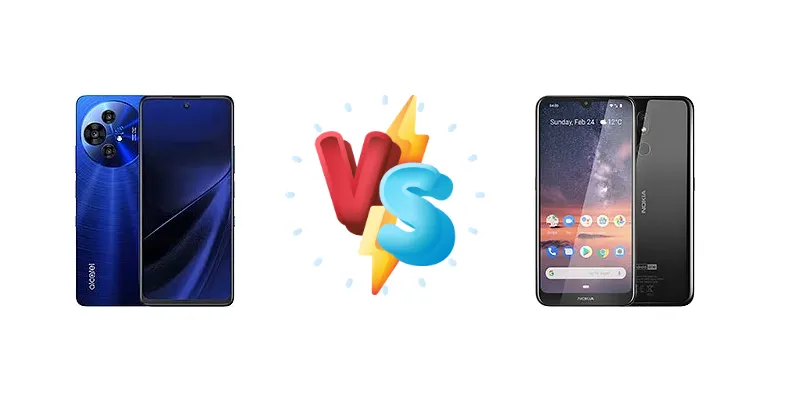
The Alcatel V3 Ultra and Nokia 3.2 represent distinct approaches to the budget smartphone market. The V3 Ultra aims for performance with a modern chipset and fast charging, while the Nokia 3.2 focuses on a more conservative, efficiency-driven design. This comparison dissects their key differences to help you determine which device best suits your needs.
🏆 Quick Verdict
For users prioritizing speed and convenience, the Alcatel V3 Ultra is the clear winner. Its Dimensity 6300 chipset and 33W charging offer a significantly smoother experience and faster top-ups. However, the Nokia 3.2 remains a viable option for those seeking a basic, reliable device with a focus on battery longevity.
| Network |
|---|
| 2G bands | GSM 850 / 900 / 1800 / 1900 | GSM 850 / 900 / 1800 / 1900 |
| 3G bands | HSDPA 850 / 900 / 1700(AWS) / 1900 / 2100 | HSDPA 850 / 900 / 2100 |
| 4G bands | 1, 2, 3, 4, 5, 7, 8, 17, 20, 26, 28, 32, 38, 40, 41, 42 | 1, 3, 5, 7, 8, 20, 28, 38, 40 - EMEA, APAC, MENA |
| 5G bands | 1, 3, 5, 7, 8, 20, 26, 28, 38, 40, 41, 48, 77, 78 SA/NSA | - |
| Speed | HSPA, LTE, 5G | HSPA 42.2/5.76 Mbps, LTE Cat4 150/50 Mbps |
| Technology | GSM / HSPA / LTE / 5G | GSM / HSPA / LTE |
| | - | 1, 3, 5, 8, 40, 41 - India |
| Launch |
|---|
| Announced | 2025, May 27 | 2019, February 24. Released 2019, May 22 |
| Status | Available. Released 2025, June 02 | Discontinued |
| Body |
|---|
| Build | - | Glass front, plastic back, plastic frame |
| Dimensions | 167.6 x 75.5 x 8 mm (6.60 x 2.97 x 0.31 in) | 159.4 x 76.2 x 8.6 mm (6.28 x 3.00 x 0.34 in) |
| SIM | Nano-SIM + eSIM | Nano-SIM + Nano-SIM |
| Weight | 196 g (6.91 oz) | 181 g (6.38 oz) |
| Display |
|---|
| Protection | Mohs level 7 | - |
| Resolution | 1080 x 2460 pixels (~395 ppi density) | 720 x 1520 pixels, 19:9 ratio (~269 ppi density) |
| Size | 6.8 inches, 109.8 cm2 (~86.8% screen-to-body ratio) | 6.26 inches, 97.8 cm2 (~80.5% screen-to-body ratio) |
| Type | IPS LCD, 120Hz, 650 nits | IPS LCD |
| Platform |
|---|
| CPU | Octa-core (2x2.4 GHz Cortex-A76 & 6x2.0 GHz Cortex-A55) | Quad-core 1.8 GHz Cortex-A53 |
| Chipset | Mediatek Dimensity 6300 (6 nm) | Qualcomm SDM429 Snapdragon 429 (12 nm) |
| GPU | Mali-G57 MC2 | Adreno 504 |
| OS | Android 14, up to 3 major Android upgrades | Android 9.0 (Pie), upgradable to Android 11, Android One |
| Memory |
|---|
| Card slot | microSDXC (dedicated slot) | microSDXC (dedicated slot) |
| Internal | 128GB 6GB RAM, 128GB 8GB RAM | 16GB 2GB RAM, 32GB 3GB RAM, 64GB 3GB RAM |
| | - | eMMC 5.1 |
| Main Camera |
|---|
| Features | LED flash, HDR | LED flash |
| Single | - | 13 MP, f/2.2, 1/3.1", 1.12µm, AF |
| Triple | 108 MP, f/1.8, (wide), 1/1.67", 0.64µm, PDAF
8 MP, f/2.2, 120˚ (ultrawide), 1/4.0", 1.12µm
2 MP (macro) | - |
| Video | 1080p@30fps | 1080p@30fps |
| Selfie camera |
|---|
| Features | HDR | - |
| Single | 32 MP, f/2.0, (wide), 1/3.45", 0.64µm | 5 MP, f/2.2, 27mm (wide), 1/5.0", 1.12µm |
| Video | 1080p@30fps | - |
| Sound |
|---|
| 3.5mm jack | - | Yes |
| 35mm jack | Yes | Yes |
| Loudspeaker | Yes, with stereo speakers | Yes |
| Comms |
|---|
| Bluetooth | 5.3, A2DP, LE | 4.2, A2DP, LE, aptX |
| NFC | Yes | No |
| Positioning | GPS, GLONASS, BDS, GALILEO | GPS, GLONASS, BDS |
| Radio | FM radio | FM radio |
| USB | USB Type-C 2.0 | microUSB 2.0, OTG |
| WLAN | Wi-Fi 802.11 a/b/g/n/ac, dual-band, Wi-Fi Direct | Wi-Fi 802.11 b/g/n |
| Features |
|---|
| Sensors | Fingerprint (side-mounted), accelerometer, gyro, proximity, compass, barometer | Fingerprint (rear-mounted, 32/3GB only), accelerometer, proximity |
| Battery |
|---|
| Charging | 33W wired | 10W wired |
| Type | 5010 mAh | Li-Ion 4000 mAh, non-removable |
| Misc |
|---|
| Colors | Hyper Blue, Champagne Gold, Ocean Grey | Black, Steel |
| Models | T803D | TA-1156, TA-1159, TA-1164 |
| Price | About 210 EUR | About 140 EUR |
| SAR EU | - | 0.24 W/kg (head) 1.63 W/kg (body) |
| EU LABEL |
|---|
| Battery | 44:33h endurance, 1000 cycles | - |
| Energy | Class B | - |
| Free fall | Class B (180 falls) | - |
| Repairability | Class B | - |
alcatel V3 Ultra
- Significantly faster processor for smoother performance
- 33W fast charging for quick top-ups
- Potentially better camera performance due to advanced ISP
- Likely higher price point
- Potentially shorter battery lifespan due to faster charging (though 1000 cycles mitigate this)
Nokia 3.2
- Lower price point
- Potentially longer battery life for basic usage
- Reliable and simple user experience
- Slow processor struggles with demanding tasks
- 10W charging is significantly slower
- Inferior camera performance
Display Comparison
Display specifications are absent from the provided data, but considering the market positioning, we can infer differences. The Alcatel V3 Ultra, likely targeting a slightly higher tier, may feature a higher resolution panel and potentially a faster refresh rate. The Nokia 3.2, given its Snapdragon 429, likely utilizes a standard 720p display. The V3 Ultra’s more powerful chipset could also drive a brighter display, improving outdoor visibility. Bezels are also likely to be slimmer on the V3 Ultra, contributing to a more modern aesthetic.
Camera Comparison
Camera details are limited, but the chipset difference suggests a significant advantage for the Alcatel V3 Ultra. The Dimensity 6300 includes a more capable image signal processor (ISP) enabling better image processing and potentially supporting higher resolution sensors. While both phones likely feature a primary camera, the V3 Ultra’s ISP will likely deliver superior dynamic range, noise reduction, and overall image quality. The Nokia 3.2’s Snapdragon 429 is likely paired with a simpler camera system, focusing on basic photography. The presence of a 2MP macro camera on either device is unlikely to significantly impact image quality.
Performance
The performance gap between these two devices is substantial. The Alcatel V3 Ultra’s Mediatek Dimensity 6300 (6nm) is a modern octa-core processor featuring a combination of Cortex-A76 and A55 cores clocked at 2.4GHz and 2.0GHz respectively. This architecture provides a significant leap in CPU and GPU performance compared to the Nokia 3.2’s Qualcomm Snapdragon 429 (12nm) quad-core Cortex-A53 processor running at 1.8GHz. The 6nm fabrication process of the Dimensity 6300 also translates to improved power efficiency and reduced thermal throttling. Users will experience noticeably faster app loading times, smoother multitasking, and a more responsive user interface on the V3 Ultra. The Nokia 3.2 will be adequate for basic tasks, but will struggle with demanding applications.
Battery Life
The Alcatel V3 Ultra boasts a 44:33h endurance rating, indicating a substantial battery life advantage. While the actual mAh capacity is unknown, the combination of the more efficient 6nm Dimensity 6300 chipset and the 33W wired charging capability provides a compelling combination. The Nokia 3.2, lacking fast charging, will take considerably longer to fully recharge. The V3 Ultra’s 33W charging allows for a significant top-up in a short amount of time, while the Nokia 3.2’s 10W charging will require several hours for a full charge. The V3 Ultra also claims 1000 charge cycles, suggesting a longer lifespan for the battery.
Buying Guide
Buy the Alcatel V3 Ultra if you need a phone capable of handling multitasking, streaming, and light gaming without significant lag, and if you value the convenience of rapid charging. Buy the Nokia 3.2 if you prioritize simplicity, extended battery life for basic tasks like calls and messaging, and a lower initial cost, accepting a slower overall performance.
Frequently Asked Questions
❓ Will the Alcatel V3 Ultra’s Dimensity 6300 handle popular games like PUBG Mobile or Call of Duty Mobile?
The Dimensity 6300 is a capable chipset that should allow for playable frame rates in PUBG Mobile and Call of Duty Mobile, likely at medium settings. However, sustained performance may be limited by thermal throttling, so extended gaming sessions might require adjusting graphics settings.
❓ How long will it take to fully charge the Alcatel V3 Ultra with the 33W charger?
While a precise time isn't available, 33W charging typically takes around 60-90 minutes for a full charge, starting from 0%. This is a significant improvement over the Nokia 3.2’s 10W charging, which could take 3-4 hours.
❓ Is the Nokia 3.2 a good choice for elderly users who primarily use their phone for calls and texts?
Yes, the Nokia 3.2 is well-suited for basic usage. Its simple interface and long battery life make it a reliable option for users who primarily need a phone for communication. The slower processor won't be a hindrance for these core functions.
❓ Does the Alcatel V3 Ultra support 5G connectivity?
The Mediatek Dimensity 6300 chipset *can* support 5G, but it depends on the specific configuration of the Alcatel V3 Ultra. It's crucial to check the phone's specifications to confirm 5G compatibility before purchasing.