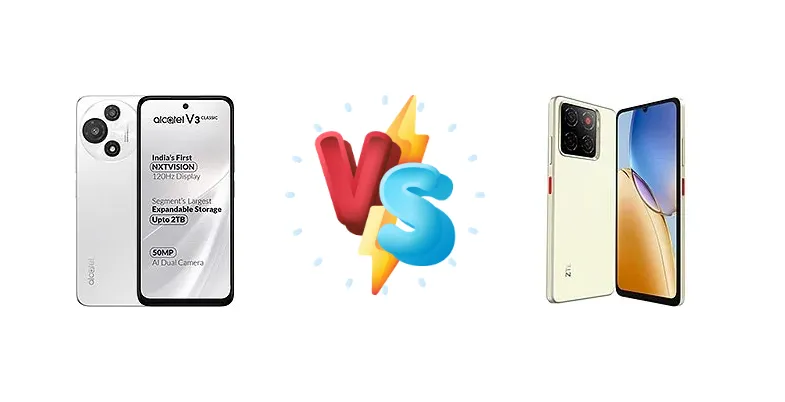
The Alcatel V3 Classic and ZTE Blade A56 represent the increasingly competitive sub-$200 smartphone market. Both aim to deliver essential functionality at an accessible price, but they take different approaches to achieving this. The V3 Classic prioritizes processing efficiency with a newer chipset, while the Blade A56 focuses on maximizing battery endurance through a larger capacity, despite a less refined manufacturing process.
🏆 Quick Verdict
For the average user prioritizing responsiveness and future-proofing, the Alcatel V3 Classic is the better choice. Its Mediatek Dimensity 6300, built on a 6nm process, offers a significant performance advantage and better thermal management compared to the ZTE Blade A56’s Unisoc T7200. While the Blade A56 boasts slightly longer battery endurance, the V3 Classic’s faster charging and more capable processor make it the overall winner.
| Network |
|---|
| 2G bands | GSM 850 / 900 / 1800 / 1900 | GSM 850 / 900 / 1800 / 1900 |
| 3G bands | HSDPA 850 / 900 / 1700(AWS) / 1900 / 2100 | HSDPA 850 / 900 / 1900 / 2100 |
| 4G bands | 1, 2, 3, 4, 5, 7, 8, 12, 13, 17, 20, 26, 28, 32, 38, 40, 41, 42, 66 | 1, 3, 5, 7, 8, 20, 28, 38, 40, 41 |
| 5G bands | 1, 3, 5, 7, 8, 20, 26, 28, 38, 40, 41, 66, 77, 78 SA/NSA | - |
| Speed | HSPA, LTE, 5G | HSPA, LTE |
| Technology | GSM / HSPA / LTE / 5G | GSM / HSPA / LTE |
| Launch |
|---|
| Announced | 2025, May 27 | 2025, June 11 |
| Status | Available. Released 2025, June 02 | Available. Released 2025, July |
| Body |
|---|
| Dimensions | 165.6 x 76.2 x 8.2 mm (6.52 x 3.00 x 0.32 in) | 167.6 x 77.4 x 8.3 mm (6.60 x 3.05 x 0.33 in) |
| SIM | Nano-SIM + Nano-SIM | Nano-SIM + Nano-SIM |
| Weight | 187 g (6.60 oz) | 193 g (6.81 oz) |
| Display |
|---|
| Protection | Mohs level 5 | Mohs level 4 |
| Resolution | 720 x 1600 pixels, 20:9 ratio (~262 ppi density) | 720 x 1600 pixels, 20:9 ratio (~260 ppi density) |
| Size | 6.67 inches, 108.2 cm2 (~85.8% screen-to-body ratio) | 6.75 inches, 110.0 cm2 (~84.8% screen-to-body ratio) |
| Type | IPS LCD, 120Hz, 570 nits | IPS LCD, 90Hz |
| Platform |
|---|
| CPU | Octa-core (2x2.4 GHz Cortex-A76 & 6x2.0 GHz Cortex-A55) | Octa-core (2x1.6 GHz Cortex-A75 & 6x1.6 GHz Cortex-A55) |
| Chipset | Mediatek Dimensity 6300 (6 nm) | Unisoc T7200 (12 nm) |
| GPU | Mali-G57 MC2 | Mali-G57 MP1 |
| OS | Android 15, up to 3 major Android upgrades | Android 15 |
| Memory |
|---|
| Card slot | microSDXC (uses shared SIM slot) | microSDXC (dedicated slot) |
| Internal | 128GB 4GB RAM, 128GB 6GB RAM | 64GB 4GB RAM, 128GB 4GB RAM |
| Main Camera |
|---|
| Features | LED flash, HDR, panorama | LED flash |
| Single | 50 MP, f/1.8, 26mm (wide), 1/2.5", 0.7µm, PDAF
Auxiliary lens | 13 MP, AF
Auxiliary lenses |
| Video | 1080p@30fps | 1080p@30fps |
| Selfie camera |
|---|
| Features | HDR | - |
| Single | 8 MP, f/2.0, (wide), 1/4.0", 1.12µm | 8 MP |
| Video | 1080p@30fps | Yes |
| Sound |
|---|
| 35mm jack | Yes | Yes |
| Loudspeaker | Yes, with stereo speakers | Yes |
| Comms |
|---|
| Bluetooth | 5.4, A2DP, LE | 5.2, A2DP, LE |
| NFC | Yes | No |
| Positioning | GPS, GLONASS, BDS, GALILEO | GPS, GALILEO, GLONASS |
| Radio | FM radio | FM radio |
| USB | USB Type-C 2.0 | USB Type-C 2.0, OTG |
| WLAN | Wi-Fi 802.11 a/b/g/n/ac, dual-band, Wi-Fi Direct | Wi-Fi 802.11 b/g/n |
| Features |
|---|
| Sensors | Accelerometer, proximity, compass | Fingerprint (side-mounted), accelerometer |
| Battery |
|---|
| Charging | 18W wired | 10W wired |
| Type | 5200 mAh | Li-Po 5000 mAh |
| Misc |
|---|
| Colors | Halo White, Cosmic Grey | Black, Yellow |
| Models | T519H | Z2473 |
| Price | About 130 EUR | € 69.00 / $ 87.12 / £ 66.75 |
| EU LABEL |
|---|
| Battery | 52:48h endurance, 1000 cycles | 56:03h endurance, 800 cycles |
| Energy | Class B | Class A |
| Free fall | Class B (180 falls) | Class D (80 falls) |
| Repairability | Class B | Class B |
alcatel V3 Classic
- More powerful and efficient processor (Dimensity 6300)
- Faster 18W charging
- Longer battery cycle life (1000 cycles)
- Slightly shorter battery endurance rating
- Potentially higher price point
ZTE Blade A56
- Longer battery endurance rating (56:03h)
- Potentially lower price point
- Simpler, potentially more reliable chipset
- Less powerful processor (Unisoc T7200)
- Slower 10W charging
- Fewer battery cycles (800 cycles)
Display Comparison
Neither device boasts a standout display. Given the price point, details like panel type and resolution are not provided. However, the focus here is on internal components. The absence of information suggests both likely utilize standard LCD panels, prioritizing cost savings over visual fidelity. Bezels are likely comparable, and color accuracy is unlikely to be a key differentiator.
Camera Comparison
Without detailed camera specifications, a direct comparison is difficult. However, given the market segment, it’s safe to assume both phones feature basic camera setups. The absence of information regarding sensor size or optical image stabilization suggests neither device will excel in low-light photography. Image processing will likely be the key differentiator, and Mediatek’s image signal processor (ISP) within the Dimensity 6300 likely offers more advanced features and better image quality than the Unisoc equivalent. Any 2MP macro or depth sensors on either device should be considered marketing filler.
Performance
The core difference lies in the chipsets. The Alcatel V3 Classic’s Mediatek Dimensity 6300 (6nm) is a clear upgrade over the ZTE Blade A56’s Unisoc T7200 (12nm). The 6nm process node allows for greater transistor density and improved power efficiency, translating to better performance and less heat generation. While both CPUs feature an octa-core configuration with 2x high-performance cores, the Cortex-A76 in the Dimensity 6300 is architecturally superior to the Cortex-A75 in the Unisoc T7200, offering a noticeable boost in single-core and multi-core performance. This benefits app launch times, smoother scrolling, and overall system responsiveness. The V3 Classic will handle demanding apps and light gaming more effectively.
Battery Life
The ZTE Blade A56 claims a 56:03h endurance rating, slightly exceeding the Alcatel V3 Classic’s 52:48h. This difference is likely attributable to the less power-hungry Unisoc T7200. However, the V3 Classic compensates with 18W wired charging, significantly faster than the Blade A56’s 10W charging. This means the V3 Classic can replenish its battery much quicker, minimizing downtime. The V3 Classic also boasts 1000 battery cycles compared to the Blade A56’s 800, suggesting a longer lifespan before significant degradation.
Buying Guide
Buy the Alcatel V3 Classic if you need a phone that feels responsive for everyday tasks, handles multitasking smoothly, and offers a more modern chipset for potential software updates. Buy the ZTE Blade A56 if you absolutely prioritize maximizing battery life above all else, and are willing to trade off processing power and charging speed for an extra few hours of use. This phone is ideal for users who primarily make calls, send texts, and occasionally browse social media.
Frequently Asked Questions
❓ Will the Unisoc T7200 in the ZTE Blade A56 struggle with modern mobile games?
Yes, the Unisoc T7200 is a budget-focused chipset. While it can handle basic games, demanding titles like PUBG or Genshin Impact will likely require significant graphics settings reductions and may still experience noticeable lag. The Alcatel V3 Classic’s Dimensity 6300 offers a much smoother gaming experience.
❓ How much faster is the 18W charging on the Alcatel V3 Classic compared to the 10W charging on the ZTE Blade A56?
The 18W charging on the V3 Classic will significantly reduce charging times. While exact 0-100% times aren't provided, expect the V3 Classic to charge roughly 60-80% faster than the Blade A56. This is a substantial difference for users who need to quickly top up their battery.
❓ What does the difference in battery cycle counts (1000 vs 800) mean for the long-term health of the battery?
Battery cycles represent a full charge and discharge. The Alcatel V3 Classic’s 1000 cycle rating suggests the battery will retain a higher percentage of its original capacity after a similar number of charge cycles compared to the ZTE Blade A56’s 800 cycle rating. This translates to a longer usable lifespan for the battery.