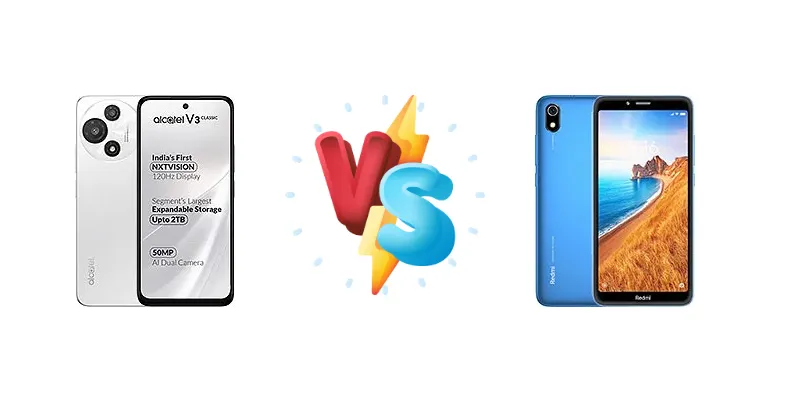
The Alcatel V3 Classic and Xiaomi Redmi 7A represent two approaches to the ultra-budget smartphone market. The Redmi 7A, a veteran of the segment, relies on Qualcomm’s tried-and-true Snapdragon 439. The V3 Classic, however, arrives with a significantly newer Mediatek Dimensity 6300 chipset, promising a leap in performance and efficiency. This comparison dissects these differences to determine which phone delivers the best value.
🏆 Quick Verdict
For the average user prioritizing performance and longevity, the Alcatel V3 Classic is the clear winner. Its Mediatek Dimensity 6300 chipset offers a substantial performance advantage over the Redmi 7A’s Snapdragon 439, coupled with faster 18W charging and a projected 1000-cycle battery lifespan. While the Redmi 7A remains a viable option, the V3 Classic represents a significant upgrade in core capabilities.
| Network |
|---|
| 2G bands | GSM 850 / 900 / 1800 / 1900 | GSM 850 / 900 / 1800 / 1900 |
| 3G bands | HSDPA 850 / 900 / 1700(AWS) / 1900 / 2100 | HSDPA 850 / 900 / 1900 / 2100 |
| 4G bands | 1, 2, 3, 4, 5, 7, 8, 12, 13, 17, 20, 26, 28, 32, 38, 40, 41, 42, 66 | 1, 2, 3, 4, 5, 7, 8, 20, 38, 40 - Global |
| 5G bands | 1, 3, 5, 7, 8, 20, 26, 28, 38, 40, 41, 66, 77, 78 SA/NSA | - |
| Speed | HSPA, LTE, 5G | HSPA, LTE |
| Technology | GSM / HSPA / LTE / 5G | GSM / HSPA / LTE |
| | - | 1, 3, 5, 8, 34, 38, 39, 40, 41 - China |
| Launch |
|---|
| Announced | 2025, May 27 | 2019, May 24. Released 2019, July 04 |
| Status | Available. Released 2025, June 02 | Discontinued |
| Body |
|---|
| Build | - | Glass front, plastic back, plastic frame |
| Dimensions | 165.6 x 76.2 x 8.2 mm (6.52 x 3.00 x 0.32 in) | 146.3 x 70.4 x 9.6 mm (5.76 x 2.77 x 0.38 in) |
| SIM | Nano-SIM + Nano-SIM | Nano-SIM + Nano-SIM |
| Weight | 187 g (6.60 oz) | 165 g (5.82 oz) |
| | - | Splash resistant |
| Display |
|---|
| Protection | Mohs level 5 | - |
| Resolution | 720 x 1600 pixels, 20:9 ratio (~262 ppi density) | 720 x 1440 pixels, 18:9 ratio (~295 ppi density) |
| Size | 6.67 inches, 108.2 cm2 (~85.8% screen-to-body ratio) | 5.45 inches, 76.7 cm2 (~74.4% screen-to-body ratio) |
| Type | IPS LCD, 120Hz, 570 nits | IPS LCD |
| Platform |
|---|
| CPU | Octa-core (2x2.4 GHz Cortex-A76 & 6x2.0 GHz Cortex-A55) | Octa-core (4x1.95 GHz Cortex-A53 & 4x1.45 GHz Cortex A53) |
| Chipset | Mediatek Dimensity 6300 (6 nm) | Qualcomm SDM439 Snapdragon 439 (12 nm) |
| GPU | Mali-G57 MC2 | Adreno 505 |
| OS | Android 15, up to 3 major Android upgrades | Android 9.0 (Pie), upgradable to Android 10, MIUI 12 |
| Memory |
|---|
| Card slot | microSDXC (uses shared SIM slot) | microSDXC (dedicated slot) |
| Internal | 128GB 4GB RAM, 128GB 6GB RAM | 16GB 2GB RAM, 32GB 2GB RAM, 32GB 3GB RAM |
| | - | eMMC 5.1 |
| Main Camera |
|---|
| Features | LED flash, HDR, panorama | LED flash, HDR |
| Single | 50 MP, f/1.8, 26mm (wide), 1/2.5", 0.7µm, PDAF
Auxiliary lens | 13 MP, f/2.2, 1/3.1", 1.12µm, PDAF - China
or
12 MP, f/2.2, 1/2.9", 1.25µm, PDAF - Global, India |
| Video | 1080p@30fps | 1080p@30fps |
| Selfie camera |
|---|
| Features | HDR | HDR |
| Single | 8 MP, f/2.0, (wide), 1/4.0", 1.12µm | 5 MP, f/2.2, 1/5.0", 1.12µm |
| Video | 1080p@30fps | 1080p@30fps |
| Sound |
|---|
| 3.5mm jack | - | Yes |
| 35mm jack | Yes | Yes |
| Loudspeaker | Yes, with stereo speakers | Yes |
| Comms |
|---|
| Bluetooth | 5.4, A2DP, LE | 4.2, A2DP, LE |
| NFC | Yes | No |
| Positioning | GPS, GLONASS, BDS, GALILEO | GPS, GLONASS, BDS |
| Radio | FM radio | FM Radio, built-in antenna |
| USB | USB Type-C 2.0 | microUSB 2.0, OTG |
| WLAN | Wi-Fi 802.11 a/b/g/n/ac, dual-band, Wi-Fi Direct | Wi-Fi 802.11 b/g/n, Wi-Fi Direct |
| Features |
|---|
| Sensors | Accelerometer, proximity, compass | Accelerometer, proximity, compass |
| Battery |
|---|
| Charging | 18W wired | 10W wired |
| Type | 5200 mAh | Li-Po 4000 mAh, non-removable |
| Misc |
|---|
| Colors | Halo White, Cosmic Grey | Matte Black, Morning blue, Matte Blue, Matte Gold, Gem Red, Gem Blue |
| Models | T519H | MZB7995IN, M1903C3EG, M1903C3EH, M1903C3EI |
| Price | About 130 EUR | About 130 EUR |
| SAR | - | 1.00 W/kg (head) 1.12 W/kg (body) |
| SAR EU | - | 0.56 W/kg (head) 1.17 W/kg (body) |
| EU LABEL |
|---|
| Battery | 52:48h endurance, 1000 cycles | - |
| Energy | Class B | - |
| Free fall | Class B (180 falls) | - |
| Repairability | Class B | - |
alcatel V3 Classic
- Significantly faster processor with the Mediatek Dimensity 6300.
- Faster 18W wired charging.
- Projected longer battery lifespan with 1000 cycles.
- Brand recognition is lower than Xiaomi.
- Camera specifications are currently unknown.
Xiaomi Redmi 7A
- Established brand reputation in the budget segment.
- Potentially lower price point (depending on retailer).
- Simple and user-friendly interface.
- Outdated Snapdragon 439 chipset offers limited performance.
- Slower 10W charging.
- Likely shorter battery lifespan compared to the V3 Classic.
Display Comparison
Neither device’s display specifications are provided, so a direct comparison is limited. However, given the V3 Classic’s more modern chipset, it’s reasonable to expect a slightly better panel in terms of color accuracy and brightness. The Redmi 7A, being an older model, likely utilizes a standard LCD panel. The absence of high refresh rates is expected in this price bracket for both devices.
Camera Comparison
Without specific camera sensor details, a detailed comparison is difficult. However, it’s safe to assume both phones feature entry-level camera systems. The Redmi 7A is known to include a 13MP main sensor, while the V3 Classic’s sensor resolution is unknown. Image processing capabilities will likely be limited on both devices, but the Dimensity 6300’s integrated image signal processor (ISP) in the V3 Classic may offer slightly better dynamic range and noise reduction. The prevalence of 2MP macro lenses on both devices suggests they are largely marketing features with limited practical utility.
Performance
The performance gap between these two devices is substantial. The Alcatel V3 Classic’s Mediatek Dimensity 6300 (6nm) utilizes Cortex-A76 and A55 cores, representing a significant architectural improvement over the Redmi 7A’s Snapdragon 439 (12nm) and its Cortex-A53 cores. The Dimensity 6300’s 6nm process node also contributes to better power efficiency, meaning less heat generation and potentially sustained performance during demanding tasks. The Snapdragon 439, while adequate for basic use, will struggle with multitasking and more demanding applications. The V3 Classic’s CPU configuration (2x2.4 GHz Cortex-A76 & 6x2.0 GHz Cortex-A55) offers a clear advantage in both single-core and multi-core performance.
Battery Life
The Alcatel V3 Classic boasts a 52:48h endurance rating, suggesting excellent battery life. While the Redmi 7A’s battery capacity isn’t specified, the V3 Classic’s 18W wired charging is a significant advantage over the Redmi 7A’s 10W charging. The V3 Classic also claims 1000 battery cycles, indicating a focus on long-term battery health. This combination of endurance, faster charging, and cycle life makes the V3 Classic the superior choice for users who heavily rely on their smartphones throughout the day.
Buying Guide
Buy the Alcatel V3 Classic if you need a phone capable of handling modern apps and multitasking without significant slowdowns, and if you value faster charging and a potentially longer-lasting battery. Buy the Xiaomi Redmi 7A if you prioritize a well-established brand reputation within the budget segment and are primarily focused on basic communication tasks like calls and messaging, and are willing to accept slower performance.
Frequently Asked Questions
❓ Will the Alcatel V3 Classic handle popular apps like WhatsApp and Facebook smoothly?
Yes, the Mediatek Dimensity 6300 chipset is more than capable of running popular social media apps like WhatsApp and Facebook smoothly, even with multiple apps open simultaneously. The Snapdragon 439 in the Redmi 7A may experience noticeable lag with similar usage.
❓ Is the 18W charging on the Alcatel V3 Classic a significant improvement over the Redmi 7A’s 10W charging?
Absolutely. 18W charging will significantly reduce the time it takes to fully charge the Alcatel V3 Classic compared to the Redmi 7A. Expect a noticeably faster top-up, especially when starting from a low battery percentage.
❓ Does the Alcatel V3 Classic support VoLTE and VoWiFi for improved call quality?
While not explicitly stated, phones with the Dimensity 6300 chipset generally support VoLTE and VoWiFi. However, compatibility depends on your carrier. Check with your mobile provider to confirm support in your region.
❓ How does the Mediatek Dimensity 6300 handle gaming compared to the Snapdragon 439?
The Dimensity 6300 offers a substantial gaming advantage. While neither phone is designed for demanding titles, the Dimensity 6300 will provide a smoother experience in less intensive games and allow for higher graphics settings. The Snapdragon 439 will struggle with most modern games.