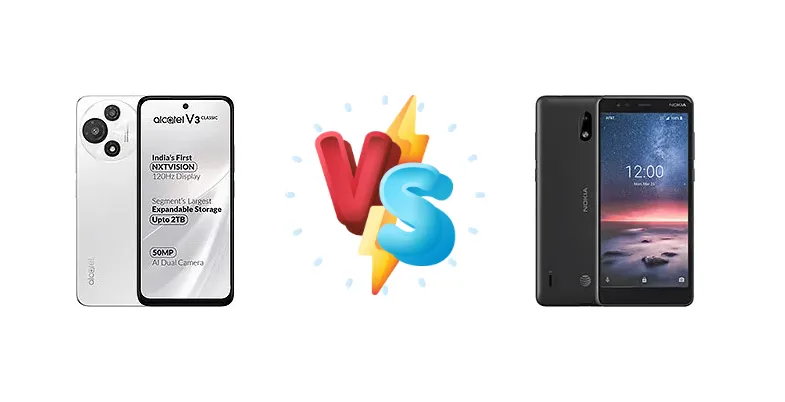
The Alcatel V3 Classic and Nokia 3.1 A represent distinct approaches to the entry-level smartphone market. The V3 Classic aims for a balance of performance and longevity, while the Nokia 3.1 A prioritizes affordability. This comparison dissects their core components to reveal which device delivers the best experience for your needs.
🏆 Quick Verdict
For the average user prioritizing responsiveness and future-proofing, the Alcatel V3 Classic is the clear winner. Its Mediatek Dimensity 6300 chipset offers a substantial performance advantage over the Nokia 3.1 A’s Snapdragon 429, coupled with faster 18W charging. While the Nokia 3.1 A is cheaper, the performance trade-offs are significant.
| Network |
|---|
| 2G bands | GSM 850 / 900 / 1800 / 1900 | GSM 850 / 900 / 1800 / 1900 |
| 3G bands | HSDPA 850 / 900 / 1700(AWS) / 1900 / 2100 | HSDPA 850 / 1700(AWS) / 1900 |
| 4G bands | 1, 2, 3, 4, 5, 7, 8, 12, 13, 17, 20, 26, 28, 32, 38, 40, 41, 42, 66 | 2, 4, 5, 12, 14, 29, 30 |
| 5G bands | 1, 3, 5, 7, 8, 20, 26, 28, 38, 40, 41, 66, 77, 78 SA/NSA | - |
| Speed | HSPA, LTE, 5G | HSPA 42.2/5.76 Mbps, LTE Cat4 150/50 Mbps |
| Technology | GSM / HSPA / LTE / 5G | GSM / HSPA / LTE |
| Launch |
|---|
| Announced | 2025, May 27 | 2019, June. Released 2019, June |
| Status | Available. Released 2025, June 02 | Discontinued |
| Body |
|---|
| Dimensions | 165.6 x 76.2 x 8.2 mm (6.52 x 3.00 x 0.32 in) | 152.7 x 71.9 x 9.4 mm (6.01 x 2.83 x 0.37 in) |
| SIM | Nano-SIM + Nano-SIM | Nano-SIM |
| Weight | 187 g (6.60 oz) | 156 g (5.50 oz) |
| Display |
|---|
| Protection | Mohs level 5 | - |
| Resolution | 720 x 1600 pixels, 20:9 ratio (~262 ppi density) | 720 x 1440 pixels, 18:9 ratio (~295 ppi density) |
| Size | 6.67 inches, 108.2 cm2 (~85.8% screen-to-body ratio) | 5.45 inches, 76.7 cm2 (~69.8% screen-to-body ratio) |
| Type | IPS LCD, 120Hz, 570 nits | IPS LCD |
| Platform |
|---|
| CPU | Octa-core (2x2.4 GHz Cortex-A76 & 6x2.0 GHz Cortex-A55) | Quad-core 1.8 GHz Cortex-A53 |
| Chipset | Mediatek Dimensity 6300 (6 nm) | Qualcomm SDM429 Snapdragon 429 (12 nm) |
| GPU | Mali-G57 MC2 | Adreno 504 |
| OS | Android 15, up to 3 major Android upgrades | Android 9.0 (Pie) |
| Memory |
|---|
| Card slot | microSDXC (uses shared SIM slot) | microSDXC (dedicated slot) |
| Internal | 128GB 4GB RAM, 128GB 6GB RAM | 32GB 2GB RAM |
| | - | eMMC 5.1 |
| Main Camera |
|---|
| Features | LED flash, HDR, panorama | LED flash, HDR, panorama |
| Single | 50 MP, f/1.8, 26mm (wide), 1/2.5", 0.7µm, PDAF
Auxiliary lens | 8 MP, f/2.0, AF |
| Video | 1080p@30fps | 1080p@30fps |
| Selfie camera |
|---|
| Features | HDR | HDR |
| Single | 8 MP, f/2.0, (wide), 1/4.0", 1.12µm | 5 MP, f/2.2 |
| Video | 1080p@30fps | 720p@30fps |
| Sound |
|---|
| 3.5mm jack | - | Yes |
| 35mm jack | Yes | Yes |
| Loudspeaker | Yes, with stereo speakers | Yes |
| Comms |
|---|
| Bluetooth | 5.4, A2DP, LE | 5.0, A2DP, LE |
| NFC | Yes | No |
| Positioning | GPS, GLONASS, BDS, GALILEO | GPS, GLONASS, BDS |
| Radio | FM radio | FM radio |
| USB | USB Type-C 2.0 | USB Type-C 2.0 |
| WLAN | Wi-Fi 802.11 a/b/g/n/ac, dual-band, Wi-Fi Direct | Wi-Fi 802.11 b/g/n |
| Features |
|---|
| Sensors | Accelerometer, proximity, compass | Accelerometer, gyro, proximity |
| Battery |
|---|
| Charging | 18W wired | 10W wired |
| Type | 5200 mAh | Li-Ion 2990 mAh, non-removable |
| Misc |
|---|
| Colors | Halo White, Cosmic Grey | Black |
| Models | T519H | TA1140 |
| Price | About 130 EUR | - |
| SAR | - | 1.11 W/kg (head) 0.81 W/kg (body) |
| EU LABEL |
|---|
| Battery | 52:48h endurance, 1000 cycles | - |
| Energy | Class B | - |
| Free fall | Class B (180 falls) | - |
| Repairability | Class B | - |
alcatel V3 Classic
- Significantly faster processor for smoother performance
- Faster 18W charging for quicker top-ups
- More efficient 6nm chipset for better battery life and reduced throttling
- Price is likely higher than the Nokia 3.1 A
- Specific display details are unknown
Nokia 3.1 A
- Lower price point for budget-conscious buyers
- Simple and straightforward user experience
- Reliable brand reputation (Nokia)
- Slow Snapdragon 429 processor struggles with demanding tasks
- Slow 10W charging
- Less efficient 12nm chipset
Display Comparison
Display specifications are not provided for either device. However, given their market segment, it's reasonable to assume both utilize LCD panels. The Nokia 3.1 A, being an older model, likely has wider bezels. The V3 Classic, benefiting from newer manufacturing techniques, may offer a slightly higher screen-to-body ratio. Color accuracy is likely similar, with both devices targeting the sRGB color space.
Camera Comparison
Camera details are limited. Without sensor size or aperture information, a direct comparison is difficult. However, the Nokia 3.1 A’s camera is likely to be a basic setup, focused on capturing acceptable images in good lighting conditions. The Alcatel V3 Classic, while not a camera-centric device, likely benefits from the improved image signal processor (ISP) within the Dimensity 6300, potentially offering better dynamic range and noise reduction. The prevalence of 2MP macro lenses on both devices suggests limited utility; these sensors typically produce low-quality images.
Performance
The performance disparity is the most significant difference. The Alcatel V3 Classic’s Mediatek Dimensity 6300, built on a 6nm process, boasts an octa-core configuration with powerful Cortex-A76 cores clocked at 2.4 GHz. This contrasts sharply with the Nokia 3.1 A’s Snapdragon 429, a quad-core Cortex-A53 processor fabricated on a less efficient 12nm node. The Dimensity 6300’s architecture provides a substantial uplift in both single-core and multi-core performance, translating to smoother app launches, faster web browsing, and improved gaming capabilities. The 6nm process also contributes to better thermal efficiency, reducing the likelihood of throttling during sustained workloads.
Battery Life
The Alcatel V3 Classic claims 52:48h endurance with 1000 cycles, suggesting a well-optimized battery system. While the exact battery capacity isn’t specified, the endurance figure indicates efficient power management. The Nokia 3.1 A lacks this endurance data. The V3 Classic’s 18W wired charging is a significant advantage over the Nokia 3.1 A’s 10W charging, allowing for considerably faster top-ups. This faster charging speed is crucial for users who frequently use their phones throughout the day.
Buying Guide
Buy the Alcatel V3 Classic if you need a phone capable of handling multitasking, moderate gaming, and demanding applications without significant lag. It’s ideal for users who want a device that will remain usable for several years. Buy the Nokia 3.1 A if you prioritize absolute affordability and only require basic smartphone functionality – calls, texts, and light social media use. It’s a suitable option for first-time smartphone owners or as a temporary device.
Frequently Asked Questions
❓ Will the Alcatel V3 Classic handle popular games like PUBG Mobile or Call of Duty?
The Mediatek Dimensity 6300 in the Alcatel V3 Classic is capable of running PUBG Mobile and Call of Duty, but likely at medium settings to maintain a stable frame rate. The Snapdragon 429 in the Nokia 3.1 A will struggle with these titles, offering a significantly less enjoyable gaming experience.
❓ How much faster is the charging on the Alcatel V3 Classic compared to the Nokia 3.1 A?
The Alcatel V3 Classic’s 18W charging is almost double the speed of the Nokia 3.1 A’s 10W charging. This translates to a significantly shorter time to fully charge the device, reducing downtime and keeping you connected for longer.
❓ Is the difference in processor performance noticeable in everyday tasks like browsing and social media?
Yes, the difference is very noticeable. The Alcatel V3 Classic’s Dimensity 6300 will result in snappier app launches, smoother scrolling, and faster page loading times compared to the Nokia 3.1 A’s Snapdragon 429. This improved responsiveness enhances the overall user experience.