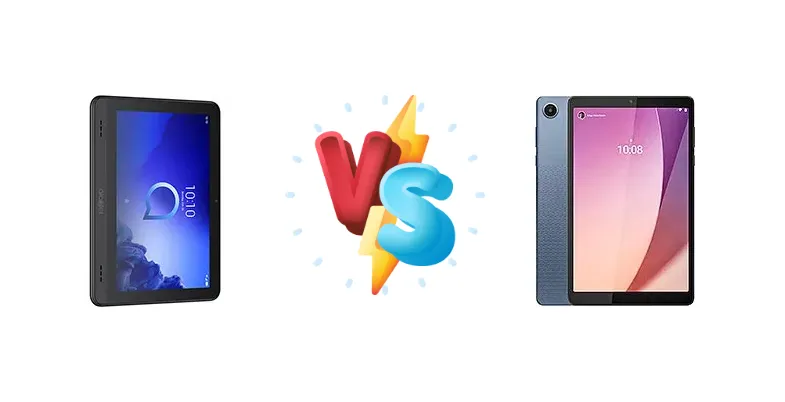
The sub-$150 tablet market is fiercely competitive, and the Alcatel Smart Tab 7 and Lenovo Tab M8 (4th Gen) represent two of the most popular options. While both aim to deliver affordable Android experiences, significant differences in their underlying hardware dictate vastly different performance and usability. This comparison dives deep into the specs to determine which tablet offers the best value for your money.
🏆 Quick Verdict
For most users, the Lenovo Tab M8 (4th Gen) is the superior choice. Its octa-core Helio A22 chipset provides a noticeably smoother and more responsive experience than the Alcatel Smart Tab 7’s quad-core MT8167D, making it better suited for multitasking, streaming, and light gaming. While both tablets are entry-level, the Lenovo offers a more future-proof platform.
| Network |
|---|
| 2G bands | N/A | GSM 850 / 900 / 1800 / 1900 |
| 3G bands | N/A | HSDPA 800 / 850 / 900 / 1900 / 2100 |
| 4G bands | N/A | 1, 2, 3, 4, 5, 7, 8, 19, 20, 26, 28, 38, 40, 41 |
| EDGE | No | - |
| GPRS | No | - |
| Speed | No | HSPA, LTE - cellular model only |
| Technology | No cellular connectivity | GSM / HSPA / LTE |
| Launch |
|---|
| Announced | 2019, September. Released 2019, Q4 | 2023, April 22 |
| Status | Discontinued | Available. Released 2023, May |
| Body |
|---|
| Build | - | Glass front, plastic frame, plastic back |
| Dimensions | 176 x 126 x 12 mm (6.93 x 4.96 x 0.47 in) | 197.8 x 119.8 x 9 mm (7.79 x 4.72 x 0.35 in) |
| SIM | No | Nano-SIM (cellular model only) |
| Weight | 268 g (9.45 oz) | 320 g (11.29 oz) |
| | Built-in kickstand | - |
| Display |
|---|
| Resolution | 600 x 1024 pixels, 16:9 ratio (~170 ppi density) | 800 x 1280 pixels, 16:10 ratio (~189 ppi density) |
| Size | 7.0 inches, 137.9 cm2 (~62.2% screen-to-body ratio) | 8.0 inches, 185.6 cm2 (~78.3% screen-to-body ratio) |
| Type | TN TFT LCD | IPS LCD, 350 nits (typ) |
| Platform |
|---|
| CPU | Quad-core 1.3 GHz Cortex-A53 | Octa-core (4x2.3 GHz Cortex-A53 & 4x1.6 GHz Cortex-A53) |
| Chipset | Mediatek MT8167D | Mediatek MT8768 Helio A22 (12 nm) |
| GPU | IMG GE8300 | PowerVR GE8320 |
| OS | Android 9.0 (Pie) | Android 13 |
| Memory |
|---|
| Card slot | microSDXC (dedicated slot) | microSDXC (dedicated slot) |
| Internal | 16GB 1.5GB RAM | 32GB 3GB RAM, 64GB 4GB RAM |
| Main Camera |
|---|
| Single | 0.3 MP, f/2.4, 1/5.0" | 5 MP, AF or 8MP, AF |
| Video | - | 1080p |
| Selfie camera |
|---|
| Single | 2 MP, f/2.4, 1/5.0", 1.65µm | 2 MP |
| Video | - | 720p |
| Sound |
|---|
| 3.5mm jack | Yes | - |
| 35mm jack | Yes | Yes |
| Loudspeaker | Yes, with dual speakers | Yes, with dual speakers |
| Comms |
|---|
| Bluetooth | 4.2, A2DP, LE | 5.0, A2DP, LE |
| NFC | No | No |
| Positioning | No | GPS, GLONASS, BDS - cellular model only |
| Radio | FM radio | FM radio |
| USB | microUSB 2.0 | USB Type-C 2.0, OTG |
| WLAN | Wi-Fi 802.11 b/g/n | Wi-Fi 802.11 a/b/g/n/ac, dual-band, Wi-Fi Direct |
| Features |
|---|
| Sensors | Accelerometer | Accelerometer, proximity |
| Battery |
|---|
| Charging | - | 10W wired |
| Type | Li-Ion 2580 mAh, non-removable | Li-Po 5100 mAh |
| Misc |
|---|
| Colors | Black | Abyss blue, Arctic grey |
| Price | About 80 EUR | About 150 EUR |
alcatel Smart Tab 7
- Potentially lower price point
- Simple and straightforward Android experience
- Lightweight and portable
- Significantly slower performance
- Less responsive user interface
- Limited multitasking capabilities
Lenovo Tab M8 (4th Gen)
- Faster and more responsive performance
- Octa-core processor for smoother multitasking
- 10W wired charging for quicker top-ups
- Slightly higher price
- Still a budget device with limitations
- May not support the latest Android updates for long
Display Comparison
Neither tablet boasts a particularly impressive display. Both likely utilize IPS LCD panels, common in this price bracket. However, detailed specs like resolution and brightness are missing. The key difference lies in processing power to drive the display smoothly. The Lenovo’s more powerful chipset will likely result in less lag when scrolling or transitioning between apps. Bezels are expected to be substantial on both, reflecting their budget nature.
Camera Comparison
Camera quality is unlikely to be a deciding factor for either tablet. Both are likely equipped with basic sensors suitable for casual snapshots. Given the market segment, detailed camera specs are unavailable, but it’s safe to assume image quality will be subpar, especially in low-light conditions. Focusing on the chipset difference is far more relevant than any potential camera improvements.
Performance
The Lenovo Tab M8 (4th Gen) significantly outperforms the Alcatel Smart Tab 7 in processing power. The MT8768 Helio A22 is an octa-core processor built on a more efficient 12nm process, compared to the Alcatel’s quad-core MT8167D. This translates to a substantial advantage in multitasking and app loading times. The Helio A22’s architecture (4x2.3 GHz Cortex-A53 & 4x1.6 GHz Cortex-A53) allows it to handle more demanding tasks without significant slowdown, while the Alcatel’s Cortex-A53 cores at 1.3 GHz will struggle with anything beyond basic operations. The Lenovo’s chipset also benefits from a newer manufacturing process, potentially leading to better thermal management.
Battery Life
Battery capacity is not specified for either device. However, the Lenovo Tab M8 (4th Gen) includes 10W wired charging, a feature absent from the Alcatel Smart Tab 7’s specifications. While charging speed isn’t everything, 10W charging offers a faster path to a full charge, reducing downtime. The more efficient Helio A22 chipset in the Lenovo may also contribute to slightly better battery life during typical usage, offsetting any potential capacity differences.
Buying Guide
Buy the Alcatel Smart Tab 7 if you need a very basic tablet primarily for static tasks like reading ebooks or displaying photos, and absolute cost is your primary concern. Buy the Lenovo Tab M8 (4th Gen) if you prefer a more responsive experience for everyday tasks, streaming video, and occasional light gaming, and are willing to spend a little more for improved performance and longevity.
Frequently Asked Questions
❓ Will the Lenovo Tab M8 (4th Gen) handle streaming video services like Netflix and YouTube smoothly?
Yes, the MediaTek Helio A22 chipset in the Lenovo Tab M8 (4th Gen) is capable of handling 720p and even 1080p video streaming without significant buffering or lag, providing a much smoother experience than the Alcatel Smart Tab 7.
❓ Is the Alcatel Smart Tab 7 suitable for playing demanding mobile games?
No, the Alcatel Smart Tab 7’s quad-core MT8167D processor is not powerful enough for most modern, graphically intensive mobile games. You’ll likely experience significant frame rate drops and lag, making the gaming experience frustrating. The Lenovo Tab M8 (4th Gen) offers a slight improvement, but is still not ideal for serious gaming.
❓ How much storage do these tablets typically offer, and can it be expanded?
While specific storage configurations vary, both tablets typically come with 32GB of internal storage. Crucially, both support microSD card expansion, allowing you to add up to 128GB or more of additional storage for apps, photos, and videos. This is essential given the limited internal storage.
❓ What version of Android do these tablets ship with, and will they receive updates?
Both tablets likely ship with Android 11 or 12 (Go Edition), a lightweight version of Android designed for devices with limited resources. Updates are not guaranteed and will likely be limited, as these are budget devices. Expect security patches to be infrequent, if at all.