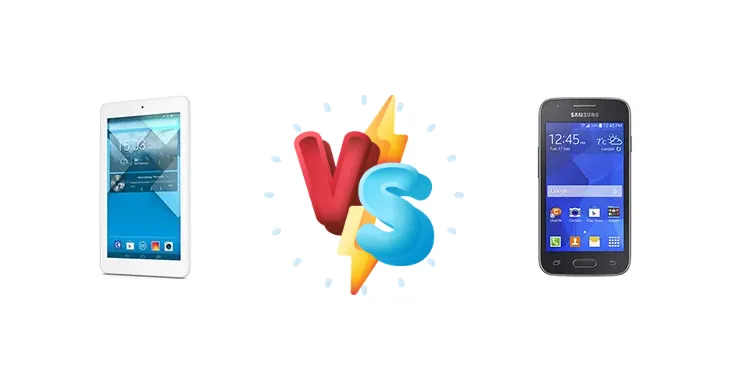
The Alcatel Pop 7 and Samsung Galaxy Ace 4 LTE represent the extreme lower end of the smartphone market. Both devices aim to provide basic smartphone functionality at the lowest possible price point. This comparison dissects their limited specifications to determine which offers the better experience for users prioritizing affordability and essential features.
🏆 Quick Verdict
For the average user seeking a functional, if basic, smartphone experience, the Alcatel Pop 7 edges out the Samsung Galaxy Ace 4 LTE. The Mediatek MT8312 chipset, despite being older, offers a slight performance advantage due to its architecture, making it marginally better for app responsiveness and multitasking.
| Network |
|---|
| 2G bands | GSM 850 / 900 / 1800 / 1900 | GSM 850 / 900 / 1800 / 1900 |
| 3G bands | HSDPA 900 / 2100 | HSDPA 850 / 900 / 2100 |
| 4G bands | - | 3, 7, 8, 20 |
| Speed | HSPA 21.1/5.76 Mbps | HSPA 42.2/5.76 Mbps, LTE Cat4 150/50 Mbps |
| Technology | GSM / HSPA | GSM / HSPA / LTE |
| | HSDPA 850 / 1900 / 2100 | - |
| Launch |
|---|
| Announced | 2014, January. Released 2014, Q2 | 2014, June. Released 2014, August |
| Status | Discontinued | Discontinued |
| Body |
|---|
| Dimensions | 192 x 113 x 8.9 mm (7.56 x 4.45 x 0.35 in) | 121.4 x 62.9 x 11 mm (4.78 x 2.48 x 0.43 in) |
| SIM | Micro-SIM | Micro-SIM |
| Weight | 285 g (10.05 oz) | 130.3 g (4.59 oz) |
| Display |
|---|
| Resolution | 600 x 1024 pixels, 16:9 ratio (~170 ppi density) | 480 x 800 pixels, 5:3 ratio (~233 ppi density) |
| Size | 7.0 inches, 137.9 cm2 (~63.6% screen-to-body ratio) | 4.0 inches, 45.5 cm2 (~59.6% screen-to-body ratio) |
| Type | TFT | TFT |
| Platform |
|---|
| CPU | Dual-core 1.3 GHz Cortex-A7 | Dual-core 1.2 GHz |
| Chipset | Mediatek MT8312 (28 nm) | - |
| GPU | Mali-400 | - |
| OS | Android 4.2 (Jelly Bean) | Android 4.4.2 (KitKat) |
| Memory |
|---|
| Card slot | microSDHC (dedicated slot) | microSDXC (dedicated slot) |
| Internal | 4GB 1GB RAM | 4GB 1GB RAM |
| Main Camera |
|---|
| Features | - | LED flash, panorama |
| Single | 2 MP | 5 MP, AF |
| Video | 720p | 720p@30fps |
| Selfie camera |
|---|
| Single | VGA | VGA |
| Sound |
|---|
| 3.5mm jack | Yes | Yes |
| 35mm jack | Yes | Yes |
| Loudspeaker | Yes | Yes |
| Comms |
|---|
| Bluetooth | 4.0, A2DP | 4.0, A2DP |
| NFC | No | Yes |
| Positioning | GPS | GPS, GLONASS |
| Radio | No | FM radio |
| USB | microUSB 2.0 | microUSB 2.0 |
| WLAN | Wi-Fi 802.11 b/g/n | Wi-Fi 802.11 b/g/n, Wi-Fi Direct, hotspot |
| Features |
|---|
| Sensors | - | Accelerometer |
| Battery |
|---|
| Music play | - | Up to 46 h |
| Stand-by | Up to 300 h (2G) / Up to 70 h (3G) | - |
| Talk time | - | Up to 9 h (3G) |
| Type | Li-Ion 3240 mAh, non-removable | Li-Ion 1800 mAh, removable |
| Misc |
|---|
| Colors | White | Iris Charcoal, Classic White |
| Models | - | SM-G313F, SM-G313MU, SM-G313HY |
| Price | About 160 EUR | About 250 EUR |
| SAR | - | 1.16 W/kg (head) 1.22 W/kg (body) |
| SAR EU | - | 0.87 W/kg (head) 0.39 W/kg (body) |
alcatel Pop 7
- Slightly better processor architecture with the Mediatek MT8312.
- More efficient 28nm manufacturing process.
- Potentially smoother multitasking compared to the Ace 4 LTE.
- Limited RAM (likely 1GB or less).
- Low-resolution display expected.
Samsung Galaxy Ace 4 LTE G313
- Brand recognition of Samsung.
- Potentially better software support (though updates are unlikely).
- Compact form factor for easy handling.
- Unspecified CPU architecture raises concerns about performance.
- Likely older and less efficient chipset.
- Limited RAM (likely 1GB or less).
Display Comparison
Both devices likely feature low-resolution displays, typical of this price bracket. Specifics are unavailable, but it's safe to assume neither offers vibrant colors or high brightness. The absence of display specifications suggests both prioritize cost savings over visual fidelity. Expect significant compromises in viewing angles and outdoor visibility on both.
Camera Comparison
Camera performance on both devices will be severely limited. Without sensor size or aperture information, it's reasonable to expect low-light performance to be poor and image quality to be subpar. Any camera features beyond basic photo capture should be considered a bonus. The lack of detail suggests neither device is intended for serious photography.
Performance
The core difference lies in the chipsets. The Alcatel Pop 7 utilizes the Mediatek MT8312, a dual-core 1.3 GHz Cortex-A7 processor built on a 28nm process. This fabrication node is more efficient than what's likely found in the Samsung Galaxy Ace 4 LTE, which only lists a dual-core 1.2 GHz CPU. While clock speed is only a partial indicator, the MT8312's architecture and process node suggest better performance per watt. This translates to potentially smoother app launches and slightly less lag during basic tasks. The Samsung's CPU lacks architectural details, making a precise comparison difficult, but it's likely an older generation design.
Battery Life
Battery capacity is unspecified for both devices. However, given their low-end specifications, battery life will likely be adequate for a day of light use – primarily calls, texts, and occasional web browsing. Charging speeds are also unknown, but likely slow due to the use of older charging standards and lower-wattage chargers.
Buying Guide
Buy the Alcatel Pop 7 if you need a device capable of running slightly more demanding apps, even if slowly, and appreciate a chipset built on a more modern 28nm process. Buy the Samsung Galaxy Ace 4 LTE G313 if you prioritize brand recognition and potentially better software support, understanding that performance will be limited by its unspecified, but likely older, CPU architecture.
Frequently Asked Questions
❓ Will the Alcatel Pop 7 struggle with modern apps like Facebook or WhatsApp?
Yes, both devices will struggle with modern apps. The limited RAM and processing power of the Mediatek MT8312 and the Samsung's CPU mean that apps will load slowly and may experience frequent crashes. Basic functionality is possible, but a smooth experience is unlikely.
❓ Is the Samsung Galaxy Ace 4 LTE a good choice for a first smartphone?
The Samsung Galaxy Ace 4 LTE could serve as a very basic first smartphone, primarily for calls and texts. However, its limited performance will likely frustrate users accustomed to more responsive devices. It's best suited for individuals with minimal smartphone needs.
❓ Can either of these phones run popular mobile games?
Running popular mobile games on either device is not recommended. The processors are simply too weak to handle the graphical demands of most modern games. Simple, older games might be playable at very low settings, but expect significant lag and poor performance.