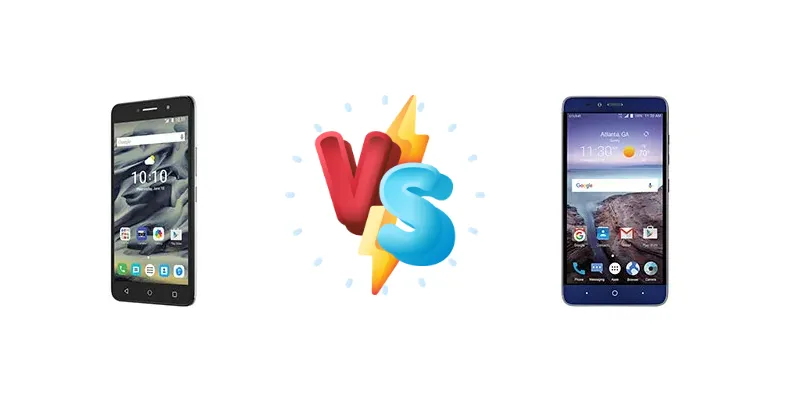
The Alcatel Pixi 4 (6) and ZTE Grand X Max 2 represent a segment of the market where affordability is paramount. Both devices aim to deliver a smartphone experience without breaking the bank, but they achieve this with significantly different internal hardware. This comparison focuses on the core performance differences stemming from their respective Qualcomm Snapdragon chipsets, and how those differences translate to everyday use.
🏆 Quick Verdict
For the average user prioritizing responsiveness and multitasking, the ZTE Grand X Max 2 is the clear winner. Its Snapdragon 617, with its octa-core configuration, offers a substantially smoother experience than the Alcatel Pixi 4 (6)'s quad-core Snapdragon 210. While the Pixi 4 (6) may suffice for basic tasks, the Grand X Max 2 provides a more future-proof and enjoyable user experience.
| Network |
|---|
| 2G bands | GSM 850 / 900 / 1800 / 1900 - SIM 1 & SIM 2 (optional) | GSM 900 / 1800 |
| 3G bands | HSDPA 850 / 900 / 1900 / 2100 | HSDPA |
| 4G bands | 1, 3, 7, 8, 20, 28 | LTE |
| EDGE | - | Yes |
| GPRS | - | Yes |
| Speed | HSPA, LTE Cat4 150/50 Mbps | HSPA, LTE |
| Technology | GSM / HSPA / LTE | GSM / HSPA / LTE |
| Launch |
|---|
| Announced | 2016, January. Released 2016, June | 2016, May. Released 2016, May |
| Status | Discontinued | Discontinued |
| Body |
|---|
| Dimensions | 165 x 83.8 x 8.3 mm (6.50 x 3.30 x 0.33 in) | 164.1 x 83.8 x 8.9 mm (6.46 x 3.30 x 0.35 in) |
| SIM | Micro-SIM | Nano-SIM |
| Weight | - | - |
| Display |
|---|
| Resolution | 720 x 1280 pixels, 16:9 ratio (~245 ppi density) | 1080 x 1920 pixels, 16:9 ratio (~367 ppi density) |
| Size | 6.0 inches, 99.2 cm2 (~71.8% screen-to-body ratio) | 6.0 inches, 99.2 cm2 (~72.2% screen-to-body ratio) |
| Type | IPS LCD | IPS LCD |
| Platform |
|---|
| CPU | Quad-core 1.1 GHz Cortex-A7 | Octa-core (4x1.5 GHz Cortex-A53 & 4x1.2 GHz Cortex-A53) |
| Chipset | Qualcomm MSM8909 Snapdragon 210 (28 nm) | Qualcomm MSM8952 Snapdragon 617 (28 nm) |
| GPU | Adreno 304 | Adreno 405 |
| OS | Android 5.1 (Lollipop), upgradable to 6.0.1 (Marshmallow) | Android 6.0 (Marshmallow) |
| Memory |
|---|
| Card slot | microSDHC (dedicated slot) | microSDXC (dedicated slot) |
| Internal | 8GB 1GB RAM, 16GB 1.5GB RAM | 16GB 2GB RAM |
| | eMMC 4.5 | eMMC 5.1 |
| Main Camera |
|---|
| Dual | - | 13 MP, AF
Auxiliary lens |
| Features | LED flash, HDR, panorama | LED flash, HDR, panorama |
| Single | 8 MP, AF | - |
| Video | 1080p@30fps | 1080p@30fps |
| Selfie camera |
|---|
| Features | LED flash | - |
| Single | 5 MP | 5 MP |
| Video | - | 1080p@30fps |
| Sound |
|---|
| 3.5mm jack | Yes | Yes |
| 35mm jack | Yes | Yes |
| Loudspeaker | Yes | Yes |
| | - | 24-bit/192kHz audio |
| Comms |
|---|
| Bluetooth | 4.1, A2DP | 4.1, A2DP, LE |
| NFC | No | No |
| Positioning | GPS | GPS |
| Radio | FM radio | No |
| USB | microUSB 2.0 | USB Type-C |
| WLAN | Wi-Fi 802.11 b/g/n, Wi-Fi Direct, hotspot | Wi-Fi 802.11 b/g/n, Wi-Fi Direct |
| Features |
|---|
| Sensors | Accelerometer, proximity, compass (optional) | Accelerometer, proximity, compass |
| Battery |
|---|
| Charging | - | 18W wired, QC2 |
| Stand-by | Up to 650 h (2G) / Up to 650 h (3G) | - |
| Talk time | Up to 26 h (2G) / Up to 15 h (3G) | - |
| Type | Li-Ion 2580 mAh, removable | Li-Ion 3400 mAh, non-removable |
| Misc |
|---|
| Colors | Black, Silver, Red, Green, Purple | Blue |
| Models | 8050D, 9001X, 5098O, 5098S | Z988 |
| Price | About 100 EUR | About 210 EUR |
alcatel Pixi 4 (6)
- Extremely affordable
- Functional for basic tasks
- Likely lightweight and compact
- Slow performance
- Limited multitasking capabilities
- No fast charging
ZTE Grand X Max 2
- Significantly faster performance
- Quick Charge 2.0 support (18W)
- Better multitasking and app loading
- Slightly higher price point
- May have a larger footprint
- Still an entry-level device
Display Comparison
Neither device boasts a particularly impressive display. Given the context of these phones, display specs are likely similar (720p resolution is probable for both). However, the focus here is on the chipset's ability to drive the display smoothly. The Snapdragon 617's more powerful GPU will likely result in slightly smoother scrolling and animations, even if the panel itself is comparable. Bezels are likely substantial on both, typical for this price point.
Camera Comparison
Without specific camera specs, it's difficult to make a definitive statement. However, the Snapdragon 617 generally includes a more capable Image Signal Processor (ISP) than the Snapdragon 210. This translates to better image processing, potentially resulting in sharper images, improved dynamic range, and faster capture times on the ZTE Grand X Max 2. It's likely both phones feature similar sensor sizes and lens apertures, given their price bracket, but the 617's ISP provides a processing advantage.
Performance
The core difference lies in the chipsets. The Alcatel Pixi 4 (6) utilizes the Qualcomm MSM8909 Snapdragon 210, featuring a quad-core 1.1 GHz Cortex-A7 CPU. This is an entry-level processor designed for basic functionality. Conversely, the ZTE Grand X Max 2 is powered by the MSM8952 Snapdragon 617, an octa-core processor with a heterogeneous architecture – four cores clocked at 1.5 GHz (Cortex-A53) and four at 1.2 GHz (Cortex-A53). This configuration allows for efficient power management and better performance in multi-threaded tasks. The 617's architecture is a significant leap forward, offering substantially improved multitasking and app loading times. The Cortex-A53 cores in the 617 are also more efficient than the A7 cores in the 210, potentially leading to better battery life under load.
Battery Life
Battery capacity is not specified, but the Snapdragon 617's Quick Charge 2.0 support (18W wired) is a significant advantage. This allows for much faster charging times compared to the Alcatel Pixi 4 (6), which likely lacks fast charging capabilities. Even if the Pixi 4 (6) has a slightly larger battery, the Grand X Max 2's faster charging will minimize downtime. The 617's more efficient CPU also contributes to better battery life during active use.
Buying Guide
Buy the Alcatel Pixi 4 (6) if you need a very basic smartphone for calls, texts, and light web browsing, and your budget is extremely limited. It's a functional device for those with minimal smartphone requirements. Buy the ZTE Grand X Max 2 if you prefer a more responsive device capable of handling multiple apps, moderate gaming, and faster charging. The extra investment delivers a significantly improved user experience and longevity.
Frequently Asked Questions
❓ Will the ZTE Grand X Max 2 handle popular social media apps like Facebook and Instagram smoothly?
Yes, the Snapdragon 617 in the ZTE Grand X Max 2 is more than capable of running social media apps smoothly. The octa-core processor and improved GPU will provide a much more responsive experience compared to the Alcatel Pixi 4 (6), especially when multitasking between apps.
❓ Is the Snapdragon 210 in the Alcatel Pixi 4 (6) sufficient for playing basic games like Candy Crush or Angry Birds?
For very simple games like Candy Crush or Angry Birds, the Snapdragon 210 will likely suffice. However, you may experience noticeable lag or slowdowns, especially with more demanding games or when running other apps in the background. The ZTE Grand X Max 2 offers a significantly better gaming experience due to its more powerful processor and GPU.
❓ How much faster is the charging on the ZTE Grand X Max 2 with Quick Charge 2.0?
Quick Charge 2.0 on the ZTE Grand X Max 2 allows for significantly faster charging compared to standard charging. While exact charging times depend on the charger and battery capacity, you can expect a substantial reduction in charging time – potentially going from 0% to 50% in around 30-45 minutes, compared to several hours on the Alcatel Pixi 4 (6).