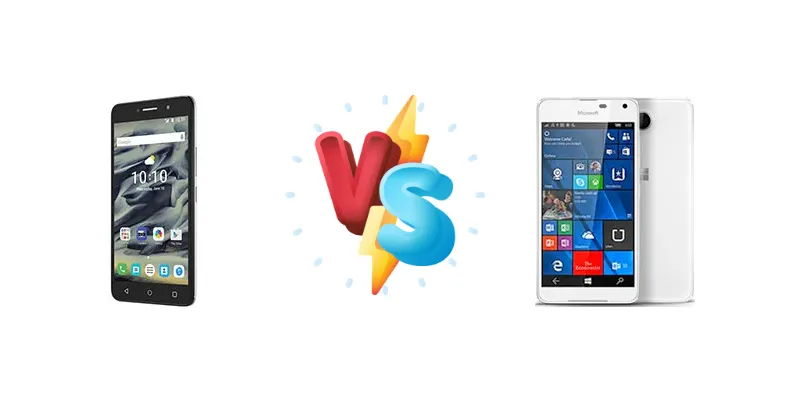
The Alcatel Pixi 4 (6) and Microsoft Lumia 650 represent a bygone era of ultra-affordable smartphones. Both devices, powered by Qualcomm's Snapdragon 210 and 212 respectively, targeted first-time smartphone buyers. This comparison dissects the nuances between these two models, focusing on where the slight hardware upgrades translate into real-world differences for the user.
🏆 Quick Verdict
For the average user seeking a basic, reliable smartphone, the Microsoft Lumia 650 edges out the Alcatel Pixi 4 (6). The marginally faster 1.3 GHz CPU and Snapdragon 212 chipset offer a slightly smoother experience, while both phones share identical battery life and display characteristics.
| Network |
|---|
| 2G bands | GSM 850 / 900 / 1800 / 1900 - SIM 1 & SIM 2 (optional) | GSM 850 / 900 / 1800 / 1900 - SIM 1 & SIM 2 (dual-SIM model only) |
| 3G bands | HSDPA 850 / 900 / 1900 / 2100 | HSDPA 850 / 900 / 2100 |
| 4G bands | 1, 3, 7, 8, 20, 28 | 1, 3, 7, 8, 20 |
| Speed | HSPA, LTE Cat4 150/50 Mbps | HSPA 42.2/5.76 Mbps, LTE Cat4 150/50 Mbps |
| Technology | GSM / HSPA / LTE | GSM / HSPA / LTE |
| Launch |
|---|
| Announced | 2016, January. Released 2016, June | 2016, February. Released 2016, February |
| Status | Discontinued | Discontinued |
| Body |
|---|
| Build | - | Glass front (Gorilla Glass 3), plastic back, aluminum frame |
| Dimensions | 165 x 83.8 x 8.3 mm (6.50 x 3.30 x 0.33 in) | 142 x 70.9 x 6.9 mm (5.59 x 2.79 x 0.27 in) |
| SIM | Micro-SIM | · Nano-SIM· Nano-SIM + Nano-SIM |
| Weight | - | 122 g (4.30 oz) |
| Display |
|---|
| Protection | - | Corning Gorilla Glass 3 |
| Resolution | 720 x 1280 pixels, 16:9 ratio (~245 ppi density) | 720 x 1280 pixels, 16:9 ratio (~297 ppi density) |
| Size | 6.0 inches, 99.2 cm2 (~71.8% screen-to-body ratio) | 5.0 inches, 67.5 cm2 (~67.1% screen-to-body ratio) |
| Type | IPS LCD | OLED |
| | - | ClearBlack display |
| Platform |
|---|
| CPU | Quad-core 1.1 GHz Cortex-A7 | Quad-core 1.3 GHz Cortex-A7 |
| Chipset | Qualcomm MSM8909 Snapdragon 210 (28 nm) | Qualcomm MSM8909v2 Snapdragon 212 (28 nm) |
| GPU | Adreno 304 | Adreno 304 |
| OS | Android 5.1 (Lollipop), upgradable to 6.0.1 (Marshmallow) | Microsoft Windows 10 |
| Memory |
|---|
| Card slot | microSDHC (dedicated slot) | microSDXC (dedicated slot) |
| Internal | 8GB 1GB RAM, 16GB 1.5GB RAM | 16GB 1GB RAM |
| | eMMC 4.5 | eMMC 4.5 |
| Main Camera |
|---|
| Features | LED flash, HDR, panorama | LED flash |
| Single | 8 MP, AF | 8 MP, f/2.2, 28mm (wide), 1/4.0", AF |
| Video | 1080p@30fps | 720p@30fps |
| Selfie camera |
|---|
| Features | LED flash | - |
| Single | 5 MP | 5 MP, f/2.2 |
| Video | - | 720p |
| Sound |
|---|
| 3.5mm jack | Yes | Yes |
| 35mm jack | Yes | Yes |
| Loudspeaker | Yes | Yes |
| Comms |
|---|
| Bluetooth | 4.1, A2DP | 4.1, A2DP, LE |
| NFC | No | Yes |
| Positioning | GPS | GPS, GLONASS, BDS |
| Radio | FM radio | FM radio |
| USB | microUSB 2.0 | microUSB 2.0 |
| WLAN | Wi-Fi 802.11 b/g/n, Wi-Fi Direct, hotspot | Wi-Fi 802.11 b/g/n, DLNA, hotspot |
| Features |
|---|
| Sensors | Accelerometer, proximity, compass (optional) | Accelerometer, proximity |
| Battery |
|---|
| Stand-by | Up to 650 h (2G) / Up to 650 h (3G) | Up to 624 h (3G) |
| Talk time | Up to 26 h (2G) / Up to 15 h (3G) | Up to 16 h (2G) / Up to 13 h (3G) |
| Type | Li-Ion 2580 mAh, removable | Li-Ion 2000 mAh, removable |
| Misc |
|---|
| Colors | Black, Silver, Red, Green, Purple | Black, White |
| Models | 8050D, 9001X, 5098O, 5098S | - |
| Price | About 100 EUR | About 150 EUR |
| Tests |
|---|
| Battery life | - |
Endurance rating 55h
|
| Camera | - |
Photo |
| Display | - |
Contrast ratio: Infinite (nominal), 3.77(sunlight) |
alcatel Pixi 4 (6)
- Potentially lower price point
- Functional for basic tasks
- Identical battery life to Lumia 650
- Slower processor (1.1 GHz)
- Snapdragon 210 chipset is less efficient
- Likely lower build quality
Microsoft Lumia 650
- Faster processor (1.3 GHz)
- Snapdragon 212 chipset offers slight performance gain
- Microsoft's software polish (at the time)
- May be slightly more expensive
- Still limited by the Cortex-A7 architecture
- Battery life is not significantly better
Display Comparison
Both the Alcatel Pixi 4 (6) and Microsoft Lumia 650 share the same display characteristics: an infinite (nominal) contrast ratio and a sunlight contrast ratio of 3.77. This suggests similar outdoor visibility. However, the specific panel technology (IPS, TFT) and resolution are not specified, meaning color accuracy and sharpness are likely comparable but not exceptional. The lack of detailed display specs indicates both devices prioritize cost savings over display quality.
Camera Comparison
Both devices are listed with simply 'Photo' as a camera feature, offering no details on sensor size, aperture, or resolution. Given their market segment, it’s safe to assume both cameras are basic and suitable for casual snapshots in good lighting conditions. The absence of any specific camera specs suggests image quality is not a key differentiator between these two models. Expect limited low-light performance and a lack of advanced features.
Performance
The core difference lies in the chipset and CPU. The Lumia 650 utilizes the Qualcomm MSM8909v2 Snapdragon 212 with a 1.3 GHz quad-core Cortex-A7 CPU, while the Pixi 4 (6) features the MSM8909 Snapdragon 210 running at 1.1 GHz. While both are based on the Cortex-A7 architecture, the 212’s higher clock speed and minor architectural improvements offer a slight performance boost. This translates to marginally faster app loading times and smoother multitasking, particularly noticeable when switching between a few basic applications. Both devices, however, will struggle with demanding games or resource-intensive tasks.
Battery Life
Remarkably, both the Alcatel Pixi 4 (6) and Microsoft Lumia 650 boast an endurance rating of 55 hours. This suggests similar battery capacity and power efficiency. The 28nm manufacturing process of both chipsets contributes to reasonable power consumption. While charging wattage isn’t specified, it’s likely both devices utilize standard 5W charging, resulting in relatively slow charge times. The identical endurance rating effectively negates any battery life advantage for either device.
Buying Guide
Buy the Alcatel Pixi 4 (6) if you need a functional smartphone at the absolute lowest possible price point and are willing to accept slightly slower performance. Buy the Microsoft Lumia 650 if you prioritize a marginally more responsive user experience and appreciate the build quality and software polish Microsoft offered, even on its budget devices. Both are suitable for basic communication and light app usage.
Frequently Asked Questions
❓ Will the Lumia 650 run modern apps like WhatsApp and Facebook smoothly?
While the Lumia 650's Snapdragon 212 offers a slight performance edge, it's still a very basic processor. WhatsApp and Facebook will likely function, but expect occasional lag and slower loading times, especially with multiple apps open. These phones are best suited for light usage.
❓ Is the Snapdragon 210 in the Pixi 4 (6) capable of playing any games?
The Snapdragon 210 is not designed for gaming. Simple 2D games might be playable at low settings, but even basic 3D games will likely experience significant lag and poor performance. Don't expect a satisfactory gaming experience on this device.
❓ How long will it take to fully charge either the Pixi 4 (6) or the Lumia 650?
Given the likely use of standard 5W charging, expect a full charge to take approximately 3-4 hours. Neither device supports fast charging technologies.
❓ Does the Lumia 650 still receive software updates?
No. Microsoft has ended support for Windows Phone, meaning the Lumia 650 no longer receives security or feature updates. This is a significant security risk and limits the device's long-term usability.