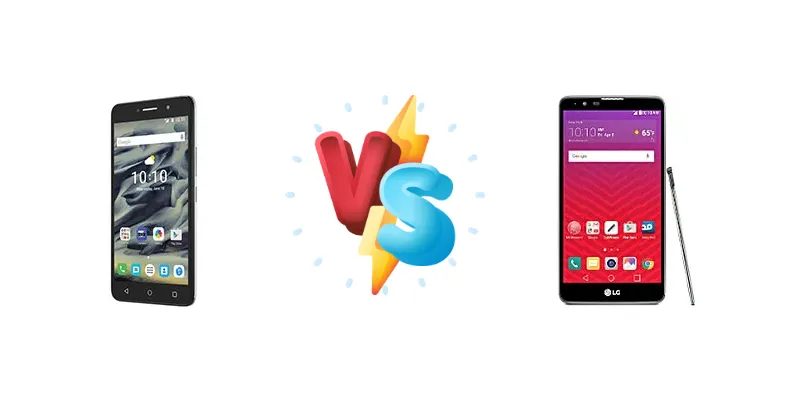
The Alcatel Pixi 4 (6) and LG Stylo 2 represent a segment of the market where affordability is paramount. Both devices aimed to deliver smartphone functionality to users on a tight budget, but they differed in their internal hardware. This comparison focuses on the core performance differences stemming from their respective Qualcomm Snapdragon chipsets – the 210 in the Pixi 4 (6) and the 410 in the Stylo 2 – and how those differences translate to real-world usage.
🏆 Quick Verdict
For the average user, the LG Stylo 2 is the better choice. While both phones are entry-level, the Snapdragon 410’s Cortex-A53 cores and slightly higher clock speed provide a noticeably smoother experience for multitasking and app loading compared to the Pixi 4 (6)'s Cortex-A7 based Snapdragon 210. The performance gap justifies the potential price difference.
| Network |
|---|
| 2G bands | GSM 850 / 900 / 1800 / 1900 - SIM 1 & SIM 2 (optional) | GSM 850 / 900 / 1800 / 1900 |
| 3G bands | HSDPA 850 / 900 / 1900 / 2100 | CDMA2000 1xEV-DO |
| 4G bands | 1, 3, 7, 8, 20, 28 | 2, 4, 5, 12, 25, 26, 41 - LS775 |
| Speed | HSPA, LTE Cat4 150/50 Mbps | HSPA 42.2/5.76 Mbps, LTE Cat4 150/50 Mbps, EV-DO Rev.A 3.1 Mbps |
| Technology | GSM / HSPA / LTE | GSM / CDMA / HSPA / EVDO / LTE |
| | - | HSDPA 850 / 1700(AWS) / 1900 / 2100 |
| Launch |
|---|
| Announced | 2016, January. Released 2016, June | 2016, April. Released 2016, April |
| Status | Discontinued | Discontinued |
| Body |
|---|
| Dimensions | 165 x 83.8 x 8.3 mm (6.50 x 3.30 x 0.33 in) | 155 x 79.5 x 7.4 mm (6.10 x 3.13 x 0.29 in) |
| SIM | Micro-SIM | Nano-SIM |
| Weight | - | 144.6 g (5.11 oz) |
| | - | Stylus |
| Display |
|---|
| Resolution | 720 x 1280 pixels, 16:9 ratio (~245 ppi density) | 720 x 1280 pixels, 16:9 ratio (~258 ppi density) |
| Size | 6.0 inches, 99.2 cm2 (~71.8% screen-to-body ratio) | 5.7 inches, 89.6 cm2 (~72.7% screen-to-body ratio) |
| Type | IPS LCD | IPS LCD |
| Platform |
|---|
| CPU | Quad-core 1.1 GHz Cortex-A7 | Quad-core 1.2 GHz Cortex-A53 |
| Chipset | Qualcomm MSM8909 Snapdragon 210 (28 nm) | Qualcomm MSM8916 Snapdragon 410 (28 nm) |
| GPU | Adreno 304 | Adreno 306 |
| OS | Android 5.1 (Lollipop), upgradable to 6.0.1 (Marshmallow) | Android 6.0 (Marshmallow) |
| Memory |
|---|
| Card slot | microSDHC (dedicated slot) | microSDXC (dedicated slot) |
| Internal | 8GB 1GB RAM, 16GB 1.5GB RAM | 16GB 2GB RAM |
| | eMMC 4.5 | eMMC 4.5 |
| Main Camera |
|---|
| Features | LED flash, HDR, panorama | LED flash, HDR, panorama |
| Single | 8 MP, AF | 13 MP, AF |
| Video | 1080p@30fps | 1080p@30fps |
| Selfie camera |
|---|
| Features | LED flash | - |
| Single | 5 MP | 5 MP |
| Video | - | 1080p@30fps |
| Sound |
|---|
| 3.5mm jack | Yes | Yes |
| 35mm jack | Yes | Yes |
| Loudspeaker | Yes | Yes |
| Comms |
|---|
| Bluetooth | 4.1, A2DP | 4.1, A2DP |
| NFC | No | No |
| Positioning | GPS | GPS |
| Radio | FM radio | No |
| USB | microUSB 2.0 | microUSB 2.0 |
| WLAN | Wi-Fi 802.11 b/g/n, Wi-Fi Direct, hotspot | Wi-Fi 802.11 a/b/g/n, Wi-Fi Direct |
| Features |
|---|
| Sensors | Accelerometer, proximity, compass (optional) | Accelerometer, proximity |
| Battery |
|---|
| Stand-by | Up to 650 h (2G) / Up to 650 h (3G) | - |
| Talk time | Up to 26 h (2G) / Up to 15 h (3G) | - |
| Type | Li-Ion 2580 mAh, removable | Li-Ion 3000 mAh, removable |
| Misc |
|---|
| Colors | Black, Silver, Red, Green, Purple | Black |
| Models | 8050D, 9001X, 5098O, 5098S | LGLS775, VS835, K540, LGL82VL |
| Price | About 100 EUR | About 150 EUR |
alcatel Pixi 4 (6)
- Potentially lower price point
- Simple and straightforward user experience
- Compact size (likely)
- Significantly slower performance
- Limited multitasking capabilities
- Less responsive user interface
LG Stylo 2
- Better overall performance
- Smoother multitasking
- More efficient processor
- Potentially higher price
- May have slightly shorter battery life under heavy load
- Larger size (potentially)
Display Comparison
Neither device boasts a particularly impressive display. Given the context data focuses on the chipset, we can infer both likely utilize similar LCD panels with resolutions around 720p. The key difference will likely be color calibration and viewing angles, areas where LG historically has a slight edge. However, without specific display specs, it's difficult to definitively state which offers a superior visual experience. Bezels are expected to be substantial on both, typical of this price bracket.
Camera Comparison
Without detailed camera specifications, it’s safe to assume both phones feature basic camera setups. Both likely include a primary rear camera and a front-facing camera for selfies. Image quality will be heavily reliant on software processing and lighting conditions. The Snapdragon 410’s ISP (Image Signal Processor) is likely more capable than the 210’s, potentially resulting in slightly better dynamic range and noise reduction in photos taken with the Stylo 2. However, the difference will likely be marginal, and neither phone will compete with higher-end camera phones.
Performance
The core of the difference lies in the chipsets. The LG Stylo 2’s Snapdragon 410, with its quad-core 1.2 GHz Cortex-A53 processors, represents a significant architectural upgrade over the Alcatel Pixi 4 (6)’s Snapdragon 210 and its 1.1 GHz Cortex-A7 cores. The Cortex-A53 architecture is more efficient and delivers better performance per clock cycle. While both are built on a 28nm process, the 410’s more modern design translates to faster app loading times, smoother multitasking, and a more responsive overall user experience. The Snapdragon 410 also includes an Adreno 306 GPU, offering a modest improvement in graphics performance over the 210’s Adreno 300, making it slightly better suited for casual gaming.
Battery Life
Battery life will depend heavily on usage patterns. While the mAh capacity isn’t specified, both phones likely feature batteries in the 2000-2500 mAh range, typical for this class. The Snapdragon 410’s improved efficiency could translate to slightly longer battery life on the Stylo 2, especially during moderate usage. Charging speeds are also likely to be similar, with both phones likely supporting standard 5W charging. Expect full charges to take several hours.
Buying Guide
Buy the Alcatel Pixi 4 (6) if you absolutely need the lowest possible price point and your smartphone usage is limited to basic tasks like calls, texts, and light web browsing. Buy the LG Stylo 2 if you prioritize a more responsive user experience, even for moderately demanding apps, and are willing to spend a little more for improved performance and potentially better software support.
Frequently Asked Questions
❓ Will the LG Stylo 2 handle basic social media apps like Facebook and Instagram without significant lag?
Yes, the Snapdragon 410 in the LG Stylo 2 is sufficiently powerful to run basic social media apps like Facebook and Instagram without significant lag. The Cortex-A53 cores provide a noticeable improvement in responsiveness compared to the Alcatel Pixi 4 (6), making for a smoother user experience.
❓ Is the performance difference between the Snapdragon 210 and 410 noticeable when simply making phone calls and sending texts?
For basic tasks like phone calls and texting, the performance difference between the two chipsets is minimal. However, the Snapdragon 410’s extra processing power will become apparent when switching between apps or performing more demanding tasks, even if those tasks aren't graphically intensive.
❓ Can either of these phones handle modern mobile games like PUBG Mobile or Call of Duty Mobile?
Neither phone is well-suited for playing demanding games like PUBG Mobile or Call of Duty Mobile. While they might be able to run these games at the lowest settings, expect significant frame rate drops and lag. The Adreno 300/306 GPUs are simply not powerful enough for a smooth gaming experience.
❓ Which phone is likely to receive more software updates?
LG generally provided better software support than Alcatel, even for their budget devices. Therefore, the LG Stylo 2 is more likely to receive at least some software updates, including security patches, compared to the Alcatel Pixi 4 (6).