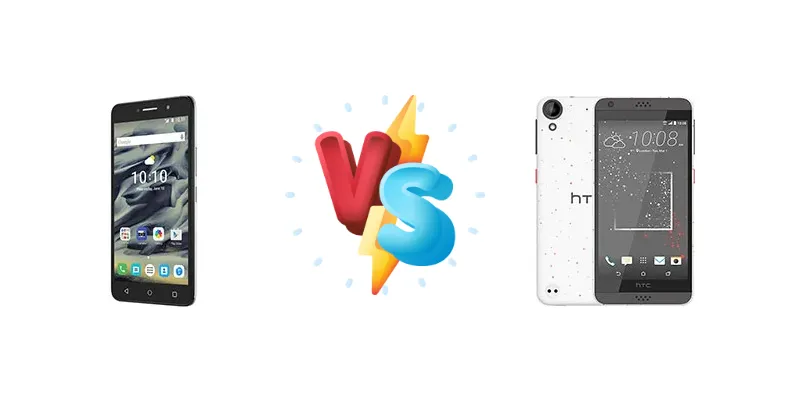
The Alcatel Pixi 4 (6) and HTC Desire 530 represent the extreme end of the smartphone spectrum – devices designed for basic connectivity at the lowest possible price point. Both rely on the Qualcomm Snapdragon 210 chipset, raising the question: are there meaningful differences between these two devices beyond branding and industrial design? This comparison aims to dissect their similarities and differences, helping budget-conscious consumers make an informed decision.
🏆 Quick Verdict
For the average user prioritizing absolute affordability, the choice between the Alcatel Pixi 4 (6) and HTC Desire 530 is largely inconsequential. Both deliver similar performance due to their identical Snapdragon 210 chipsets. However, the HTC Desire 530 *may* benefit from HTC’s historically better software optimization, potentially leading to a slightly smoother user experience, though this is difficult to quantify without extensive testing.
| Network |
|---|
| 2G bands | GSM 850 / 900 / 1800 / 1900 - SIM 1 & SIM 2 (optional) | GSM 850 / 900 / 1800 / 1900 |
| 3G bands | HSDPA 850 / 900 / 1900 / 2100 | HSDPA 850 / 900 / 2100 |
| 4G bands | 1, 3, 7, 8, 20, 28 | 1, 3, 5, 7, 8, 20, 28 |
| Speed | HSPA, LTE Cat4 150/50 Mbps | HSPA, LTE Cat4 150/50 Mbps |
| Technology | GSM / HSPA / LTE | GSM / HSPA / LTE |
| | - | 2, 4, 5, 7, 12, 13 - USA |
| Launch |
|---|
| Announced | 2016, January. Released 2016, June | 2016, February. Released 2016, March |
| Status | Discontinued | Discontinued |
| Body |
|---|
| Dimensions | 165 x 83.8 x 8.3 mm (6.50 x 3.30 x 0.33 in) | 146.9 x 70.9 x 8.3 mm (5.78 x 2.79 x 0.33 in) |
| SIM | Micro-SIM | Nano-SIM |
| Weight | - | 140 g (4.94 oz) |
| Display |
|---|
| Resolution | 720 x 1280 pixels, 16:9 ratio (~245 ppi density) | 720 x 1280 pixels, 16:9 ratio (~294 ppi density) |
| Size | 6.0 inches, 99.2 cm2 (~71.8% screen-to-body ratio) | 5.0 inches, 68.9 cm2 (~66.2% screen-to-body ratio) |
| Type | IPS LCD | Super LCD |
| Platform |
|---|
| CPU | Quad-core 1.1 GHz Cortex-A7 | Quad-core 1.1 GHz Cortex-A7 |
| Chipset | Qualcomm MSM8909 Snapdragon 210 (28 nm) | Qualcomm MSM8909 Snapdragon 210 (28 nm) |
| GPU | Adreno 304 | Adreno 304 |
| OS | Android 5.1 (Lollipop), upgradable to 6.0.1 (Marshmallow) | Android 6.0 (Marshmallow) |
| Memory |
|---|
| Card slot | microSDHC (dedicated slot) | microSDXC (dedicated slot) |
| Internal | 8GB 1GB RAM, 16GB 1.5GB RAM | 16GB 1.5GB RAM |
| | eMMC 4.5 | eMMC 4.5 |
| Main Camera |
|---|
| Features | LED flash, HDR, panorama | LED flash, HDR, panorama |
| Single | 8 MP, AF | 8 MP, f/2.4, AF |
| Video | 1080p@30fps | 720p@30fps |
| Selfie camera |
|---|
| Features | LED flash | - |
| Single | 5 MP | 5 MP, f/2.8 |
| Sound |
|---|
| 3.5mm jack | Yes | Yes |
| 35mm jack | Yes | Yes |
| Loudspeaker | Yes | Yes |
| Comms |
|---|
| Bluetooth | 4.1, A2DP | 4.1, A2DP |
| NFC | No | Yes (market dependant) |
| Positioning | GPS | GPS, GLONASS |
| Radio | FM radio | FM radio |
| USB | microUSB 2.0 | microUSB 2.0 |
| WLAN | Wi-Fi 802.11 b/g/n, Wi-Fi Direct, hotspot | Wi-Fi 802.11 b/g/nWi-Fi 802.11 a/b/g/n/ac, Wi-Fi Direct - USA version |
| Features |
|---|
| Sensors | Accelerometer, proximity, compass (optional) | Accelerometer, proximity |
| Battery |
|---|
| Stand-by | Up to 650 h (2G) / Up to 650 h (3G) | - |
| Talk time | Up to 26 h (2G) / Up to 15 h (3G) | - |
| Type | Li-Ion 2580 mAh, removable | Li-Ion 2200 mAh, non-removable |
| Misc |
|---|
| Colors | Black, Silver, Red, Green, Purple | Black, White |
| Models | 8050D, 9001X, 5098O, 5098S | Desire 530, D530u, HTCD160LVW |
| Price | About 100 EUR | About 170 EUR |
alcatel Pixi 4 (6)
- Larger 6-inch display for better media consumption
- Potentially lower price point
- Alcatel brand recognition in certain markets
- Potentially less refined software experience
- Larger size may be less comfortable for one-handed use
HTC Desire 530
- HTC’s historical software optimization
- Potentially more compact form factor
- Established brand reputation
- Likely smaller display
- Potentially higher price point
Display Comparison
Both the Alcatel Pixi 4 (6) and HTC Desire 530 are expected to feature displays optimized for cost, likely utilizing TFT LCD panels. Given the target market, neither device is expected to boast high brightness levels or color accuracy. The Pixi 4 (6)'s larger 6-inch display, compared to the Desire 530's unspecified size (but likely smaller), will offer a more immersive viewing experience for videos, but at the cost of potentially lower pixel density. Bezels are expected to be substantial on both devices, reflecting their budget nature.
Camera Comparison
Camera performance on both devices is expected to be subpar. While specifications are not provided beyond the chipset, budget smartphones in this class typically feature low-resolution sensors and lack features like optical image stabilization (OIS). Image quality will likely be acceptable only in well-lit conditions. Any marketing claims regarding camera capabilities should be viewed with skepticism. The absence of detailed camera specs suggests neither device prioritizes photography.
Performance
The core of both devices is the Qualcomm MSM8909 Snapdragon 210 (28 nm) chipset, paired with a Quad-core 1.1 GHz Cortex-A7 CPU. This configuration is demonstrably underpowered by modern standards, suitable only for the most basic tasks. The 28nm manufacturing process is relatively inefficient, meaning both phones will struggle with sustained workloads and are prone to thermal throttling. RAM capacity, a crucial factor for multitasking, is not specified in the provided data, but is likely limited to 1GB or 2GB in both cases, further restricting performance. The identical chipset and likely similar RAM configurations mean performance will be virtually indistinguishable in everyday use.
Battery Life
Battery capacity is not specified for either device. However, given the power-efficient Snapdragon 210 and limited display demands, both the Alcatel Pixi 4 (6) and HTC Desire 530 should be able to achieve all-day battery life with moderate usage. Charging wattage is also unknown, but is likely to be low, resulting in relatively slow charging times. The larger screen of the Pixi 4 (6) may slightly reduce battery life compared to the Desire 530, but the difference is unlikely to be significant.
Buying Guide
Buy the Alcatel Pixi 4 (6) if you need a larger screen for media consumption and are comfortable with a potentially less refined software experience. Buy the HTC Desire 530 if you prefer a more established brand with a history of software polish, even if the hardware is identical. Both are suitable for basic tasks like calling, texting, and light web browsing, but neither is ideal for demanding applications.
Frequently Asked Questions
❓ Will the Snapdragon 210 struggle with popular apps like Facebook or WhatsApp?
While the Snapdragon 210 can run basic apps like Facebook and WhatsApp, expect slow loading times and occasional lag, especially with multiple apps open. These phones are designed for light usage, and demanding applications will likely result in a frustrating experience.
❓ Is either phone suitable for playing mobile games?
Neither the Alcatel Pixi 4 (6) nor the HTC Desire 530 is suitable for playing modern mobile games. The Snapdragon 210 lacks the processing power and graphics capabilities to deliver a smooth gaming experience. Simple, older games may be playable at low settings, but don't expect to run titles like PUBG or Genshin Impact.
❓ How much storage space do these phones typically offer, and can it be expanded?
Storage space is likely limited to 8GB or 16GB on both devices. Fortunately, both the Alcatel Pixi 4 (6) and HTC Desire 530 typically include a microSD card slot, allowing you to expand storage capacity for photos, videos, and other files. This is highly recommended given the limited internal storage.