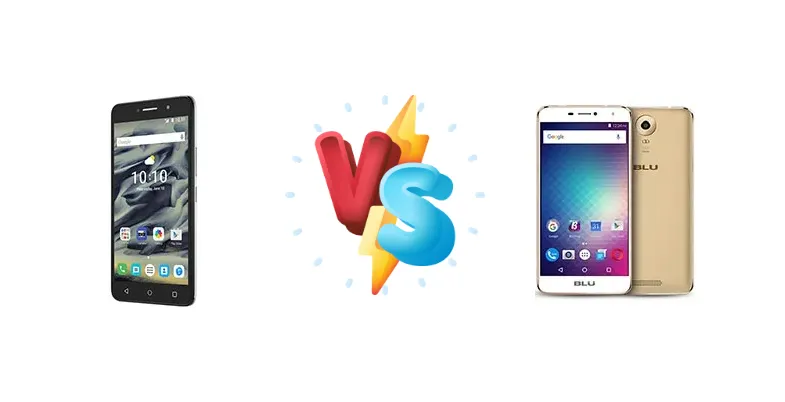
The Alcatel Pixi 4 (6) and BLU Studio XL2 represent the extreme end of the smartphone price spectrum. Both devices aim to deliver basic smartphone functionality at an incredibly low cost, but they achieve this with different chipsets and slight variations in specifications. This comparison dissects their core components to determine which offers the best value for users prioritizing affordability.
🏆 Quick Verdict
For the average user seeking a functional, ultra-budget smartphone, the BLU Studio XL2 emerges as the slightly better choice. Its Mediatek MT6737 chipset, with its Cortex-A53 cores clocked at 1.3 GHz, provides a noticeable performance advantage over the Alcatel Pixi 4 (6)'s Snapdragon 210, making everyday tasks feel smoother.
| Network |
|---|
| 2G bands | GSM 850 / 900 / 1800 / 1900 - SIM 1 & SIM 2 (optional) | GSM 850 / 900 / 1800 / 1900 - SIM 1 & SIM 2 |
| 3G bands | HSDPA 850 / 900 / 1900 / 2100 | HSDPA 850 / 1700(AWS) / 1900 / 2100 |
| 4G bands | 1, 3, 7, 8, 20, 28 | 2, 4, 7, 12, 17 |
| Speed | HSPA, LTE Cat4 150/50 Mbps | HSPA 42.2/11.5 Mbps, LTE Cat4 150/50 Mbps |
| Technology | GSM / HSPA / LTE | GSM / HSPA / LTE |
| Launch |
|---|
| Announced | 2016, January. Released 2016, June | 2016, November. Released 2016, November |
| Status | Discontinued | Discontinued |
| Body |
|---|
| Dimensions | 165 x 83.8 x 8.3 mm (6.50 x 3.30 x 0.33 in) | 165.7 x 83.6 x 9.1 mm (6.52 x 3.29 x 0.36 in) |
| SIM | Micro-SIM | Dual SIM (Micro-SIM, dual stand-by) |
| Weight | - | 200 g (7.05 oz) |
| Display |
|---|
| Resolution | 720 x 1280 pixels, 16:9 ratio (~245 ppi density) | 720 x 1280 pixels, 16:9 ratio (~245 ppi density) |
| Size | 6.0 inches, 99.2 cm2 (~71.8% screen-to-body ratio) | 6.0 inches, 99.2 cm2 (~71.6% screen-to-body ratio) |
| Type | IPS LCD | IPS LCD |
| Platform |
|---|
| CPU | Quad-core 1.1 GHz Cortex-A7 | Quad-core 1.3 GHz Cortex-A53 |
| Chipset | Qualcomm MSM8909 Snapdragon 210 (28 nm) | Mediatek MT6737 (28 nm) |
| GPU | Adreno 304 | Mali-T720 |
| OS | Android 5.1 (Lollipop), upgradable to 6.0.1 (Marshmallow) | Android 6.0 (Marshmallow) |
| Memory |
|---|
| Card slot | microSDHC (dedicated slot) | microSDXC |
| Internal | 8GB 1GB RAM, 16GB 1.5GB RAM | 16GB 2GB RAM |
| | eMMC 4.5 | eMMC 5.0 |
| Main Camera |
|---|
| Features | LED flash, HDR, panorama | LED flash, panorama |
| Single | 8 MP, AF | 13 MP, f/2.2, AF |
| Video | 1080p@30fps | 1080p@30fps |
| Selfie camera |
|---|
| Features | LED flash | LED flash |
| Single | 5 MP | 5 MP |
| Sound |
|---|
| 3.5mm jack | Yes | Yes |
| 35mm jack | Yes | Yes |
| Loudspeaker | Yes | Yes |
| Comms |
|---|
| Bluetooth | 4.1, A2DP | 4.1, A2DP, LE |
| NFC | No | No |
| Positioning | GPS | GPS |
| Radio | FM radio | FM radio |
| USB | microUSB 2.0 | microUSB 2.0, OTG |
| WLAN | Wi-Fi 802.11 b/g/n, Wi-Fi Direct, hotspot | Wi-Fi 802.11 b/g/n, Wi-Fi Direct |
| Features |
|---|
| Sensors | Accelerometer, proximity, compass (optional) | Accelerometer, proximity |
| Battery |
|---|
| Stand-by | Up to 650 h (2G) / Up to 650 h (3G) | Up to 800 h (2G) / Up to 700 h (3G) |
| Talk time | Up to 26 h (2G) / Up to 15 h (3G) | Up to 68 h (2G) / Up to 46 h (3G) |
| Type | Li-Ion 2580 mAh, removable | Li-Po 4900 mAh, non-removable |
| Misc |
|---|
| Colors | Black, Silver, Red, Green, Purple | Gray, Gold, Rose Gold |
| Models | 8050D, 9001X, 5098O, 5098S | Studio XL 2 |
| Price | About 100 EUR | - |
alcatel Pixi 4 (6)
- Potentially better brand recognition (Alcatel)
- Simple and straightforward user experience
- Likely wider availability in some regions
- Less powerful Snapdragon 210 chipset
- Older Cortex-A7 CPU architecture
- Potentially slower app loading times
BLU Studio XL2
- More powerful Mediatek MT6737 chipset
- More efficient Cortex-A53 CPU architecture
- Smoother multitasking experience
- Less established brand (BLU)
- Potential software update concerns
- May have limited regional availability
Display Comparison
Neither device boasts a standout display. Given the shared 28nm manufacturing process, display power draw is likely similar. Specifics like panel type (IPS vs TFT) and resolution are not provided, but both are likely 720p given the target price point. Bezels are expected to be substantial on both, maximizing screen real estate within a budget-friendly form factor. Color accuracy is unlikely to be a priority on either device.
Camera Comparison
Camera performance on both devices will be limited. Without specific sensor size or aperture information, it’s safe to assume both rely on low-resolution sensors (likely 5MP or 8MP main cameras). Image processing will be minimal, resulting in photos with limited dynamic range and detail, especially in low-light conditions. Any included 'macro' or 'beauty' modes should be approached with skepticism. The focus here isn't image quality, but basic functionality.
Performance
The core difference lies in the chipsets. The BLU Studio XL2’s Mediatek MT6737, featuring quad-core Cortex-A53 processors clocked at 1.3 GHz, represents a more modern architecture than the Alcatel Pixi 4 (6)’s Qualcomm MSM8909 Snapdragon 210 with its quad-core Cortex-A7 processors at 1.1 GHz. Cortex-A53 cores offer improved instruction set efficiency compared to A7, translating to better performance per clock cycle. While both are 28nm, the A53’s architecture allows for more efficient task handling. This means the BLU Studio XL2 will likely exhibit less lag when switching between apps or loading web pages. The Snapdragon 210 is known for being a very basic processor, suitable only for the most undemanding tasks.
Battery Life
Battery capacity is not specified for either device. However, given the low-power chipsets and likely smaller screen sizes, both should be able to achieve at least a full day of light use. Charging wattage is also unknown, but likely falls in the 5W-10W range, meaning a full charge will take several hours. The slightly more efficient MT6737 in the BLU Studio XL2 might translate to marginally better battery life, but the difference will likely be minimal.
Buying Guide
Buy the Alcatel Pixi 4 (6) if you need a phone primarily for basic communication – calls, texts, and light web browsing – and prioritize brand recognition. Buy the BLU Studio XL2 if you prefer a slightly more responsive experience for social media, basic gaming, and multitasking, and are comfortable with a less established brand.
Frequently Asked Questions
❓ Will the BLU Studio XL2 struggle with popular apps like Facebook or WhatsApp?
While the BLU Studio XL2's MT6737 chipset is an entry-level processor, it should be capable of running Facebook and WhatsApp without significant issues. However, expect some lag when scrolling through image-heavy feeds or loading videos. It's not designed for demanding apps or heavy multitasking.
❓ Is the Alcatel Pixi 4 (6) a good choice for someone who primarily uses their phone for calls and texts?
Yes, the Alcatel Pixi 4 (6) is a perfectly adequate choice for basic communication. Its Snapdragon 210 chipset is sufficient for making calls, sending texts, and checking simple notifications. However, if you anticipate using any apps beyond the basics, the BLU Studio XL2 offers a more responsive experience.
❓ Can either of these phones play PUBG Mobile?
No. Both the Snapdragon 210 and MT6737 are far too underpowered to run PUBG Mobile at playable framerates. Even at the lowest settings, expect significant lag and stuttering, making the game virtually unplayable.