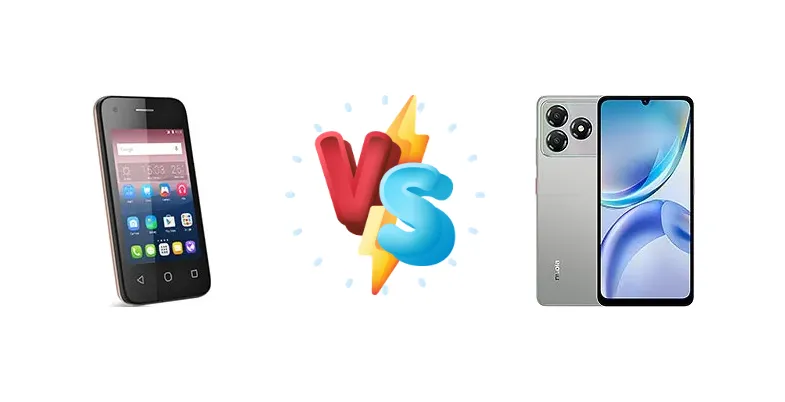
The Alcatel Pixi 4 (3.5) represents an older generation of ultra-budget smartphones, while the ZTE Blade A36 aims to deliver a more modern experience at a similar price point. This comparison dissects the core differences between these two devices, focusing on how their internal hardware translates to real-world usability.
🏆 Quick Verdict
For the vast majority of users, the ZTE Blade A36 is the clear winner. Its Unisoc T7200 chipset, built on a 12nm process, provides a substantial performance advantage over the Alcatel Pixi 4’s aging Mediatek MT6572M. The A36’s impressive battery endurance further solidifies its position as the better choice.
| Network |
|---|
| 2G bands | GSM 850 / 900 / 1800 / 1900 | GSM 850 / 900 / 1800 / 1900 |
| 3G bands | HSDPA 900 / 2100 | HSDPA 850 / 900 / 1900 / 2100 |
| 4G bands | - | 1, 3, 5, 7, 8, 20, 28, 38, 40, 41 |
| Speed | HSPA 21.1/5.76 Mbps | HSPA, LTE |
| Technology | GSM / HSPA | GSM / HSPA / LTE |
| | HSDPA 850 / 900 / 2100 | - |
| Launch |
|---|
| Announced | 2016, January. Released 2016, Q3 | 2025, June 18 |
| Status | Discontinued | Available. Released 2025, June |
| Body |
|---|
| Build | - | Glass front, plastic frame, plastic back |
| Dimensions | 116 x 62 x 10 mm (4.57 x 2.44 x 0.39 in) | 167.6 x 77.4 x 8.3 mm (6.60 x 3.05 x 0.33 in) |
| SIM | Micro-SIM | Nano-SIM + Nano-SIM |
| Weight | - | - |
| Display |
|---|
| Protection | - | Mohs level 4 |
| Resolution | 320 x 480 pixels, 3:2 ratio (~165 ppi density) | 720 x 1600 pixels, 20:9 ratio (~260 ppi density) |
| Size | 3.5 inches, 36.5 cm2 (~50.7% screen-to-body ratio) | 6.75 inches, 110.0 cm2 (~84.8% screen-to-body ratio) |
| Type | TFT | IPS LCD, 90Hz |
| Platform |
|---|
| CPU | Dual-core 1.0 GHz Cortex-A7 | Octa-core (2x1.6 GHz Cortex-A75 & 6x1.6 GHz Cortex-A55) |
| Chipset | Mediatek MT6572M (28 nm) | Unisoc T7200 (12 nm) |
| GPU | Mali-400 | Mali-G57 MP1 |
| OS | Android 5.1 (Lollipop) | Android 15 |
| Memory |
|---|
| Card slot | microSDHC (dedicated slot) | microSDXC (dedicated slot) |
| Internal | 4GB 512MB RAM | 64GB 4GB RAM |
| Main Camera |
|---|
| Features | LED flash | LED flash |
| Single | 2 MP | 13 MP, AF
Auxiliary lens |
| Video | 480p@15fps | 1080p@30fps |
| Selfie camera |
|---|
| Single | VGA | 5 MP |
| Video | - | Yes |
| Sound |
|---|
| 3.5mm jack | Yes | - |
| 35mm jack | Yes | Yes |
| Loudspeaker | Yes | Yes |
| Comms |
|---|
| Bluetooth | 4.0, A2DP | 5.2, A2DP, LE |
| NFC | No | No |
| Positioning | GPS (optional) | GPS, GALILEO, GLONASS |
| Radio | FM radio | FM radio |
| USB | microUSB 2.0 | USB Type-C 2.0 |
| WLAN | Wi-Fi 802.11 b/g/n, Wi-Fi Direct, hotspot | Wi-Fi 802.11 a/b/g/n/ac |
| Features |
|---|
| Sensors | Accelerometer | Accelerometer, proximity, compass |
| Battery |
|---|
| Charging | - | 10W wired |
| Stand-by | Up to 250 h (2G) / Up to 250 h (3G) | - |
| Talk time | Up to 4 h (3G) | - |
| Type | Li-Ion 1300 mAh, removable | 5000 mAh |
| Misc |
|---|
| Colors | Black, White | Black, Green, Silver |
| Models | - | Z2472 |
| Price | - | About 60 EUR |
| EU LABEL |
|---|
| Battery | - | 54:13h endurance, 800 cycles |
| Energy | - | Class A |
| Free fall | - | Class D (80 falls) |
| Repairability | - | Class B |
alcatel Pixi 4 (3.5)
- Extremely compact size
- Very low cost (likely)
- Simple and easy to use
- Outdated processor
- Poor performance
- Limited app compatibility
- Likely low-resolution display
ZTE Blade A36
- Significantly faster processor
- Long battery life (54:13h endurance)
- More modern software experience
- Better app compatibility
- May be larger than desired for some users
- Camera performance likely limited
- 10W charging is relatively slow
Display Comparison
Neither device boasts a standout display. The Alcatel Pixi 4 (3.5) is defined by its small 3.5-inch screen, likely with a low resolution given its age. The ZTE Blade A36’s display specifications are not provided, but given its market segment, it’s reasonable to expect a 720p+ panel. The key difference isn’t likely resolution, but the A36’s larger screen size will offer a more immersive experience. Both will likely utilize IPS LCD technology, offering acceptable viewing angles, but neither will compete with OLED displays in terms of contrast or color vibrancy.
Camera Comparison
Camera performance is likely to be limited on both devices. The Alcatel Pixi 4 (3.5) likely features a basic camera sensor, and details are scarce. The ZTE Blade A36’s camera specifications are also not provided, but it’s reasonable to assume a primary sensor around 8-13MP. Given the price point, image quality will be acceptable in good lighting conditions, but expect significant noise and a lack of detail in low light. The absence of Optical Image Stabilization (OIS) on either device will further exacerbate low-light performance issues. Focusing on megapixel counts alone would be misleading; image processing capabilities are equally important, and the A36’s newer chipset likely offers more sophisticated algorithms.
Performance
The performance gap between these two devices is significant. The Alcatel Pixi 4 (3.5) is powered by a Mediatek MT6572M, a dual-core 1.0 GHz Cortex-A7 processor fabricated on a 28nm node. This architecture is several years old and struggles with modern multitasking. In contrast, the ZTE Blade A36 features a Unisoc T7200, an octa-core processor (2x1.6 GHz Cortex-A75 & 6x1.6 GHz Cortex-A55) built on a more efficient 12nm process. The Cortex-A75 cores in the A36 represent a substantial architectural improvement over the A7 cores in the Pixi 4, delivering significantly faster performance in CPU-intensive tasks. The A36’s higher core count and more advanced architecture will result in smoother app launches, faster web browsing, and a more responsive overall experience.
Battery Life
The ZTE Blade A36 excels in battery endurance, boasting 54:13h of usage time and an impressive 800 charge cycles. This suggests a well-optimized power management system and a durable battery. The Alcatel Pixi 4 (3.5)’s battery capacity is unknown, but given its smaller size and older technology, it’s unlikely to match the A36’s longevity. The A36 also supports 10W wired charging, which, while not fast, is sufficient for topping up the battery overnight. The A36’s superior battery life is a major advantage for users who rely heavily on their smartphones throughout the day.
Buying Guide
Buy the Alcatel Pixi 4 (3.5) if you absolutely need the smallest possible phone and are only using it for the most basic tasks like calls and texts. Buy the ZTE Blade A36 if you prioritize a responsive user experience, longer battery life, and the ability to run modern apps without significant lag. The A36 is the better all-around device for anyone beyond the most minimal usage.
Frequently Asked Questions
❓ Is the Unisoc T7200 in the ZTE Blade A36 powerful enough for basic social media and web browsing?
Yes, the Unisoc T7200 is more than capable of handling everyday tasks like social media, web browsing, and messaging. Its octa-core architecture and Cortex-A75 cores provide a noticeable performance boost over older processors, ensuring a smooth and responsive experience.
❓ How does the 800 charge cycle rating of the ZTE Blade A36 impact its long-term usability?
The 800 charge cycle rating indicates the battery’s durability. It means the battery is designed to retain a significant portion of its original capacity after being fully charged and discharged 800 times. This translates to several years of reliable use, even with daily charging, making the A36 a more sustainable choice.
❓ Would the Alcatel Pixi 4 (3.5) be a suitable phone for a first-time smartphone user?
While simple, the Alcatel Pixi 4 (3.5)'s outdated hardware and limited capabilities make it a less-than-ideal choice for a first-time smartphone user. The slow performance and limited app compatibility could lead to a frustrating experience. The ZTE Blade A36 offers a much more modern and user-friendly experience.