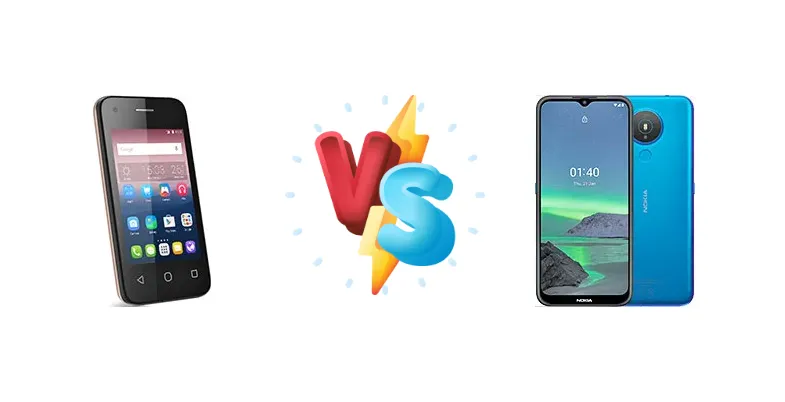
The Alcatel Pixi 4 (3.5) and Nokia 1.4 represent the absolute bottom end of the smartphone market, often serving as first phones or emergency backups. Both devices target users prioritizing affordability above all else, but significant differences in their underlying hardware can impact daily usability. This comparison dissects the Mediatek MT6572M-powered Pixi 4 against the Qualcomm Snapdragon 215-driven Nokia 1.4 to determine which offers the better experience.
🏆 Quick Verdict
For the average user, the Nokia 1.4 emerges as the slightly better choice. While both phones are limited, the Snapdragon 215’s quad-core Cortex-A53 architecture provides a noticeable performance advantage over the Pixi 4’s dual-core Cortex-A7, resulting in smoother multitasking and app loading, even within the constraints of Android Go.
| Network |
|---|
| 2G bands | GSM 850 / 900 / 1800 / 1900 | GSM 850 / 900 / 1800 / 1900 |
| 3G bands | HSDPA 900 / 2100 | HSDPA 850 / 900 / 2100 - International |
| 4G bands | - | 1, 3, 5, 7, 8, 20, 28, 38, 40, 41 - International |
| Speed | HSPA 21.1/5.76 Mbps | HSPA 42.2/5.76 Mbps, LTE Cat4 150/50 Mbps |
| Technology | GSM / HSPA | GSM / HSPA / LTE |
| | HSDPA 850 / 900 / 2100 | 1, 2, 3, 4, 5, 7, 12, 17, 28, 66 - LATAM, USA |
| Launch |
|---|
| Announced | 2016, January. Released 2016, Q3 | 2021, February 03 |
| Status | Discontinued | Available. Released 2021, February 03 |
| Body |
|---|
| Build | - | Glass front, plastic back, plastic frame |
| Dimensions | 116 x 62 x 10 mm (4.57 x 2.44 x 0.39 in) | 166.4 x 76.7 x 8.7 mm (6.55 x 3.02 x 0.34 in) |
| SIM | Micro-SIM | · Nano-SIM· Nano-SIM + Nano-SIM |
| Weight | - | 178 g (6.28 oz) |
| Display |
|---|
| Resolution | 320 x 480 pixels, 3:2 ratio (~165 ppi density) | 720 x 1600 pixels, 20:9 ratio (~269 ppi density) |
| Size | 3.5 inches, 36.5 cm2 (~50.7% screen-to-body ratio) | 6.52 inches, 102.6 cm2 (~80.4% screen-to-body ratio) |
| Type | TFT | IPS LCD |
| Platform |
|---|
| CPU | Dual-core 1.0 GHz Cortex-A7 | Quad-core 1.3 GHz Cortex-A53 |
| Chipset | Mediatek MT6572M (28 nm) | Qualcomm QM215 Snapdragon 215 (28 nm) |
| GPU | Mali-400 | Adreno 308 |
| OS | Android 5.1 (Lollipop) | Android 10 (Go edition), planned upgrade to Android 11 (Go edition) |
| Memory |
|---|
| Card slot | microSDHC (dedicated slot) | microSDXC |
| Internal | 4GB 512MB RAM | 16GB 1GB RAM, 32GB 2GB RAM, 64GB 3GB RAM |
| | - | eMMC 5.1 |
| Main Camera |
|---|
| Dual | - | 8 MP, (wide), AF
2 MP (macro) |
| Features | LED flash | LED flash, HDR |
| Single | 2 MP | - |
| Video | 480p@15fps | 720p@30fps |
| Selfie camera |
|---|
| Single | VGA | 5 MP |
| Video | - | 720p@30fps |
| Sound |
|---|
| 3.5mm jack | Yes | Yes |
| 35mm jack | Yes | Yes |
| Loudspeaker | Yes | Yes |
| Comms |
|---|
| Bluetooth | 4.0, A2DP | 4.2, A2DP, LE |
| NFC | No | No |
| Positioning | GPS (optional) | GPS |
| Radio | FM radio | FM radio |
| USB | microUSB 2.0 | microUSB 2.0 |
| WLAN | Wi-Fi 802.11 b/g/n, Wi-Fi Direct, hotspot | Wi-Fi 802.11 b/g/n |
| Features |
|---|
| Sensors | Accelerometer | Fingerprint (rear-mounted), accelerometer, proximity |
| Battery |
|---|
| Stand-by | Up to 250 h (2G) / Up to 250 h (3G) | - |
| Talk time | Up to 4 h (3G) | - |
| Type | Li-Ion 1300 mAh, removable | Li-Po 4000 mAh |
| Misc |
|---|
| Colors | Black, White | Fjord, Charcoal, Dusk |
| Models | - | TA-1322 |
| Price | - | About 90 EUR |
alcatel Pixi 4 (3.5)
- Potentially lower price point
- Compact size (likely)
- Simple and straightforward interface
- Significantly weaker processor
- Limited multitasking capabilities
- Outdated CPU architecture
Nokia 1.4
- More powerful Snapdragon 215 processor
- Quad-core CPU for smoother performance
- More efficient CPU architecture
- Slightly higher price
- Still limited by budget components
- May not be significantly better in real-world use for very basic tasks
Display Comparison
Neither device boasts a standout display. Both are likely to feature low-resolution panels given their price points, and specific details like brightness and color accuracy are unavailable. However, the focus should be on usability, and a sharper, more responsive display is preferable. Without specific data, we can assume both displays are adequate for basic tasks but will struggle in direct sunlight.
Camera Comparison
Camera performance on both devices is expected to be extremely limited. Given the target market, both likely feature basic sensors with minimal image processing capabilities. Without specific sensor details, it’s difficult to make a definitive statement. However, the Nokia 1.4’s slightly more powerful processor *could* allow for marginally faster image processing, but don’t expect flagship-level results from either.
Performance
The core difference lies in the chipset. The Nokia 1.4’s Qualcomm QM215 Snapdragon 215, with its quad-core 1.3 GHz Cortex-A53 CPUs, represents a significant architectural leap over the Alcatel Pixi 4 (3.5)’s Mediatek MT6572M. The Cortex-A53 is a more modern and efficient design than the Cortex-A7, offering better performance per clock cycle. While both are built on a 28nm process, the increased core count and improved architecture of the Snapdragon 215 translate to a more fluid user experience, particularly when multitasking. The Pixi 4’s dual-core processor will likely struggle with even moderately demanding apps.
Battery Life
Battery life will heavily depend on usage patterns. Both devices likely feature relatively small batteries to keep costs down. The Snapdragon 215’s improved efficiency *could* translate to slightly longer battery life on the Nokia 1.4, but the difference is unlikely to be substantial. Charging speeds are also likely to be slow on both devices, given the lack of fast charging support.
Buying Guide
Buy the Alcatel Pixi 4 (3.5) if you absolutely need the lowest possible price and your usage is limited to basic calling and texting. Buy the Nokia 1.4 if you prioritize a more responsive user experience, even for light social media browsing and occasional app use, and are willing to spend a small premium.
Frequently Asked Questions
❓ Will the Nokia 1.4 handle popular social media apps like Facebook and WhatsApp smoothly?
The Nokia 1.4, with its Snapdragon 215, is more likely to handle Facebook and WhatsApp with acceptable performance than the Alcatel Pixi 4 (3.5). However, don't expect a lag-free experience, especially with multiple apps open simultaneously. Android Go edition helps mitigate some of the performance limitations.
❓ Is the Mediatek MT6572M in the Alcatel Pixi 4 (3.5) sufficient for basic web browsing?
Basic web browsing is *possible* on the Alcatel Pixi 4 (3.5), but it will likely be a slow and frustrating experience. The dual-core processor and older Cortex-A7 architecture will struggle with rendering complex web pages. Expect significant loading times and potential lag.
❓ Which phone is better for someone who primarily uses their phone for calls and texts?
For calls and texts, both phones are adequate. The performance difference is less critical for these basic functions. The Alcatel Pixi 4 (3.5) would suffice if that's the primary use case, potentially saving you some money.
❓ Does either phone support common streaming services like YouTube?
Both phones *can* run YouTube, but video playback quality and smoothness will be limited. Expect lower resolutions and potential buffering, especially on the Alcatel Pixi 4 (3.5). The Nokia 1.4 will offer a slightly better streaming experience due to its more capable processor.