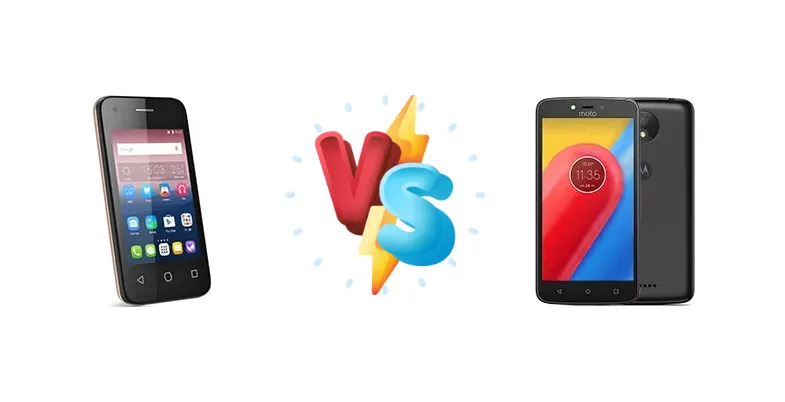
The Alcatel Pixi 4 (3.5) and Motorola Moto C represent the absolute bottom end of the smartphone market, often serving as first phones or emergency backups. Both devices prioritize affordability, but significant differences in their underlying hardware dictate which one delivers a more usable experience, even within this limited segment. This comparison focuses on the core performance implications of their respective chipsets.
🏆 Quick Verdict
For the average user needing a basic smartphone for calls, texts, and light app usage, the Motorola Moto C is the better choice. Its quad-core MT6737M processor offers a noticeable performance advantage over the Pixi 4’s dual-core MT6572M, resulting in smoother multitasking and a more responsive user interface.
| Network |
|---|
| 2G bands | GSM 850 / 900 / 1800 / 1900 | GSM 850 / 900 / 1800 / 1900 - SIM 1 & SIM 2 (dual-SIM model only) |
| 3G bands | HSDPA 900 / 2100 | HSDPA 850 / 900 / 1900 / 2100 |
| 4G bands | - | 1, 3, 5, 7, 8, 20, 38, 40 |
| Speed | HSPA 21.1/5.76 Mbps | HSPA 42.2/5.76 Mbps, LTE Cat4 150/50 Mbps |
| Technology | GSM / HSPA | GSM / HSPA / LTE |
| | HSDPA 850 / 900 / 2100 | - |
| Launch |
|---|
| Announced | 2016, January. Released 2016, Q3 | 2017, May. Released 2017, June |
| Status | Discontinued | Discontinued |
| Body |
|---|
| Build | - | Glass front, plastic back, plastic frame |
| Dimensions | 116 x 62 x 10 mm (4.57 x 2.44 x 0.39 in) | 145.5 x 73.6 x 9 mm (5.73 x 2.90 x 0.35 in) |
| SIM | Micro-SIM | Single SIM (Micro-SIM) or Dual SIM (Micro-SIM, dual stand-by) |
| Weight | - | 154 g (5.43 oz) |
| Display |
|---|
| Resolution | 320 x 480 pixels, 3:2 ratio (~165 ppi density) | 480 x 854 pixels, 16:9 ratio (~196 ppi density) |
| Size | 3.5 inches, 36.5 cm2 (~50.7% screen-to-body ratio) | 5.0 inches, 68.9 cm2 (~64.3% screen-to-body ratio) |
| Type | TFT | TFT |
| Platform |
|---|
| CPU | Dual-core 1.0 GHz Cortex-A7 | Quad-core 1.1 GHz Cortex-A53 |
| Chipset | Mediatek MT6572M (28 nm) | Mediatek MT6737M (28 nm) |
| GPU | Mali-400 | Mali-T720MP2 |
| OS | Android 5.1 (Lollipop) | Android 7.0 (Nougat) |
| Memory |
|---|
| Card slot | microSDHC (dedicated slot) | microSDHC (dedicated slot) |
| Internal | 4GB 512MB RAM | 8GB 1GB RAM, 16GB 1GB RAM |
| | - | eMMC 5.0 |
| Main Camera |
|---|
| Features | LED flash | LED flash, panorama |
| Single | 2 MP | 5 MP, 1.4µm |
| Video | 480p@15fps | 720p@30fps |
| Selfie camera |
|---|
| Features | - | LED flash |
| Single | VGA | 2 MP |
| Sound |
|---|
| 3.5mm jack | Yes | Yes |
| 35mm jack | Yes | Yes |
| Loudspeaker | Yes | Yes |
| Comms |
|---|
| Bluetooth | 4.0, A2DP | 4.2, A2DP, LE, aptX |
| NFC | No | No |
| Positioning | GPS (optional) | GPS |
| Radio | FM radio | FM radio |
| USB | microUSB 2.0 | microUSB 2.0 |
| WLAN | Wi-Fi 802.11 b/g/n, Wi-Fi Direct, hotspot | Wi-Fi 802.11 b/g/n |
| Features |
|---|
| Sensors | Accelerometer | Accelerometer |
| Battery |
|---|
| Stand-by | Up to 250 h (2G) / Up to 250 h (3G) | - |
| Talk time | Up to 4 h (3G) | - |
| Type | Li-Ion 1300 mAh, removable | Li-Po 2350 mAh, removable |
| Misc |
|---|
| Colors | Black, White | Metallic Cherry, Pearl White, Fine Gold, Starry Black |
| Price | - | About 100 EUR |
| SAR | - | 0.85 W/kg (head) 1.04 W/kg (body) |
alcatel Pixi 4 (3.5)
- Extremely compact size
- Lowest possible price point
- Potentially slightly sharper display due to smaller screen size
- Significantly slower performance
- Outdated processor architecture
- Limited multitasking capabilities
Motorola Moto C
- Quad-core processor for smoother performance
- More modern processor architecture (Cortex-A53)
- Better multitasking capabilities
- Likely larger and less pocketable
- May have a lower pixel density display
- Still limited overall performance
Display Comparison
Neither device boasts a particularly impressive display. Both are likely to feature low-resolution panels given their price points, and specific details like brightness and color accuracy are unavailable. However, the Pixi 4’s 3.5-inch screen size suggests a higher pixel density than the Moto C’s likely larger display, potentially resulting in a slightly sharper image, though the overall visual experience will remain basic. Bezels are expected to be substantial on both.
Camera Comparison
Camera performance on both devices is expected to be extremely limited. Details regarding sensor size and image quality are unavailable, but given the target market, both likely feature low-resolution sensors with minimal image processing capabilities. Any claims of advanced features should be viewed with skepticism. The focus should be on basic functionality – capturing snapshots in good lighting conditions – rather than expecting high-quality photos.
Performance
The core difference lies in the chipsets. The Motorola Moto C’s Mediatek MT6737M, with its quad-core 1.1 GHz Cortex-A53 CPU, represents a significant architectural leap over the Alcatel Pixi 4 (3.5)’s Mediatek MT6572M, a dual-core 1.0 GHz Cortex-A7 processor. The Cortex-A53 architecture is more efficient and capable than the older A7, translating to better performance per clock speed. While both are built on a 28nm process, the additional cores and improved architecture of the MT6737M will handle multitasking and app loading times far more effectively. The MT6737M also supports more modern connectivity standards, potentially including faster Wi-Fi and Bluetooth versions.
Battery Life
Battery capacity details are missing for both devices. However, given their low-power chipsets and basic displays, both should be able to provide at least a full day of standby time and moderate usage. Charging speeds are also unknown, but likely to be slow due to the use of older charging standards and low-wattage chargers. The smaller screen size of the Pixi 4 (3.5) *might* translate to slightly better battery life, but the difference is unlikely to be substantial.
Buying Guide
Buy the Alcatel Pixi 4 (3.5) if you absolutely need the smallest possible smartphone and are only planning to make calls and send texts. Its compact size and extremely low price point are its primary advantages. Buy the Motorola Moto C if you prioritize a slightly more responsive experience, even for basic tasks, and want a device capable of handling a few more apps without significant slowdown. The Moto C’s quad-core processor provides a tangible benefit for everyday use.
Frequently Asked Questions
❓ Will the Motorola Moto C handle basic social media apps like Facebook and WhatsApp without lagging?
The Moto C’s quad-core processor and Cortex-A53 architecture are sufficient to run basic social media apps like Facebook and WhatsApp, though performance won’t be snappy. Expect some loading times and occasional slowdowns when switching between apps. The Pixi 4 (3.5) will struggle significantly more with these tasks.
❓ Is either phone suitable for playing mobile games?
Neither phone is suitable for playing demanding mobile games. The processors are simply too weak and lack the necessary graphics capabilities. Very simple, older games might be playable on the Moto C at low settings, but the Pixi 4 (3.5) will likely struggle even with basic titles.
❓ Does the Motorola Moto C support 4G LTE connectivity?
The Mediatek MT6737M chipset in the Moto C *does* support 4G LTE connectivity, allowing for faster data speeds where available. The Alcatel Pixi 4 (3.5)'s MT6572M chipset is limited to 3G, resulting in significantly slower internet speeds.
❓ Which phone is better for someone who primarily uses their phone for calls and texts?
While both phones can handle calls and texts, the Motorola Moto C is still the better choice. The slightly improved performance ensures a more responsive user interface, even for these basic functions. The Pixi 4 (3.5) is only preferable if absolute minimum size is a critical requirement.