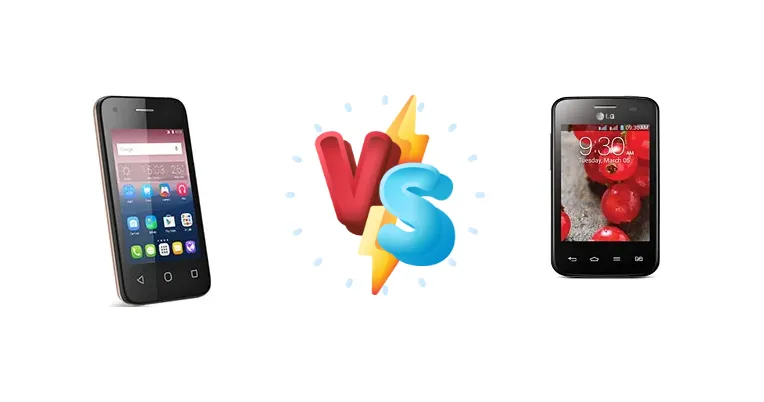
Released in the early 2010s, the Alcatel Pixi 4 (3.5) and LG Optimus L3 II Dual represent a generation of ultra-affordable Android smartphones. Both aimed to deliver basic smartphone functionality to a wider audience, but employed different chipsets and approaches. This comparison dissects their strengths and weaknesses to determine which offers the better experience, even by the standards of their time.
🏆 Quick Verdict
For the average user seeking a functional, albeit basic, smartphone experience, the Alcatel Pixi 4 (3.5) emerges as the slightly better choice. Its Mediatek MT6572M chipset, built on a 28nm process, offers a marginal performance advantage over the Qualcomm MSM7225A in the LG Optimus L3 II, despite both utilizing Cortex-A series CPUs.
| Network |
|---|
| 2G bands | GSM 850 / 900 / 1800 / 1900 | GSM 850 / 900 / 1800 / 1900 - SIM 1 & SIM 2 |
| 3G bands | HSDPA 900 / 2100 | HSDPA 850 / 900 / 1900 / 2100 |
| Speed | HSPA 21.1/5.76 Mbps | HSPA 7.2/5.76 Mbps |
| Technology | GSM / HSPA | GSM / HSPA |
| | HSDPA 850 / 900 / 2100 | - |
| Launch |
|---|
| Announced | 2016, January. Released 2016, Q3 | 2013, February. Released 2013, April |
| Status | Discontinued | Discontinued |
| Body |
|---|
| Dimensions | 116 x 62 x 10 mm (4.57 x 2.44 x 0.39 in) | 102.9 x 61.3 x 11.9 mm (4.05 x 2.41 x 0.47 in) |
| SIM | Micro-SIM | Dual SIM (Mini-SIM) |
| Weight | - | 110 g (3.88 oz) |
| Display |
|---|
| Resolution | 320 x 480 pixels, 3:2 ratio (~165 ppi density) | 240 x 320 pixels, 4:3 ratio (~125 ppi density) |
| Size | 3.5 inches, 36.5 cm2 (~50.7% screen-to-body ratio) | 3.2 inches, 31.7 cm2 (~50.3% screen-to-body ratio) |
| Type | TFT | IPS LCD |
| Platform |
|---|
| CPU | Dual-core 1.0 GHz Cortex-A7 | 1.0 GHz Cortex-A5 |
| Chipset | Mediatek MT6572M (28 nm) | Qualcomm MSM7225A Snapdragon S1 |
| GPU | Mali-400 | Adreno 200 |
| OS | Android 5.1 (Lollipop) | Android 4.1.2 (Jelly Bean) |
| Memory |
|---|
| Card slot | microSDHC (dedicated slot) | microSDHC (dedicated slot) |
| Internal | 4GB 512MB RAM | 4GB (1.6GB user available), 512MB RAM |
| Main Camera |
|---|
| Features | LED flash | - |
| Single | 2 MP | 3.15 MP |
| Video | 480p@15fps | 480p@30fps |
| Selfie camera |
|---|
| Single | VGA | - |
| | - | No |
| Sound |
|---|
| 3.5mm jack | Yes | Yes |
| 35mm jack | Yes | Yes |
| Loudspeaker | Yes | Yes |
| Comms |
|---|
| Bluetooth | 4.0, A2DP | 3.0, A2DP |
| NFC | No | No |
| Positioning | GPS (optional) | GPS, GLONASS |
| Radio | FM radio | FM radio |
| USB | microUSB 2.0 | microUSB 2.0 |
| WLAN | Wi-Fi 802.11 b/g/n, Wi-Fi Direct, hotspot | Wi-Fi 802.11 b/g/n, hotspot |
| Features |
|---|
| Sensors | Accelerometer | Accelerometer, proximity, compass |
| Battery |
|---|
| Stand-by | Up to 250 h (2G) / Up to 250 h (3G) | Up to 730 h (2G) / Up to 680 h (3G) |
| Talk time | Up to 4 h (3G) | Up to 16 h 30 min (2G) / Up to 11 h 30 min (3G) |
| Type | Li-Ion 1300 mAh, removable | Li-Po 1540 mAh, removable |
| Misc |
|---|
| Colors | Black, White | Indigo Black, Titanium silver, White |
| Price | - | About 90 EUR |
| SAR EU | - | 0.74 W/kg (head) 0.44 W/kg (body) |
alcatel Pixi 4 (3.5)
- Slightly better processor architecture (Cortex-A7)
- More efficient chipset fabrication (28nm)
- Potentially longer battery life
- Limited RAM (likely 512MB or 1GB)
- Basic camera capabilities
LG Optimus L3 II Dual E435
- Dual SIM functionality
- LG's user interface (preference-based)
- Qualcomm's reputation for modem performance
- Less powerful processor architecture (Cortex-A5)
- Less efficient chipset fabrication
- Potentially shorter battery life
Display Comparison
Neither device boasts a standout display. Both feature 3.5-inch displays, typical for the era. Detailed display specs like resolution and panel type are unavailable, but given the price point, both likely utilize TN panels with limited viewing angles and color accuracy. The focus here isn't on visual fidelity, but on basic readability. The smaller fabrication node of the MT6572M *could* translate to slightly better power efficiency in driving the display, but the difference would be minimal.
Camera Comparison
Camera performance on both devices is expected to be extremely limited. Details regarding sensor size and image quality are scarce, but both likely feature low-resolution cameras (likely around 3-5MP) with limited features. Image processing capabilities would have been rudimentary. The focus here isn't on photography, but on basic image capture for occasional use. Any comparison in this area is largely academic given the limitations of both sensors.
Performance
The core difference lies in the chipsets. The Alcatel Pixi 4 (3.5) utilizes the Mediatek MT6572M, a dual-core 1.0 GHz Cortex-A7 processor built on a 28nm process. The LG Optimus L3 II Dual features the Qualcomm MSM7225A Snapdragon S1, also a 1.0 GHz Cortex-A5 dual-core processor. While both are Cortex-A series CPUs, the Cortex-A7 architecture in the Mediatek chip generally offers a modest performance improvement over the Cortex-A5. Crucially, the 28nm fabrication process of the MT6572M is more efficient than the process used for the MSM7225A, potentially leading to better thermal management and slightly longer runtimes. Neither chipset is capable of handling demanding tasks; these phones are designed for basic communication and light app usage.
Battery Life
Battery capacity details are unavailable for both devices. However, the Mediatek MT6572M's 28nm process offers a potential advantage in power efficiency. This means the Alcatel Pixi 4 (3.5) *could* achieve slightly longer battery life on a single charge, even with a similar battery capacity to the LG Optimus L3 II Dual. Charging times would have been slow on both devices, likely several hours from a wall adapter.
Buying Guide
Buy the Alcatel Pixi 4 (3.5) if you prioritize slightly better performance for basic tasks like web browsing and social media, and potentially longer battery life due to the more efficient chipset fabrication. Buy the LG Optimus L3 II Dual if you specifically need dual SIM functionality and prefer the LG user interface, recognizing that performance will be comparatively limited.
Frequently Asked Questions
❓ Will either of these phones run modern apps like WhatsApp or Facebook?
While basic versions of WhatsApp and Facebook *might* function, performance will be extremely slow and unreliable. These phones lack the processing power and RAM to handle modern app demands effectively. Expect frequent crashes and lag.
❓ Is the dual SIM functionality of the LG Optimus L3 II Dual useful in 2024?
For users who specifically need to manage two separate phone numbers on a single device, the dual SIM functionality remains relevant. However, the limitations of the phone's performance and software support should be considered. Modern dual-SIM phones offer a far superior experience.
❓ Which phone is better for playing basic games like Snake or Tetris?
Both phones can handle extremely simple games like Snake or Tetris, but even these may experience occasional lag. The Alcatel Pixi 4 (3.5)'s slightly more powerful processor might provide a marginally smoother experience, but don't expect anything resembling modern gaming performance.