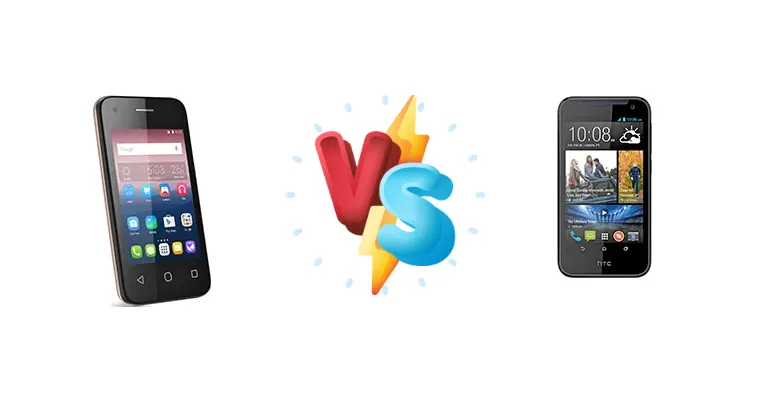
Both the alcatel Pixi 4 (3.5) and the HTC Desire 310 represent the extreme lower end of the smartphone market, often found as prepaid devices or deeply discounted options. This comparison focuses on how their core hardware – specifically the chipset – impacts real-world usability, and which device offers the best experience for the price-conscious consumer.
🏆 Quick Verdict
For the average user prioritizing responsiveness and multitasking, the HTC Desire 310 is the clear winner. Its quad-core Mediatek MT6582M processor provides a noticeable performance boost over the alcatel Pixi 4 (3.5)'s dual-core MT6572M, making it better suited for running multiple apps and handling slightly more demanding tasks.
| Network |
|---|
| 2G bands | GSM 850 / 900 / 1800 / 1900 | GSM 850 / 900 / 1800 / 1900 |
| 3G bands | HSDPA 900 / 2100 | HSDPA 900 / 2100 - EU, Asia, China |
| EDGE | - | No |
| GPRS | - | Yes |
| Speed | HSPA 21.1/5.76 Mbps | HSPA 21.1/5.76 Mbps |
| Technology | GSM / HSPA | GSM / HSPA |
| | HSDPA 850 / 900 / 2100 | - |
| Launch |
|---|
| Announced | 2016, January. Released 2016, Q3 | 2014, January. Released 2014, April |
| Status | Discontinued | Discontinued |
| Body |
|---|
| Dimensions | 116 x 62 x 10 mm (4.57 x 2.44 x 0.39 in) | 132.4 x 68 x 11.3 mm (5.21 x 2.68 x 0.44 in) |
| SIM | Micro-SIM | Mini-SIM |
| Weight | - | 140 g (4.94 oz) |
| Display |
|---|
| Resolution | 320 x 480 pixels, 3:2 ratio (~165 ppi density) | 480 x 854 pixels, 16:9 ratio (~218 ppi density) |
| Size | 3.5 inches, 36.5 cm2 (~50.7% screen-to-body ratio) | 4.5 inches, 55.8 cm2 (~62.0% screen-to-body ratio) |
| Type | TFT | TFT |
| Platform |
|---|
| CPU | Dual-core 1.0 GHz Cortex-A7 | Quad-core 1.3 GHz Cortex-A7 |
| Chipset | Mediatek MT6572M (28 nm) | Mediatek MT6582M (28 nm) |
| GPU | Mali-400 | Mali-400MP2 |
| OS | Android 5.1 (Lollipop) | Android 4.2.2 (Jelly Bean), Sense UI 5.1 |
| Memory |
|---|
| Call records | - | Yes |
| Card slot | microSDHC (dedicated slot) | microSDHC (dedicated slot) |
| Internal | 4GB 512MB RAM | 4GB 512MB, 4GB 1GB RAM |
| Phonebook | - | Yes |
| Main Camera |
|---|
| Features | LED flash | - |
| Single | 2 MP | 5 MP |
| Video | 480p@15fps | 1080p@30fps |
| Selfie camera |
|---|
| Single | VGA | VGA |
| Video | - | 480p |
| | - | No |
| Sound |
|---|
| 3.5mm jack | Yes | Yes |
| 35mm jack | Yes | Yes |
| Loudspeaker | Yes | Yes |
| Comms |
|---|
| Bluetooth | 4.0, A2DP | 4.0, A2DP, aptX |
| NFC | No | No |
| Positioning | GPS (optional) | GPS, GLONASS |
| Radio | FM radio | No |
| USB | microUSB 2.0 | microUSB 2.0 |
| WLAN | Wi-Fi 802.11 b/g/n, Wi-Fi Direct, hotspot | Wi-Fi 802.11 b/g/n, hotspot |
| Features |
|---|
| Games | - | Downloadable |
| Java | - | No |
| Messaging | - | SMS, IM |
| Sensors | Accelerometer | Accelerometer |
| | - | Audio/video player |
| Battery |
|---|
| Stand-by | Up to 250 h (2G) / Up to 250 h (3G) | Up to 852 h |
| Talk time | Up to 4 h (3G) | Up to 11 h |
| Type | Li-Ion 1300 mAh, removable | Li-Ion 2000 mAh, removable |
| Misc |
|---|
| Colors | Black, White | Black, White, Red |
| Models | - | D310n |
| Price | - | About 150 EUR |
alcatel Pixi 4 (3.5)
- Potentially higher pixel density due to smaller screen size.
- May be available at an even lower price point.
- Simpler user experience for those new to smartphones.
- Significantly slower performance due to dual-core processor.
- Likely struggles with multitasking.
- May exhibit noticeable lag during app switching.
HTC Desire 310
- Faster quad-core processor for improved responsiveness.
- Better multitasking capabilities.
- Smoother user experience overall.
- Potentially lower pixel density due to larger screen size.
- May be slightly more expensive.
- More demanding processor could slightly reduce battery life under heavy load.
Display Comparison
Neither device boasts a particularly impressive display. Both utilize 28nm chipsets, suggesting similar power constraints impacting display capabilities. While specific display specs (resolution, brightness) are unavailable, the 3.5-inch screen size of the Pixi 4 suggests a higher pixel density than the Desire 310's likely larger display. However, this is offset by the Pixi 4's age and potential for lower panel quality. The lack of information prevents a detailed comparison of color accuracy or viewing angles.
Camera Comparison
Given the target market, camera performance is unlikely to be a deciding factor. Both devices likely feature low-resolution sensors, and image quality will be limited. Without specific sensor details, it's difficult to make a meaningful comparison. It's safe to assume both cameras are adequate for basic snapshots in good lighting conditions, but struggle in low light. Focusing on megapixel counts would be misleading; image processing and sensor size are far more important, and data on these is unavailable.
Performance
The core difference lies in the processors. The HTC Desire 310’s Mediatek MT6582M, with its quad-core 1.3 GHz Cortex-A7 CPUs, offers a significant architectural advantage over the alcatel Pixi 4 (3.5)’s dual-core 1.0 GHz Cortex-A7 Mediatek MT6572M. While both are based on the Cortex-A7 architecture, the additional cores in the Desire 310 allow for better parallel processing, resulting in smoother app switching and a more responsive user interface. The 28nm fabrication process is shared, meaning thermal efficiency is comparable, but the Desire 310 will likely handle sustained loads slightly better due to its processing headroom. Users who frequently use multiple apps or browse the web will see a tangible benefit from the Desire 310’s superior processing power.
Battery Life
Battery capacity details are missing for both devices. However, given their similar chipsets (both 28nm) and screen sizes, battery life is likely comparable. The Desire 310’s more powerful processor *could* consume slightly more power under load, but the difference is unlikely to be significant in typical usage scenarios. Charging wattage is also unknown, making it impossible to compare 0-100% charging times. Both devices will likely require daily charging with moderate use.
Buying Guide
Buy the alcatel Pixi 4 (3.5) if you need an extremely basic smartphone for calls, texts, and very light app usage, and are on the absolute tightest budget. Buy the HTC Desire 310 if you prefer a smoother, more responsive experience, even with basic apps, and are willing to spend a little more for improved multitasking capabilities. The Desire 310 is the better choice for anyone who doesn't want to constantly fight with lag.
Frequently Asked Questions
❓ Will the HTC Desire 310 struggle with popular social media apps like Facebook and WhatsApp?
While not a powerhouse, the Desire 310’s quad-core processor should handle Facebook and WhatsApp without significant issues. These apps are relatively lightweight, and the extra cores provide headroom for smooth operation. However, running multiple social media apps simultaneously might cause some slowdown.
❓ Is the alcatel Pixi 4 (3.5) suitable for a first-time smartphone user?
The Pixi 4 (3.5) could be suitable for a very basic first-time user who primarily needs a device for calls and texts. However, its limited processing power may lead to frustration when attempting to use more demanding apps or browse the web. The Desire 310 offers a more forgiving experience for new smartphone users.
❓ Can either of these phones play modern mobile games?
Neither phone is well-suited for modern mobile gaming. The processors are too weak, and the lack of dedicated graphics hardware will result in poor performance and low frame rates. Simple, older games might be playable at low settings, but don't expect a good gaming experience.