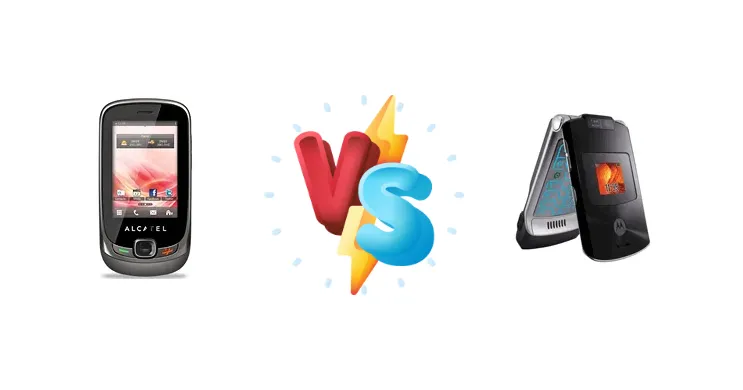
The early 2000s were defined by the rise of the feature phone, and two models stand out as particularly iconic: the Alcatel OT-602 and the Motorola RAZR V3xx. While both offered connectivity in a compact form factor, they approached the market with different philosophies. This comparison examines their core differences, acknowledging the limited available specifications for the RAZR V3xx and focusing on its market positioning.
🏆 Quick Verdict
For the user seeking a glimpse into early mobile processing, the Alcatel OT-602 offers a quantifiable 104 MHz CPU. However, the Motorola RAZR V3xx wins for its cultural impact and design, representing a shift towards fashion-forward mobile technology, even without detailed specs.
| Network |
|---|
| 2G bands | GSM 850 / 900 / 1800 / 1900 | GSM 900 / 1800 / 1900 |
| 3G bands | - | HSDPA 850 / 1900 |
| EDGE | No | - |
| GPRS | Class 12 | - |
| Speed | - | HSPA 3.6/0.384 Mbps |
| Technology | GSM | GSM / HSPA |
| Launch |
|---|
| Announced | 2011, July. Released 2011, July | 2006, July |
| Status | Discontinued | Discontinued |
| Body |
|---|
| Dimensions | 101.5 x 52.5 x 12.8 mm (4.00 x 2.07 x 0.50 in) | 103 x 53 x 15 mm, 80 cc (4.06 x 2.09 x 0.59 in) |
| SIM | Mini-SIM | Mini-SIM |
| Weight | - | 107 g (3.77 oz) |
| Display |
|---|
| Resolution | 240 x 320 pixels, 4:3 ratio (~167 ppi density) | 240 x 320 pixels, 4:3 ratio (~182 ppi density) |
| Size | 2.4 inches, 17.8 cm2 (~33.5% screen-to-body ratio) | 2.2 inches, 33 x 45 mm, 15.0 cm2 (~27.5% screen-to-body ratio) |
| Type | TFT resistive touchscreen, 256K colors | TFT, 256K colors |
| | - | Second external CSTN, 65K colors display (96 x 80 pixels)
Screensavers and wallpapers
Downloadable logos |
| Memory |
|---|
| Call records | Yes | 10 dialed, 10 received, 10 missed calls |
| Card slot | microSDHC (dedicated slot) | microSD (dedicated slot) |
| Internal | 3MB | 50MB |
| Phonebook | Yes, Photocall | 1000 entries, Photocall |
| Main Camera |
|---|
| Single | 2 MP | 1.3 MP |
| Video | Yes | Yes |
| Selfie camera |
|---|
| Single | - | VGA videocall camera |
| Sound |
|---|
| 3.5mm jack | - | No |
| 35mm jack | Yes | No |
| Alert types | - | Vibration; Downloadable polyphonic, MP3 ringtones |
| Loudspeaker | Yes | Yes |
| Comms |
|---|
| Bluetooth | 2.1, A2DP | 2.0, A2DP |
| Positioning | No | No |
| Radio | Stereo FM radio, RDS | No |
| USB | microUSB 2.0 | miniUSB |
| WLAN | No | No |
| Features |
|---|
| Browser | WAP 2.0/xHTML | WAP 2.0/xHTML, HTML (Opera) |
| Games | Yes | Yes |
| Java | Yes, MIDP 2.0 | Yes, MIDP 2.0 |
| Messaging | SMS, MMS, Email, IM | SMS, EMS, MMS, Email, Instant Messaging |
| | - | Video download
MP3/AAC/AAC+ player
Predictive text input
Organizer
Voice memo |
| Battery |
|---|
| Stand-by | Up to 560 h | Up to 290 h |
| Talk time | Up to 7 h | Up to 3 h |
| Type | Removable Li-Ion 850 mAh battery | Removable Li-Ion 940 mAh battery |
| Misc |
|---|
| Colors | Titanium gray, Fuchsia, Cyber blue, Orange, Aubergine, Black | Black |
| Price | About 50 EUR | About 160 EUR |
alcatel OT-602
- Known CPU speed (104 MHz)
- Represents early mobile processing advancements
- Potentially more capable of running Java apps
- Less iconic design than the RAZR V3xx
- Limited functionality compared to smartphones
Motorola RAZR V3xx
- Highly recognizable and influential design
- Represents a shift towards fashion-focused phones
- Strong brand recognition
- Lack of detailed specifications
- Limited functionality compared to smartphones
Display Comparison
Information regarding the display technology of either device is unavailable. However, both phones would have utilized small, low-resolution color LCD screens typical of the era. The RAZR V3xx’s focus was on minimizing the overall device size, likely resulting in a smaller screen relative to the Alcatel OT-602, though this is speculative. Both would have suffered from poor outdoor visibility compared to modern displays.
Camera Comparison
Neither the Alcatel OT-602 nor the Motorola RAZR V3xx were known for their camera capabilities. Any cameras included would have been extremely low resolution (likely VGA or below) and offered limited functionality. Image quality would have been poor by modern standards, and the primary purpose of these cameras was novelty rather than serious photography. The absence of detailed camera specs for the RAZR V3xx is typical for phones of this era.
Performance
The Alcatel OT-602 is equipped with a 104 MHz CPU, representing a significant step up in processing power for feature phones of its time. The Motorola RAZR V3xx’s processor specifications are unknown, but it likely operated within a similar performance range, prioritizing power efficiency and basic functionality over raw processing speed. The 104 MHz CPU in the Alcatel OT-602 would have allowed for slightly faster menu navigation and potentially more complex (for the time) Java applications.
Battery Life
Battery life for both devices would have been measured in days, rather than hours, due to the limited functionality and low-power components. The Alcatel OT-602’s 104 MHz processor would have consumed more power than a more efficient (but unknown) processor in the RAZR V3xx, potentially resulting in slightly shorter battery life. However, both phones were designed for standby operation, minimizing power consumption when not in use.
Buying Guide
Buy the Alcatel OT-602 if you're a collector interested in the technical specifications of early mobile processors and want a device with a known clock speed. Buy the Motorola RAZR V3xx if you prioritize design, brand recognition, and a piece of mobile history, understanding that detailed technical specifications are scarce and its value lies in its aesthetic and cultural significance.
Frequently Asked Questions
❓ What kind of applications could the Alcatel OT-602 run?
The 104 MHz processor in the Alcatel OT-602 allowed it to run basic Java applications, such as simple games and utilities. However, these applications were limited by the phone's small screen and limited memory.
❓ Was the Motorola RAZR V3xx durable?
The RAZR V3xx was known for its thin profile, but this came at the cost of durability. The plastic construction was prone to scratches and cracks, and the hinge was a common point of failure. Its iconic design prioritized aesthetics over robustness.
❓ Can either of these phones connect to the internet?
Both phones supported basic internet connectivity via WAP (Wireless Application Protocol), but the experience was extremely slow and limited compared to modern smartphones. Browsing was text-based and data charges were high.