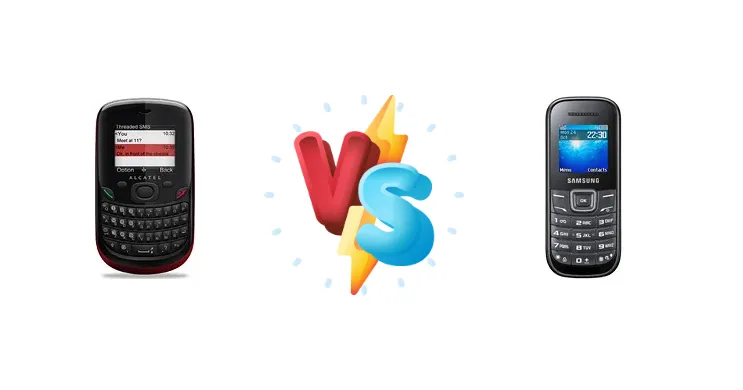
In a market saturated with smartphones, the Alcatel OT-355 and Samsung E1200 Pusha represent a return to simplicity. These feature phones cater to users prioritizing call functionality, long battery life, and affordability. However, a significant difference lies under the hood: the Samsung E1200 Pusha boasts a substantially faster processor, raising the question of whether this translates to a noticeably improved user experience.
🏆 Quick Verdict
For the average user seeking a reliable, no-frills phone, the Samsung E1200 Pusha is the better choice. Its 156 MHz CPU provides a smoother, more responsive experience for navigating menus and accessing basic features, despite both phones excelling in battery life and simplicity.
| Network |
|---|
| 2G bands | GSM 850 / 1900 | GSM 900 / 1800 |
| EDGE | No | No |
| GPRS | Class 10 | No |
| Technology | GSM | GSM |
| | GSM 900 / 1800 | - |
| Launch |
|---|
| Announced | 2011, February. Released 2011, March | 2012. Released 2012 |
| Status | Discontinued | Discontinued |
| Body |
|---|
| Dimensions | 103 x 58 x 12.1 mm (4.06 x 2.28 x 0.48 in) | 108 x 45 x 13.5 mm (4.25 x 1.77 x 0.53 in) |
| Keyboard | QWERTY | - |
| SIM | Mini-SIM | Mini-SIM |
| Weight | 80 g (2.82 oz) | 65.1 g (2.29 oz) |
| Display |
|---|
| Resolution | 160 x 128 pixels (~114 ppi density) | 128 x 128 pixels, 1:1 ratio (~119 ppi density) |
| Size | 1.8 inches, 10.2 cm2 (~17.1% screen-to-body ratio) | 1.52 inches, 7.5 cm2 (~15.3% screen-to-body ratio) |
| Type | TFT, 65K colors | TFT, 65K colors |
| Memory |
|---|
| Call records | Yes | Yes |
| Card slot | microSDHC (dedicated slot) | No |
| Internal | 0.7MB | - |
| Phonebook | Yes, Photocall | Yes |
| Main Camera |
|---|
| Single | VGA | - |
| Video | No | - |
| Sound |
|---|
| 3.5mm jack | Yes | No |
| 35mm jack | Yes | No |
| Loudspeaker | Yes | Yes |
| Comms |
|---|
| Bluetooth | No | No |
| Positioning | No | No |
| Radio | FM radio, RDS | No |
| USB | miniUSB (charging only) | Proprietary |
| WLAN | No | No |
| Features |
|---|
| Browser | WAP 2.0/xHTML | - |
| Games | Yes | No |
| Java | No | No |
| Messaging | SMS, MMS, Email | SMS |
| | MP3 player
Organizer
Voice memo
Predictive text input | - |
| Battery |
|---|
| Music play | Up to 17 h | - |
| Stand-by | Up to 450 h | Up to 720 h |
| Talk time | Up to 9 h | Up to 7 h |
| Type | Removable Li-Ion 650 mAh battery | Removable Li-Ion 800 mAh battery |
| Misc |
|---|
| Colors | Siver, Cherry red, Cyber blue | Black, White, Blue |
| Price | - | About 20 EUR |
| SAR EU | - | 0.81 W/kg (head) |
alcatel OT-355
- Extremely affordable
- Long battery life (typical of feature phones)
- Simple and easy to use
- Slow processor (52 MHz)
- Limited functionality
Samsung E1200 Pusha
- Faster processor (156 MHz) for smoother operation
- Long battery life
- Slightly more responsive user interface
- Still limited by feature phone OS
- May be slightly more expensive than the Alcatel OT-355
Display Comparison
Neither device specifies display resolution or panel technology, typical of this market segment. However, the user experience will be largely dictated by the processor's ability to render the interface smoothly. The absence of advanced display features like high refresh rates or HDR is expected, focusing instead on legibility and power efficiency.
Camera Comparison
Both devices are likely equipped with basic VGA cameras, primarily for capturing simple snapshots. Image quality will be limited by the low resolution and lack of advanced features like optical image stabilization or autofocus. The CPU speed will play a minor role in image processing time, but the sensor itself is the primary limiting factor. Expect similar results from both devices in terms of image quality.
Performance
The core difference lies in the CPU: the Alcatel OT-355 operates at 52 MHz, while the Samsung E1200 Pusha reaches 156 MHz. This nearly threefold increase in clock speed suggests a significantly faster processing capability for the Pusha. While both phones are limited by their feature phone operating systems, the faster CPU will result in quicker menu transitions, faster contact list scrolling, and a more responsive overall experience. The impact is particularly noticeable when accessing features like the calculator or calendar.
Battery Life
Neither device specifies battery capacity, but feature phones are renowned for exceptional battery life. The 156 MHz CPU in the Samsung E1200 Pusha *could* consume slightly more power, but the difference is likely negligible. Both phones should easily last several days on a single charge with moderate use, making them ideal for travel or emergency situations.
Buying Guide
Buy the Alcatel OT-355 if you need an extremely basic phone for essential calls and texts, and prioritize absolute minimal cost. It's ideal for emergency use or as a secondary device. Buy the Samsung E1200 Pusha if you prefer a slightly more refined experience, with faster menu navigation and a more responsive user interface, even within the constraints of a feature phone. It's a better daily driver for those who want a bit more than the bare minimum.
Frequently Asked Questions
❓ Will the faster processor in the Samsung E1200 Pusha allow me to run more apps?
No, both phones operate on feature phone operating systems with limited app support. The faster processor primarily improves the responsiveness of the existing features, such as menu navigation and contact list scrolling, rather than enabling the installation of additional applications.
❓ Is the difference in CPU speed noticeable in everyday use?
Yes, the 156 MHz CPU in the Samsung E1200 Pusha will provide a smoother and more responsive experience compared to the 52 MHz CPU in the Alcatel OT-355. This is most apparent when navigating menus, accessing contacts, and using basic features like the calculator.
❓ Which phone is better for someone who primarily needs a phone for making calls and sending texts?
Both phones are excellent choices for basic communication. However, the Samsung E1200 Pusha's faster processor offers a slightly more pleasant user experience, making it a better option if you plan to use the phone regularly for calls and texts.