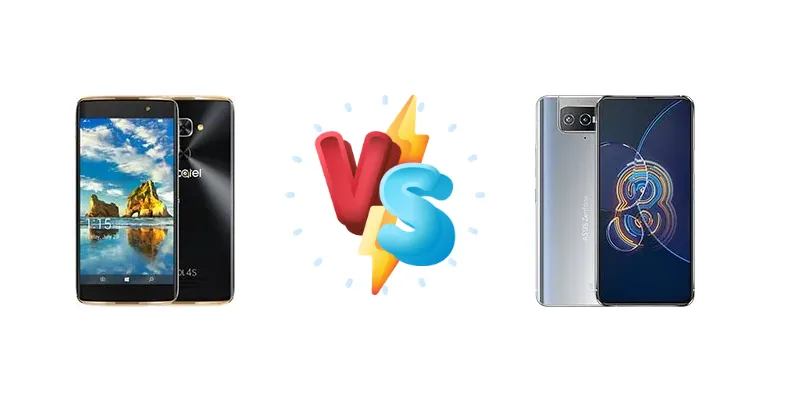
The smartphone landscape is constantly evolving, and choosing the right device can be overwhelming. Today, we're pitting two very different phones against each other: the Alcatel Idol 4s Windows, a legacy device with a unique operating system, and the Asus Zenfone 8 Flip, a modern flip phone with flagship specs. Let's dive into a comprehensive comparison to see which one comes out on top.
🏆 Quick Verdict
The Asus Zenfone 8 Flip is the clear winner. While the Idol 4s Windows boasts a powerful Snapdragon 820, its outdated Windows OS and limited software support can't compete with the Zenfone 8 Flip's modern Android experience, superior camera, faster charging, and overall performance.
| Network |
|---|
| 2G bands | GSM 850 / 900 / 1800 / 1900 | GSM 850 / 900 / 1800 / 1900 |
| 3G bands | HSDPA 850 / 1700(AWS) / 1900 / 2100 | HSDPA 800 / 850 / 900 / 1700(AWS) / 1900 / 2100 |
| 4G bands | 2, 4, 12 | 1, 2, 3, 4, 5, 7, 8, 12, 17, 18, 19, 20, 26, 28, 34, 38, 39, 40, 41, 42 |
| 5G bands | - | 1, 2, 3, 5, 7, 8, 12, 20, 28, 38, 77, 78, 77, 78 SA/NSA |
| Speed | HSPA 42.2/5.76 Mbps, LTE Cat4 150/50 Mbps | HSPA 42.2/5.76 Mbps, LTE (6CA) Cat20 2000/150 Mbps, 5G |
| Technology | GSM / HSPA / LTE | GSM / HSPA / LTE / 5G |
| Launch |
|---|
| Announced | 2016, Q3. Released 2016, Q3 | 2021, May 12 |
| Status | Discontinued | Available. Released 2021, May 13 |
| Body |
|---|
| Build | - | Glass front (Gorilla Glass 6), glass back (Gorilla Glass 3), aluminum frame |
| Dimensions | 153.9 x 75.4 x 7 mm (6.06 x 2.97 x 0.28 in) | 165 x 77.3 x 9.6 mm (6.50 x 3.04 x 0.38 in) |
| SIM | Nano-SIM | Nano-SIM + Nano-SIM |
| Weight | 152 g (5.36 oz) | 230 g (8.11 oz) |
| Display |
|---|
| Protection | Asahi Dragontrail Glass | Corning Gorilla Glass 6 |
| Resolution | 1080 x 1920 pixels, 16:9 ratio (~401 ppi density) | 1080 x 2400 pixels, 20:9 ratio (~395 ppi density) |
| Size | 5.5 inches, 83.4 cm2 (~71.9% screen-to-body ratio) | 6.67 inches, 107.4 cm2 (~84.2% screen-to-body ratio) |
| Type | AMOLED | Super AMOLED, 90Hz, HDR10+, 700 nits (HBM), 1000 nits (peak) |
| | - | Always-on display |
| Platform |
|---|
| CPU | Quad-core (2x2.15 GHz Kryo & 2x1.6 GHz Kryo) | Octa-core (1x2.84 GHz Cortex-X1 & 3x2.42 GHz Cortex-A78 & 4x1.80 GHz Cortex-A55) |
| Chipset | Qualcomm MSM8996 Snapdragon 820 (14 nm) | Qualcomm SM8350 Snapdragon 888 5G (5 nm) |
| GPU | Adreno 530 | Adreno 660 |
| OS | Microsoft Windows 10 | Android 11, upgradable to Android 13 |
| Memory |
|---|
| Card slot | microSDXC (dedicated slot) | microSDXC (dedicated slot) |
| Internal | 64GB 4GB RAM | 128GB 8GB RAM, 256GB 8GB RAM |
| | - | UFS 3.1 |
| Main Camera |
|---|
| Features | Dual-LED dual-tone flash, panorama, HDR | Dual-LED flash, HDR, auto panorama (motorized rotation) |
| Single | 21 MP, PDAF | - |
| Triple | - | 64 MP, f/1.8, 26mm (wide), 1/1.73", 0.8µm, PDAF
8 MP, f/2.4, 80mm (telephoto), PDAF, 3x optical zoom
12 MP, f/2.2, 112˚, 14mm (ultrawide), 1/2.55", 1.4µm, dual pixel PDAF |
| Video | 4K@30fps | 8K@30fps, 4K@30/60/120fps, 1080p@30/60/240fps, 720p@480fps; gyro-EIS, HDR |
| Selfie camera |
|---|
| Features | LED flash | Dual-LED flash, HDR, auto panorama (motorized rotation) |
| Single | 8 MP | - |
| Triple | - | Motorized flip-up main camera module |
| Video | 1080p@30fps | 8K@30fps, 4K@30/60/120fps, 1080p@30/60/240fps, 720p@480fps; gyro-EIS, HDR |
| Sound |
|---|
| 3.5mm jack | Yes | No |
| 35mm jack | Yes | No |
| Loudspeaker | Yes, with stereo speakers | Yes, with stereo speakers |
| | - | 24-bit/192kHz audio |
| Comms |
|---|
| Bluetooth | 4.1, A2DP, LE | 5.2, A2DP, LE, aptX HD, aptX Adaptive |
| NFC | No | Yes |
| Positioning | GPS | GPS (L1+L5), GLONASS (L1), BDS (B1I+B1c+B2a), GALILEO (E1+E5a), QZSS (L1+L5), NavIC (L5) |
| Radio | No | No |
| USB | USB Type-C | USB Type-C 2.0 |
| WLAN | Wi-Fi 802.11 a/b/g/n/ac, dual-band, Wi-Fi Direct, hotspot | Wi-Fi 802.11 a/b/g/n/ac/6e, dual-band, Wi-Fi Direct |
| Features |
|---|
| Sensors | Fingerprint (rear-mounted), accelerometer, gyro, proximity, compass | Fingerprint (under display, optical), accelerometer, gyro, proximity, compass |
| | Virtual Reality Goggles included | - |
| Battery |
|---|
| Charging | 10W wired | 30W wired, PD3.0 |
| Stand-by | Up to 420 h (3G) | - |
| Talk time | Up to 13 h 20 min (3G) | - |
| Type | Li-Ion 3000 mAh, non-removable | Li-Po 5000 mAh |
| Misc |
|---|
| Colors | Halo Gold | Galactic Black, Glacier Silver |
| Models | - | ZS672KS, I004D |
| Price | About 200 EUR | About 380 EUR |
| Tests |
|---|
| Battery life | - |
Endurance rating 98h
|
| Camera | - |
Photo / Video |
| Display | - |
Contrast ratio: Infinite (nominal) |
| Loudspeaker | - |
-26.8 LUFS (Good)
|
| Performance | - |
AnTuTu: 675851 (v8) | 797848(v9)
GeekBench: 3673 (v5.1)
GFXBench: 62fps (ES 3.1 onscreen) |
alcatel Idol 4s Windows
- Powerful Snapdragon 820 (for its time)
- Decent display
- Compact design
- Outdated Windows OS
- Limited software support
- Slow charging
- Older camera technology
Asus Zenfone 8 Flip
- Flagship Snapdragon 888 performance
- Excellent battery life
- Fast charging (30W PD3.0)
- Bright and vibrant display
- Unique flip phone design
- Flip phone form factor may not appeal to everyone
- Price may be higher
Display Comparison
The Asus Zenfone 8 Flip takes a commanding lead in the display department. Its 735 nits max brightness is significantly higher than the Idol 4s, offering better visibility in sunlight. The 'infinite' contrast ratio suggests excellent blacks and vibrant colors. The Idol 4s had a decent display for its time, but it simply can't match the Zenfone 8 Flip's modern panel.
Camera Comparison
The Asus Zenfone 8 Flip's camera system is a major advantage. While specific details are missing, the inclusion of 'Photo / Video' suggests a versatile setup. The Idol 4s' camera was adequate for its time, but it lacks the advanced features and image processing capabilities of the Zenfone 8 Flip.
Performance
The Zenfone 8 Flip's Snapdragon 888, built on a 5nm process, is a substantial upgrade over the Idol 4s' Snapdragon 820 (14nm). The Zenfone 8 Flip's octa-core CPU, with its Cortex-X1 prime core, delivers significantly faster processing speeds and smoother multitasking. While the Idol 4s was a powerhouse in its day, the Zenfone 8 Flip offers a modern, responsive experience.
Battery Life
Both phones boast impressive endurance ratings (98h), suggesting excellent battery life. However, the Zenfone 8 Flip's 30W wired charging and PD3.0 support offer significantly faster charging speeds compared to the Idol 4s' 10W charging.
Buying Guide
The Alcatel Idol 4s Windows is for those nostalgic for Windows Phone or needing a very specific legacy app. The Asus Zenfone 8 Flip is ideal for users seeking a compact, powerful Android phone with a unique form factor and excellent battery life, prioritizing performance and camera capabilities.
Frequently Asked Questions
❓ Is the Alcatel Idol 4s Windows still worth buying?
Only if you specifically need a Windows Phone or have legacy apps that won't run on Android. Otherwise, it's outdated and lacks modern features.
❓ What is the advantage of the Asus Zenfone 8 Flip's flip design?
The flip design makes the phone more compact when closed, offering a pocket-friendly form factor while still providing a large display when open.