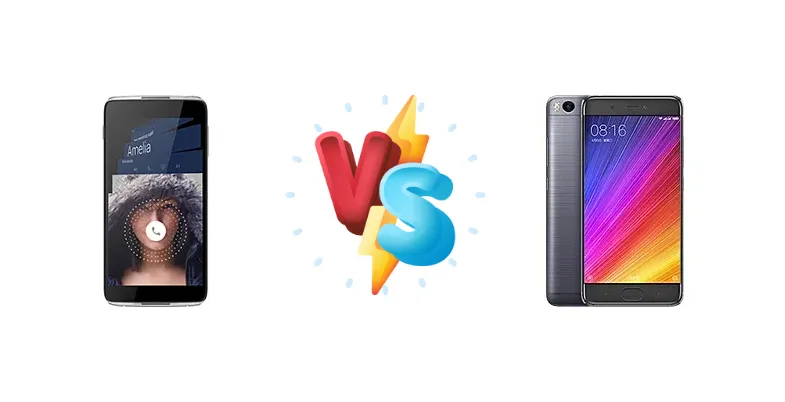
Released in 2016, the Alcatel Idol 4 and Xiaomi Mi 5s represent different approaches to the mid-range smartphone market. The Idol 4 aimed for broad appeal with a focus on audio, while the Mi 5s targeted a more performance-conscious user with a flagship-tier Snapdragon processor. This comparison dissects their key differences to determine which device holds up better today.
🏆 Quick Verdict
For the average user seeking a responsive experience, the Xiaomi Mi 5s is the clear winner. Its Snapdragon 821 chipset, built on a 14nm process, delivers significantly superior performance compared to the Alcatel Idol 4’s Snapdragon 617. While both offer 18W Quick Charge, the Mi 5s benefits from QC3, and its overall hardware package provides a more future-proof experience.
| Network |
|---|
| 2G bands | GSM 850 / 900 / 1800 / 1900 - SIM 1 & SIM 2 (optional) | GSM 850 / 900 / 1800 / 1900 - SIM 1 & SIM 2 |
| 3G bands | HSDPA 850 / 900 / 1900 / 2100 - 6055Y, 6055K, 6055B, 6055I | HSDPA 850 / 900 / 1900 / 2100 |
| 4G bands | 1, 3, 7, 8, 20, 28 - 6055K | 1, 3, 5, 7, 8, 38, 39, 40, 41 |
| Speed | HSPA 42.2/5.76 Mbps, LTE Cat4 150/50 Mbps or LTE (2CA) Cat6 300/50 Mbps | HSPA 42.2/5.76 Mbps, LTE (4CA) Cat12 600/150 Mbps |
| Technology | GSM / HSPA / LTE | GSM / CDMA / HSPA / EVDO / LTE |
| | 2, 3, 4, 7, 13, 17, 28 - 6055B, 6055I | CDMA2000 1xEV-DO |
| Launch |
|---|
| Announced | 2016, February. Released 2016, June | 2016, September. Released 2016, October |
| Status | Discontinued | Discontinued |
| Body |
|---|
| Build | - | Glass front, aluminum back, aluminum frame |
| Dimensions | 147 x 72.5 x 7.1 mm (5.79 x 2.85 x 0.28 in) | 145.6 x 70.3 x 8.3 mm (5.73 x 2.77 x 0.33 in) |
| SIM | Nano-SIM + Nano-SIM (6055K, 6055I) | Nano-SIM + Nano-SIM |
| Weight | 135 g (4.76 oz) | 145 g (5.11 oz) |
| Display |
|---|
| Protection | - | To be confirmed |
| Resolution | 1080 x 1920 pixels, 16:9 ratio (~424 ppi density) | 1080 x 1920 pixels, 16:9 ratio (~428 ppi density) |
| Size | 5.2 inches, 74.5 cm2 (~69.9% screen-to-body ratio) | 5.15 inches, 73.1 cm2 (~71.4% screen-to-body ratio) |
| Type | IPS LCD | IPS LCD |
| | - | 3D Touch display (128 GB, 4 GB RAM model) |
| Platform |
|---|
| CPU | Octa-core (4x1.7 GHz Cortex-A53 & 4x1.2 GHz Cortex-A53) | Quad-core (2x2.15 GHz Kryo & 2x1.6 GHz Kryo) |
| Chipset | Qualcomm MSM8952 Snapdragon 617 (28 nm) | Qualcomm MSM8996 Snapdragon 821 (14 nm) |
| GPU | Adreno 405 | Adreno 530 |
| OS | Android 6.0.1 (Marshmallow) | Android 6.0 (Marshmallow), upgradable to 7.0 (Nougat), MIUI 10 |
| Memory |
|---|
| Card slot | microSDXC (uses shared SIM slot) | No |
| Internal | 16GB 2GB RAM (6055Y,6055K), 16GB 3GB RAM (6055B,6055H,6055I) | 64GB 3GB RAM, 128GB 4GB RAM |
| | eMMC 5.1 | - |
| Main Camera |
|---|
| Features | Dual-LED dual-tone flash, panorama, HDR | Dual-LED dual-tone flash, panorama |
| Single | 13 MP, f/2.0, PDAF | 12 MP, f/2.0, 1/2.3", 1.55µm, PDAF |
| Triple | - | 16 MP, f/1.8, (wide), PDAF
8 MP, f/2.2, 13mm (ultrawide)
2 MP, f/2.4, (macro) |
| Video | 1080p@30fps | 4K@30fps, 1080p@120fps |
| Selfie camera |
|---|
| Features | LED flash | HDR |
| Single | 8 MP | 4 MP, f/2.0, 1/3", 2µm |
| Video | 1080p@30fps | 1080p@30fps |
| Sound |
|---|
| 3.5mm jack | Yes | Yes |
| 35mm jack | Yes | Yes |
| Loudspeaker | Yes, with stereo speakers | Yes |
| | Hi-Fi audio
| - |
| Comms |
|---|
| Bluetooth | 4.2, A2DP, LE | 4.2, A2DP, LE |
| NFC | Yes | Yes |
| Positioning | GPS | GPS, GLONASS, BDS |
| Radio | FM radio, RDS | No |
| USB | microUSB 2.0, OTG | USB Type-C |
| WLAN | Wi-Fi 802.11 a/b/g/n/ac, dual-band, Wi-Fi Direct | Wi-Fi 802.11 a/b/g/n/ac, dual-band, Wi-Fi Direct, DLNA |
| Features |
|---|
| Sensors | Accelerometer, gyro, proximity, compass | Fingerprint (front-mounted), accelerometer, gyro, proximity, compass, barometer |
| Battery |
|---|
| Charging | 18W wired, QC2 | 18W wired, QC3 |
| Stand-by | Up to 520 h (2G) / Up to 520 h (3G) | - |
| Talk time | Up to 15 h (2G) / Up to 15 h (3G) | - |
| Type | Li-Ion 2610 mAh, non-removable | Li-Ion 3200 mAh, non-removable |
| Misc |
|---|
| Colors | Gold, Dark Gray, Rose Gold, Metal Silver | Silver, Gray, Gold, Rose Gold |
| Models | 6055K, 6055P, 6055B, 6055U, 6055I, 6055H, 6055Y | 2015711 |
| Price | About 200 EUR | About 250 EUR |
| SAR | - | 0.77 W/kg (head) 1.01 W/kg (body) |
| Tests |
|---|
| Audio quality | - |
Noise -89.6dB / Crosstalk -85.5dB |
| Battery life | - |
Endurance rating 84h
|
| Camera | - |
Photo / Video |
| Display | - |
Contrast ratio: 1294:1 (nominal), 3.276 (sunlight) |
| Loudspeaker | - |
Voice 64dB / Noise 70dB / Ring 84dB
|
| Performance | - |
Basemark OS II 2.0: 2378Basemark X: 36240 |
alcatel Idol 4
- Potentially lower price point (at time of release)
- Decent battery endurance (84h rating)
- QC2 fast charging support
- Significantly weaker Snapdragon 617 processor
- Less efficient 28nm manufacturing process
- Likely inferior camera performance
Xiaomi Mi 5s
- Powerful Snapdragon 821 processor (14nm)
- QC3 fast charging for faster and more efficient charging
- Likely superior camera performance
- Potentially higher price point (at time of release)
- May experience more heat under sustained load (though 821 is efficient)
- Battery life is comparable despite more powerful processor
Display Comparison
Both devices share a similar display contrast ratio of 1294:1 (nominal) and 3.276 (sunlight), suggesting comparable outdoor visibility. However, detailed display specs like resolution and panel type are missing for the Idol 4. The Mi 5s, being positioned as a higher-end device, likely benefits from better color accuracy and potentially higher peak brightness, though this isn't explicitly stated. The shared contrast ratio indicates both displays are capable of producing deep blacks, enhancing the viewing experience.
Camera Comparison
Both phones feature photo and video capabilities, but specifics are limited. The Mi 5s, given its flagship positioning, likely incorporates a more advanced camera sensor and image processing pipeline. Sensor size and aperture are crucial factors not provided, but the Mi 5s likely has a larger sensor, allowing for better low-light performance. The Idol 4’s camera is likely adequate for casual snapshots, but will fall short in challenging conditions compared to the Mi 5s.
Performance
The core difference lies in the chipsets. The Xiaomi Mi 5s boasts the Qualcomm MSM8996 Snapdragon 821, a 14nm processor with a quad-core Kryo architecture (2x2.15 GHz & 2x1.6 GHz). This is a substantial upgrade over the Alcatel Idol 4’s Qualcomm MSM8952 Snapdragon 617 (28nm), which utilizes an octa-core configuration (4x1.7 GHz Cortex-A53 & 4x1.2 GHz Cortex-A53). The 821’s smaller manufacturing process and more efficient Kryo cores translate to significantly higher performance and better thermal management. The Idol 4’s Cortex-A53 cores, while power-efficient, are less capable than the Kryo cores in demanding applications. This difference is particularly noticeable in gaming and multitasking.
Battery Life
Both devices share an endurance rating of 84 hours, suggesting similar real-world battery life despite the Mi 5s’ more powerful processor. This is likely due to the Snapdragon 821’s improved power efficiency. Both support 18W wired charging, but the Mi 5s utilizes Quick Charge 3 (QC3) while the Idol 4 uses Quick Charge 2 (QC2). QC3 is faster and more efficient, meaning the Mi 5s will likely achieve a full charge slightly quicker and with less heat generation.
Buying Guide
Buy the Alcatel Idol 4 if you prioritize a lower initial cost and are primarily focused on basic smartphone tasks like calling, texting, and light social media use. Buy the Xiaomi Mi 5s if you value performance for gaming, multitasking, and camera capabilities, and are willing to spend a bit more for a smoother, more responsive user experience. The Mi 5s is the better choice for users who want a phone that will remain usable for longer.
Frequently Asked Questions
❓ Is the Snapdragon 617 in the Alcatel Idol 4 sufficient for modern app usage?
While the Snapdragon 617 can handle basic tasks, it will struggle with demanding applications and multitasking. Modern apps are increasingly resource-intensive, and the 617’s older architecture and lower processing power will result in noticeable lag and slowdowns. It's best suited for light users.
❓ Does the Xiaomi Mi 5s experience significant thermal throttling during extended gaming sessions?
The Snapdragon 821 is relatively efficient, and the Mi 5s incorporates thermal management solutions. While some throttling may occur during prolonged, intensive gaming, it's less likely to be severe compared to earlier Snapdragon 810 devices. The 14nm process helps mitigate heat buildup.
❓ How does Quick Charge 3 (QC3) on the Mi 5s compare to Quick Charge 2 (QC2) on the Idol 4 in terms of charging speed?
QC3 is significantly faster and more efficient than QC2. It supports a wider voltage range, allowing for more granular power delivery and faster charging times. While both phones support 18W charging, the Mi 5s will likely reach a full charge quicker and with less heat generation due to QC3’s improved technology.