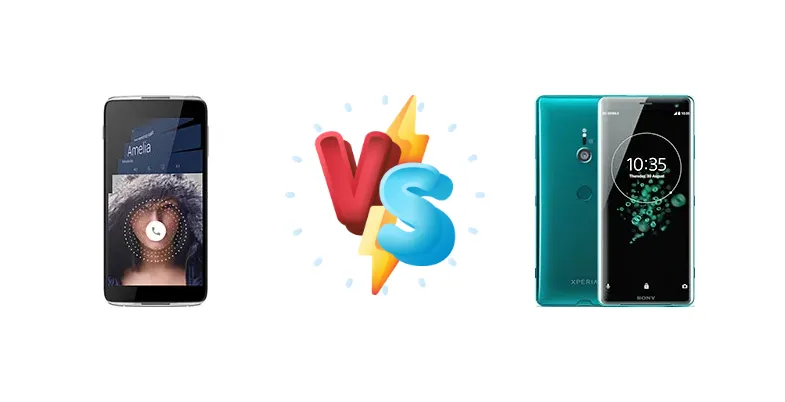
The Alcatel Idol 4 and Sony Xperia XZ3 represent vastly different eras of smartphone technology. The Idol 4, released with a Snapdragon 617, aimed for affordability, while the XZ3, powered by the Snapdragon 845, was a premium flagship. This comparison dissects their core differences, revealing where each phone excels and who benefits most from its strengths.
🏆 Quick Verdict
For the average user prioritizing responsiveness and future-proofing, the Sony Xperia XZ3 is the clear winner. Its Snapdragon 845 offers significantly superior performance, and the inclusion of wireless charging adds convenience. However, the Idol 4 remains a viable option for basic tasks and users on a tight budget.
| Network |
|---|
| 2G bands | GSM 850 / 900 / 1800 / 1900 - SIM 1 & SIM 2 (optional) | GSM 850 / 900 / 1800 / 1900 |
| 3G bands | HSDPA 850 / 900 / 1900 / 2100 - 6055Y, 6055K, 6055B, 6055I | HSDPA 800 / 850 / 900 / 1700(AWS) / 1900 / 2100 - H8416, H9436, H9493 |
| 4G bands | 1, 3, 7, 8, 20, 28 - 6055K | 1, 2, 3, 4, 5, 7, 8, 12, 13, 17, 19, 20, 26, 28, 29, 32, 38, 39, 40, 41, 46, 66 - H8416, H9436, H9493 |
| Speed | HSPA 42.2/5.76 Mbps, LTE Cat4 150/50 Mbps or LTE (2CA) Cat6 300/50 Mbps | HSPA 42.2/5.76 Mbps, LTE (5CA) Cat18 1200/200 Mbps |
| Technology | GSM / HSPA / LTE | GSM / HSPA / LTE |
| | 2, 3, 4, 7, 13, 17, 28 - 6055B, 6055I | - |
| Launch |
|---|
| Announced | 2016, February. Released 2016, June | 2018, August 30. Released 2018, October 05 |
| Status | Discontinued | Discontinued |
| Body |
|---|
| Build | - | Glass front (Gorilla Glass 5), glass back (Gorilla Glass 5), aluminum frame |
| Dimensions | 147 x 72.5 x 7.1 mm (5.79 x 2.85 x 0.28 in) | 158 x 73 x 9.9 mm (6.22 x 2.87 x 0.39 in) |
| SIM | Nano-SIM + Nano-SIM (6055K, 6055I) | · Nano-SIM· Nano-SIM + Nano-SIM |
| Weight | 135 g (4.76 oz) | 193 g (6.81 oz) |
| | - | IP65/IP68 dust/water resistant (up to 1.5m for 30 mins) |
| Display |
|---|
| Protection | - | Corning Gorilla Glass 5 |
| Resolution | 1080 x 1920 pixels, 16:9 ratio (~424 ppi density) | 1440 x 2880 pixels, 18:9 ratio (~537 ppi density) |
| Size | 5.2 inches, 74.5 cm2 (~69.9% screen-to-body ratio) | 6.0 inches, 92.9 cm2 (~80.5% screen-to-body ratio) |
| Type | IPS LCD | P-OLED, HDR BT.2020 |
| | - | Triluminos display
X-Reality Engine |
| Platform |
|---|
| CPU | Octa-core (4x1.7 GHz Cortex-A53 & 4x1.2 GHz Cortex-A53) | Octa-core (4x2.7 GHz Kryo 385 Gold & 4x1.7 GHz Kryo 385 Silver) |
| Chipset | Qualcomm MSM8952 Snapdragon 617 (28 nm) | Qualcomm SDM845 Snapdragon 845 (10 nm) |
| GPU | Adreno 405 | Adreno 630 |
| OS | Android 6.0.1 (Marshmallow) | Android 9.0 (Pie), upgradable to Android 10 |
| Memory |
|---|
| Card slot | microSDXC (uses shared SIM slot) | microSDXC (uses shared SIM slot) - dual SIM model only |
| Internal | 16GB 2GB RAM (6055Y,6055K), 16GB 3GB RAM (6055B,6055H,6055I) | 64GB 4GB RAM, 64GB 6GB RAM |
| | eMMC 5.1 | UFS 2.1 |
| Main Camera |
|---|
| Features | Dual-LED dual-tone flash, panorama, HDR | Laser AF, color spectrum sensor, LED flash, panorama, HDR |
| Single | 13 MP, f/2.0, PDAF | 19 MP, f/2.0, 25mm (wide), 1/2.3", 1.22µm, predictive PDAF |
| Video | 1080p@30fps | 4K@30fps, 1080p@60fps, 1080p@30fps (5-axis gyro-EIS), 1080p@960fps, HDR |
| Selfie camera |
|---|
| Features | LED flash | HDR |
| Single | 8 MP | 13 MP, f/1.9, 23mm (wide), 1/3.1", 1.12µm |
| Video | 1080p@30fps | 1080p@30fps (5-axis gyro-EIS) |
| Sound |
|---|
| 3.5mm jack | Yes | No |
| 35mm jack | Yes | No |
| Loudspeaker | Yes, with stereo speakers | Yes, with stereo speakers |
| | Hi-Fi audio
| 24-bit/192kHz audio
Dynamic vibration system
|
| Comms |
|---|
| Bluetooth | 4.2, A2DP, LE | 5.0, A2DP, aptX HD, LE |
| NFC | Yes | Yes |
| Positioning | GPS | GPS, GLONASS, BDS, GALILEO |
| Radio | FM radio, RDS | No |
| USB | microUSB 2.0, OTG | USB Type-C 3.1, OTG |
| WLAN | Wi-Fi 802.11 a/b/g/n/ac, dual-band, Wi-Fi Direct | Wi-Fi 802.11 a/b/g/n/ac, dual-band, Wi-Fi Direct, DLNA |
| Features |
|---|
| Sensors | Accelerometer, gyro, proximity, compass | Fingerprint (rear-mounted), accelerometer, gyro, proximity, barometer, compass |
| Battery |
|---|
| Charging | 18W wired, QC2 | 18W wired, PD2.0
Wireless (Qi) |
| Stand-by | Up to 520 h (2G) / Up to 520 h (3G) | - |
| Talk time | Up to 15 h (2G) / Up to 15 h (3G) | - |
| Type | Li-Ion 2610 mAh, non-removable | Li-Ion 3300 mAh, non-removable |
| Misc |
|---|
| Colors | Gold, Dark Gray, Rose Gold, Metal Silver | Black, Silver White, Forest Green, Bordeaux Red |
| Models | 6055K, 6055P, 6055B, 6055U, 6055I, 6055H, 6055Y | H9436, H8416, H9493 |
| Price | About 200 EUR | About 510 EUR |
| Tests |
|---|
| Audio quality | - |
Noise -91.2dB / Crosstalk -88.7dB |
| Battery life | - | Endurance rating 90h |
| Camera | - |
Photo / Video |
| Display | - |
Contrast ratio: Infinite (nominal), 4.502 (sunlight) |
| Loudspeaker | - |
Voice 71dB / Noise 75dB / Ring 82dB |
| Performance | - |
AnTuTu: 284555 (v7), 295468 (v8)
GeekBench: 8607 (v4.4), 2137 (v5.1)
GFXBench: 19fps (ES 3.1 onscreen) |
alcatel Idol 4
- Significantly lower price point
- Functional for basic smartphone tasks
- QC2 fast charging support
- Outdated Snapdragon 617 processor
- Limited performance for demanding apps
- Lack of advanced features like wireless charging
Sony Xperia XZ3
- Powerful Snapdragon 845 processor
- Wireless charging (Qi)
- Superior camera capabilities (likely)
- Higher price point
- May be difficult to find new
- Battery life, while good, isn't exceptional compared to newer phones
Display Comparison
Both devices share an 'Infinite' contrast ratio (nominal) and a 4.502 sunlight contrast ratio, suggesting similar outdoor visibility. However, the Idol 4’s display specifications are not detailed enough to assess its color accuracy or resolution. The XZ3, being a flagship, likely boasts a higher resolution and more accurate color reproduction. The lack of detailed display specs for the Idol 4 indicates a cost-cutting measure, prioritizing function over visual fidelity.
Camera Comparison
Both phones feature photo and video capabilities, but the specifics are limited. The XZ3, as a flagship, likely incorporates a more advanced image sensor and image processing pipeline. While the Idol 4 may suffice for casual snapshots, the XZ3 is expected to deliver superior image quality, particularly in low-light conditions. Without sensor size or aperture details for either device, a precise comparison is impossible, but the XZ3’s flagship status strongly suggests a more capable camera system.
Performance
The performance gap between the Snapdragon 617 and Snapdragon 845 is substantial. The 845, built on a 10nm process, features octa-core Kryo 385 Gold (2.7 GHz) and Silver (1.7 GHz) cores, delivering significantly faster processing speeds than the Idol 4’s 28nm Snapdragon 617 with its Cortex-A53 cores (1.7 GHz & 1.2 GHz). This translates to smoother app launches, faster multitasking, and a far superior gaming experience on the XZ3. The 10nm process also contributes to better thermal efficiency, reducing throttling during sustained workloads. The Idol 4 will struggle with demanding applications and may exhibit noticeable lag.
Battery Life
Both devices share an endurance rating of 90 hours, suggesting comparable battery life despite the XZ3’s more powerful processor. This is likely due to the XZ3’s more efficient Snapdragon 845 and optimized software. The XZ3 also offers 18W wired charging with PD2.0 and Qi wireless charging, providing greater convenience than the Idol 4’s 18W QC2 wired charging only. The XZ3’s wireless charging capability is a significant advantage for users who prefer cable-free charging.
Buying Guide
Buy the Alcatel Idol 4 if you need a functional smartphone for essential tasks like calling, texting, and light social media use, and your budget is extremely limited. Buy the Sony Xperia XZ3 if you prioritize smooth multitasking, demanding games, a more refined camera experience, and features like wireless charging, even if it means spending more.
Frequently Asked Questions
❓ Is the Snapdragon 617 in the Alcatel Idol 4 sufficient for playing modern mobile games?
The Snapdragon 617 will struggle with most modern, graphically demanding games. While simpler titles may be playable at lower settings, expect significant frame rate drops and lag in more intensive games. The XZ3’s Snapdragon 845 is far better equipped for gaming.
❓ Does the Sony Xperia XZ3 still receive software updates?
As a phone released in 2018, the Xperia XZ3 is unlikely to receive major Android version updates. However, it may still receive occasional security patches. Check Sony’s official support website for the latest update information.
❓ What type of charging does the Idol 4 support, and how long does it take to fully charge?
The Alcatel Idol 4 supports 18W Quick Charge 2.0 (QC2) wired charging. A full charge from 0-100% will likely take around 1.5 to 2 hours, depending on the charger and battery condition.
❓ Is the battery on the Xperia XZ3 still good, considering its age?
While the Xperia XZ3’s battery had an endurance rating of 90 hours when new, battery health degrades over time. Expect slightly reduced battery life compared to its original performance, but it should still provide a full day of moderate use.