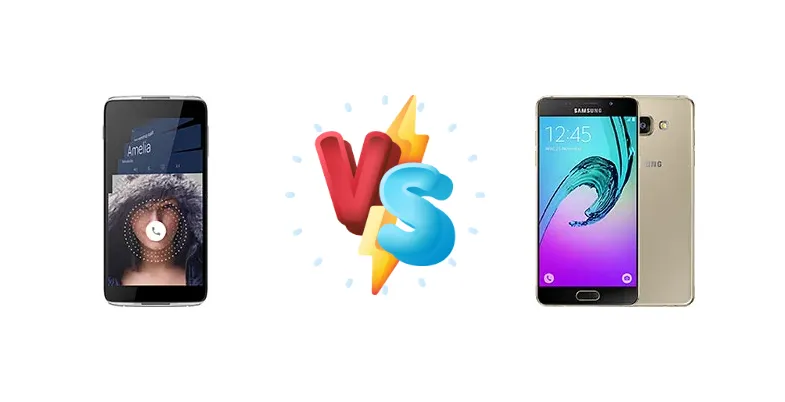
Released in 2016, the Alcatel Idol 4 and Samsung Galaxy A5 represent competing visions of the mid-range smartphone. Both aimed to deliver a premium experience without the flagship price tag, but they took different approaches to achieve this. The Idol 4 prioritized a more aggressive price point coupled with Qualcomm’s Snapdragon 617, while the Galaxy A5 focused on Samsung’s Exynos 7580 and a refined design. This comparison dissects their key differences to determine which device offered the better value.
🏆 Quick Verdict
For the average user prioritizing consistent performance and a more polished software experience, the Samsung Galaxy A5 (2016) is the better choice. While both phones share 18W charging and similar battery endurance ratings, the Exynos 7580 generally offers a smoother experience than the Snapdragon 617, particularly in graphically demanding tasks.
| Network |
|---|
| 2G bands | GSM 850 / 900 / 1800 / 1900 - SIM 1 & SIM 2 (optional) | GSM 850 / 900 / 1800 / 1900 - SIM 1 & SIM 2 (dual-SIM model only) |
| 3G bands | HSDPA 850 / 900 / 1900 / 2100 - 6055Y, 6055K, 6055B, 6055I | HSDPA 850 / 900 / 1900 / 2100 |
| 4G bands | 1, 3, 7, 8, 20, 28 - 6055K | 1, 3, 5, 7, 8, 20, 40 |
| Speed | HSPA 42.2/5.76 Mbps, LTE Cat4 150/50 Mbps or LTE (2CA) Cat6 300/50 Mbps | HSPA 42.2/5.76 Mbps, LTE Cat6 300/50 Mbps |
| Technology | GSM / HSPA / LTE | GSM / UMTS / HSPA / LTE |
| | 2, 3, 4, 7, 13, 17, 28 - 6055B, 6055I | UMTS 2100 |
| Launch |
|---|
| Announced | 2016, February. Released 2016, June | 2015, December. Released 2015, December |
| Status | Discontinued | Discontinued |
| Body |
|---|
| Build | - | Glass front (Gorilla Glass 4), glass back (Gorilla Glass 4), aluminum frame |
| Dimensions | 147 x 72.5 x 7.1 mm (5.79 x 2.85 x 0.28 in) | 144.8 x 71 x 7.3 mm (5.70 x 2.80 x 0.29 in) |
| SIM | Nano-SIM + Nano-SIM (6055K, 6055I) | · Nano-SIM· Nano-SIM + Nano-SIM |
| Weight | 135 g (4.76 oz) | 155 g (5.47 oz) |
| Display |
|---|
| Protection | - | Corning Gorilla Glass 4 |
| Resolution | 1080 x 1920 pixels, 16:9 ratio (~424 ppi density) | 1080 x 1920 pixels, 16:9 ratio (~424 ppi density) |
| Size | 5.2 inches, 74.5 cm2 (~69.9% screen-to-body ratio) | 5.2 inches, 74.5 cm2 (~72.5% screen-to-body ratio) |
| Type | IPS LCD | Super AMOLED |
| Platform |
|---|
| CPU | Octa-core (4x1.7 GHz Cortex-A53 & 4x1.2 GHz Cortex-A53) | Octa-core 1.6 GHz Cortex-A53Octa-core (4x1.2 GHz Cortex-A53 & 4x1.5 GHz Cortex-A53) - China only |
| Chipset | Qualcomm MSM8952 Snapdragon 617 (28 nm) | Exynos 7580 Octa (28 nm)Qualcomm MSM8939 Snapdragon 615 (28 nm) - China only |
| GPU | Adreno 405 | Mali-T720MP2Adreno 405 - China only |
| OS | Android 6.0.1 (Marshmallow) | Android 5.1.1 (Lollipop), upgradable to 7.0 (Nougat) |
| Memory |
|---|
| Card slot | microSDXC (uses shared SIM slot) | microSDXC (uses shared SIM slot) - dual SIM model only |
| Internal | 16GB 2GB RAM (6055Y,6055K), 16GB 3GB RAM (6055B,6055H,6055I) | 16GB 2GB RAM |
| | eMMC 5.1 | eMMC 5.0 or eMMC 4.5 |
| Main Camera |
|---|
| Features | Dual-LED dual-tone flash, panorama, HDR | LED flash, panorama, HDR |
| Quad | - | 48 MP, (wide), 1/2.0", 0.8µm, PDAF
2 MP, (macro)
2 MP, (depth)
2 MP |
| Single | 13 MP, f/2.0, PDAF | 13 MP, f/1.9, 28mm (wide), AF, OIS |
| Video | 1080p@30fps | 1080p@30fps |
| Selfie camera |
|---|
| Features | LED flash | Dual-LED flash |
| Single | 8 MP | 5 MP, f/1.9, 24mm (wide) |
| Video | 1080p@30fps | 1080p@30fps |
| Sound |
|---|
| 3.5mm jack | Yes | Yes |
| 35mm jack | Yes | Yes |
| Loudspeaker | Yes, with stereo speakers | Yes |
| | Hi-Fi audio
| - |
| Comms |
|---|
| Bluetooth | 4.2, A2DP, LE | 4.1, A2DP, EDR, LE |
| NFC | Yes | Yes |
| Positioning | GPS | GPS, GLONASS |
| Radio | FM radio, RDS | FM radio |
| USB | microUSB 2.0, OTG | microUSB 2.0, OTG |
| WLAN | Wi-Fi 802.11 a/b/g/n/ac, dual-band, Wi-Fi Direct | Wi-Fi 802.11 a/b/g/n, dual-band, Wi-Fi Direct, hotspot |
| Features |
|---|
| Sensors | Accelerometer, gyro, proximity, compass | Fingerprint (front-mounted), accelerometer, proximity, compass |
| | - | ANT+
Samsung Pay |
| Battery |
|---|
| Charging | 18W wired, QC2 | 18W wired |
| Music play | - | Up to 75 h |
| Stand-by | Up to 520 h (2G) / Up to 520 h (3G) | - |
| Talk time | Up to 15 h (2G) / Up to 15 h (3G) | Up to 16 h (3G) |
| Type | Li-Ion 2610 mAh, non-removable | Li-Ion 2900 mAh, non-removable |
| Misc |
|---|
| Colors | Gold, Dark Gray, Rose Gold, Metal Silver | Black, White, Gold, Pink |
| Models | 6055K, 6055P, 6055B, 6055U, 6055I, 6055H, 6055Y | SM-A5100, SM-A510F, SM-A510M, SM-A510Y, SM-A510FD, SM-A5108, SM-A510S, SM-A510K, SM-A510L, SM-A510 |
| Price | About 200 EUR | About 160 EUR |
| SAR | - | 0.29 W/kg (head) 0.47 W/kg (body) |
| SAR EU | - | 0.29 W/kg (head) 0.47 W/kg (body) |
| Tests |
|---|
| Audio quality | - |
Noise -93.4dB / Crosstalk -53.0dB |
| Battery life | - |
Endurance rating 91h
|
| Camera | - |
Photo / Video |
| Display | - |
Contrast ratio: Infinite (nominal), 3.789 (sunlight)3.789 |
| Loudspeaker | - |
Voice 65dB / Noise 66dB / Ring 66dB
|
| Performance | - |
Basemark OS II 2.0: 833Basemark X: 4947 |
alcatel Idol 4
- More affordable price point.
- Quick Charge 2.0 support for faster charging.
- Potentially better thermal management due to the Snapdragon 617's efficiency.
- Generally lower performance compared to the Exynos 7580.
- Less refined software experience.
- Potentially inferior camera performance.
Samsung Galaxy A5 (2016)
- Smoother performance thanks to the Exynos 7580 chipset.
- Potentially better camera quality.
- More polished design and build quality.
- Higher price compared to the Alcatel Idol 4.
- China-specific models used a less powerful Snapdragon 615.
- Software updates may have been limited over time.
Display Comparison
Both the Alcatel Idol 4 and Samsung Galaxy A5 (2016) share an infinite (nominal) contrast ratio and a 3.789 sunlight contrast ratio, suggesting similar outdoor visibility. However, detailed panel specifications like resolution and pixel density are missing. Given Samsung’s display expertise, it’s reasonable to assume the A5’s panel benefits from superior color accuracy and viewing angles. The lack of information on PWM dimming rates prevents a definitive statement on eye strain, but Samsung historically employed higher frequencies in their AMOLED displays.
Camera Comparison
Both phones are listed with 'Photo / Video' capabilities, offering minimal insight. Without specific sensor sizes, apertures, or megapixel counts, a direct comparison is difficult. However, Samsung typically prioritizes camera performance in its A-series devices. It’s likely the Galaxy A5 (2016) benefits from more sophisticated image processing algorithms and potentially a larger sensor, resulting in better low-light performance and dynamic range. The presence of a 2MP macro camera on either device is unlikely to significantly impact image quality.
Performance
The core difference lies in the chipsets. The Alcatel Idol 4 utilizes the Qualcomm MSM8952 Snapdragon 617, an octa-core processor with a split core configuration (4x1.7 GHz Cortex-A53 & 4x1.2 GHz Cortex-A53). The Samsung Galaxy A5 (2016) features the Exynos 7580 Octa, also an octa-core processor, but with a more uniform configuration (1.6 GHz Cortex-A53). Notably, a China-specific version of the A5 used the Qualcomm MSM8939 Snapdragon 615 (4x1.5 GHz Cortex-A53 & 4x1.2 GHz Cortex-A53). The Exynos 7580 generally outperforms the Snapdragon 617 in GPU benchmarks, translating to smoother gaming and faster app loading times. The Snapdragon 617’s split core design, while power-efficient, can lead to noticeable performance dips when switching between tasks.
Battery Life
Both devices boast an endurance rating of 91 hours, indicating comparable battery life under similar usage conditions. Both also support 18W wired charging with Quick Charge 2.0 compatibility. While the actual battery capacity isn’t specified, the similar endurance ratings suggest efficient power management on both sides. The faster charging speeds are a welcome addition, allowing for quicker top-ups when needed.
Buying Guide
Buy the Alcatel Idol 4 if you need a highly affordable smartphone with Quick Charge 2.0 support and are willing to accept some performance compromises. Buy the Samsung Galaxy A5 (2016) if you prefer a more refined design, a potentially smoother user experience thanks to the Exynos chipset, and a brand known for its software support (at the time of release).
Frequently Asked Questions
❓ Does the Exynos 7580 in the Galaxy A5 (2016) suffer from significant thermal throttling under sustained load?
While the Exynos 7580 isn't a flagship-level processor, it generally exhibits good thermal management for its class. Reports from the time indicated minimal throttling during extended gaming sessions, though performance will naturally decrease over prolonged use. The Snapdragon 617 in the Idol 4 might offer slightly better sustained performance due to its lower peak power draw, but at the cost of overall speed.
❓ Is the 18W charging on either device compatible with newer Power Delivery (PD) chargers?
No. Both the Alcatel Idol 4 and Samsung Galaxy A5 (2016) utilize Quick Charge 2.0, which is a different standard than USB Power Delivery (PD). While they may charge with a PD charger, they won't benefit from the faster charging speeds that PD offers. You'll need a charger specifically supporting Quick Charge 2.0 to achieve the advertised 18W charging speeds.
❓ Which phone is more likely to receive software updates and security patches in 2024?
Neither phone is likely to receive official software updates or security patches in 2024. Both devices are several years old and have reached the end of their software support lifecycle. However, the Samsung Galaxy A5 (2016) may have a more active custom ROM community, offering a potential path to updated software.