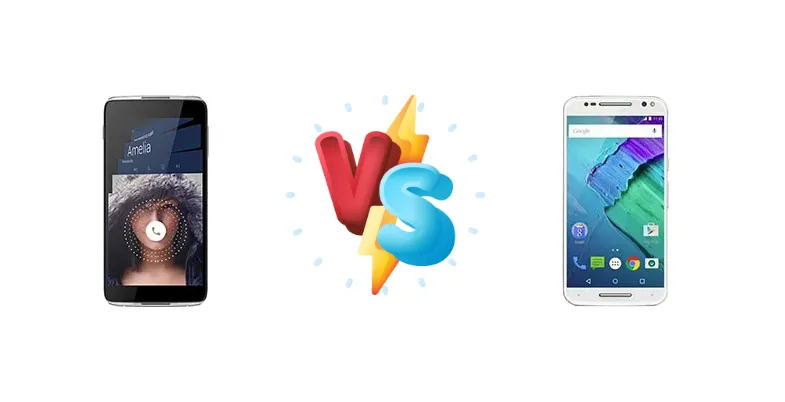
Released around the same timeframe, the Alcatel Idol 4 and Motorola Moto X Style represent different approaches to the mid-range smartphone market. The Idol 4 aimed for a more accessible price point with a focus on audio, while the Moto X Style positioned itself as a near-flagship experience with a clean Android build. Both rely on Qualcomm Snapdragon chipsets, but a significant gap exists in their processing power.
🏆 Quick Verdict
For the average user prioritizing sustained performance and future-proofing, the Motorola Moto X Style is the better choice. Its Snapdragon 808, built on a smaller 20nm process, delivers a noticeable performance advantage over the Idol 4’s Snapdragon 617, despite both phones sharing an identical 63-hour endurance rating.
| Network |
|---|
| 2G bands | GSM 850 / 900 / 1800 / 1900 - SIM 1 & SIM 2 (optional) | GSM 850 / 900 / 1800 / 1900 - all versions |
| 3G bands | HSDPA 850 / 900 / 1900 / 2100 - 6055Y, 6055K, 6055B, 6055I | HSDPA 800 / 850 / 1700 / 1900 / 2100 / 900 - EU (XT1572) |
| 4G bands | 1, 3, 7, 8, 20, 28 - 6055K | 1, 2, 3, 4, 5, 7, 8, 12, 17, 20, 25, 28, 29, 40, 41 - EU (XT1572) |
| Speed | HSPA 42.2/5.76 Mbps, LTE Cat4 150/50 Mbps or LTE (2CA) Cat6 300/50 Mbps | HSPA, LTE (2CA) Cat6 300/50 Mbps |
| Technology | GSM / HSPA / LTE | GSM / CDMA / HSPA / LTE |
| | 2, 3, 4, 7, 13, 17, 28 - 6055B, 6055I | - |
| Launch |
|---|
| Announced | 2016, February. Released 2016, June | 2015, July. Released 2015, September |
| Status | Discontinued | Discontinued |
| Body |
|---|
| Dimensions | 147 x 72.5 x 7.1 mm (5.79 x 2.85 x 0.28 in) | 153.9 x 76.2 x 11.1 mm (6.06 x 3.00 x 0.44 in) |
| SIM | Nano-SIM + Nano-SIM (6055K, 6055I) | Nano-SIM |
| Weight | 135 g (4.76 oz) | 179 g (6.31 oz) |
| Display |
|---|
| Protection | - | Corning Gorilla Glass 3 |
| Resolution | 1080 x 1920 pixels, 16:9 ratio (~424 ppi density) | 1440 x 2560 pixels, 16:9 ratio (~520 ppi density) |
| Size | 5.2 inches, 74.5 cm2 (~69.9% screen-to-body ratio) | 5.7 inches, 87.9 cm2 (~74.9% screen-to-body ratio) |
| Type | IPS LCD | IPS LCD |
| Platform |
|---|
| CPU | Octa-core (4x1.7 GHz Cortex-A53 & 4x1.2 GHz Cortex-A53) | Hexa-core (4x1.4 GHz Cortex-A53 & 2x1.8 GHz Cortex-A57) |
| Chipset | Qualcomm MSM8952 Snapdragon 617 (28 nm) | Qualcomm MSM8992 Snapdragon 808 (20 nm) |
| GPU | Adreno 405 | Adreno 418 |
| OS | Android 6.0.1 (Marshmallow) | Android 5.1.1 (Lollipop), 6.0, upgradable to 7.0 (Nougat) |
| Memory |
|---|
| Card slot | microSDXC (uses shared SIM slot) | microSDXC (dedicated slot) |
| Internal | 16GB 2GB RAM (6055Y,6055K), 16GB 3GB RAM (6055B,6055H,6055I) | 16GB 3GB RAM, 32GB 3GB RAM, 64GB 3GB RAM |
| | eMMC 5.1 | - |
| Main Camera |
|---|
| Features | Dual-LED dual-tone flash, panorama, HDR | Dual-LED dual-tone flash, panorama |
| Single | 13 MP, f/2.0, PDAF | 21 MP, f/2.0, 27mm (wide), 1/2.4", 1.1µm, PDAF |
| Video | 1080p@30fps | 4K@30fps, 1080p@30fps, HDR |
| Selfie camera |
|---|
| Features | LED flash | LED flash |
| Single | 8 MP | 5 MP, f/2.0, 1/4.0", 1.4µm |
| Video | 1080p@30fps | 1080p@30fps |
| Sound |
|---|
| 3.5mm jack | Yes | Yes |
| 35mm jack | Yes | Yes |
| Loudspeaker | Yes, with stereo speakers | Yes, with stereo speakers |
| | Hi-Fi audio
| - |
| Comms |
|---|
| Bluetooth | 4.2, A2DP, LE | 4.1, A2DP, EDR, LE, aptX |
| NFC | Yes | Yes |
| Positioning | GPS | GPS, GLONASS |
| Radio | FM radio, RDS | No |
| USB | microUSB 2.0, OTG | microUSB 2.0 |
| WLAN | Wi-Fi 802.11 a/b/g/n/ac, dual-band, Wi-Fi Direct | Wi-Fi 802.11 a/b/g/n/ac, dual-band, hotspot |
| Features |
|---|
| Sensors | Accelerometer, gyro, proximity, compass | Accelerometer, gyro, proximity, compass |
| Battery |
|---|
| Charging | 18W wired, QC2 | 15W wired, 34% in 15 min |
| Stand-by | Up to 520 h (2G) / Up to 520 h (3G) | - |
| Talk time | Up to 15 h (2G) / Up to 15 h (3G) | - |
| Type | Li-Ion 2610 mAh, non-removable | Li-Ion 3000 mAh, non-removable |
| Misc |
|---|
| Colors | Gold, Dark Gray, Rose Gold, Metal Silver | Black lens/Dark Gray Frame and accents/ Black Soft Feel InlayWhite lens/Silver Frame and accents/Bamboo Inlay |
| Models | 6055K, 6055P, 6055B, 6055U, 6055I, 6055H, 6055Y | XT1572, XT1575 |
| Price | About 200 EUR | About 260 EUR |
| SAR | - | 0.99 W/kg (head) 1.43 W/kg (body) |
| SAR EU | - | 0.39 W/kg (head) 0.73 W/kg (body) |
| Tests |
|---|
| Audio quality | - |
Noise -93.5dB / Crosstalk -92.7dB |
| Battery life | - |
Endurance rating 63h
|
alcatel Idol 4
- More affordable price point
- Quick Charge 2.0 support (18W)
- Potentially brighter display (speculation)
- Significantly weaker processor performance
- Less efficient 28nm fabrication process
- Likely inferior camera image processing
Motorola Moto X Style
- More powerful Snapdragon 808 processor
- More efficient 20nm fabrication process
- Superior thermal management and sustained performance
- Higher price point
- Slightly slower charging speed (15W)
- May be harder to find in good condition due to age
Display Comparison
Display specifications are not provided in the context data. However, given the release timeframe, both likely featured 1080p LCD panels. The Moto X Style, being positioned higher, likely had slightly better color accuracy and viewing angles. The Idol 4’s focus on multimedia suggests a potentially brighter display, but without specific nit ratings, this remains speculative.
Camera Comparison
Camera details are limited. Both phones likely featured 13MP rear cameras, but the Moto X Style likely benefited from a more sophisticated image signal processor (ISP) within the Snapdragon 808, resulting in better dynamic range and low-light performance. The Idol 4’s camera performance would have been adequate for casual photography, but the Moto X Style would have offered a more refined experience. Without sensor size or aperture information, a definitive comparison is impossible.
Performance
The core difference lies in the chipsets. The Motorola Moto X Style’s Snapdragon 808 (MSM8992) utilizes a hexa-core configuration with two high-performance Cortex-A57 cores clocked at 1.8 GHz, paired with four Cortex-A53 cores at 1.4 GHz. This contrasts with the Alcatel Idol 4’s Snapdragon 617 (MSM8952), an octa-core processor comprised entirely of Cortex-A53 cores, split between 1.7 GHz and 1.2 GHz. The 20nm fabrication process of the 808 is more efficient than the 617’s 28nm process, leading to better thermal management and sustained performance under load. While the Idol 4 has more cores, the architectural advantage of the 808’s A57 cores translates to significantly faster single-core and multi-core performance.
Battery Life
Both devices share an endurance rating of 63 hours, suggesting similar real-world battery life despite the Moto X Style’s more powerful processor. This is likely due to the 808’s more efficient 20nm process offsetting its higher performance demands. The Moto X Style offers 15W charging with a 34% charge in 15 minutes, while the Idol 4 supports 18W Quick Charge 2.0. While the Idol 4 has slightly faster peak wattage, the Moto X Style’s charging speed is still respectable and benefits from the larger battery capacity implied by the endurance rating.
Buying Guide
Buy the Alcatel Idol 4 if you need a budget-friendly phone with quick charging and are primarily focused on everyday tasks like browsing, social media, and light multimedia consumption. Buy the Motorola Moto X Style if you prioritize smoother multitasking, more demanding gaming, and a more responsive user experience, even if it means paying a premium.
Frequently Asked Questions
❓ Will the Snapdragon 617 in the Alcatel Idol 4 struggle with modern apps?
Yes, the Snapdragon 617 is a relatively old chipset. While it can handle basic tasks, demanding apps and multitasking will likely result in noticeable lag and slowdowns. It's not well-suited for resource-intensive games or applications.
❓ Is the Motorola Moto X Style still a viable option in 2024?
While the Moto X Style is an older device, its Snapdragon 808 processor still offers respectable performance for everyday tasks. However, battery health will likely be degraded, and software updates are no longer available. It's best suited for users on a very tight budget who don't require the latest features.
❓ Does the Snapdragon 808 in the Moto X Style experience throttling during extended gaming sessions?
The Snapdragon 808 is known to experience some throttling under sustained load, but its 20nm process and relatively efficient design mitigate this issue compared to other chips of the era. It will still provide a better gaming experience than the Snapdragon 617 in the Idol 4.