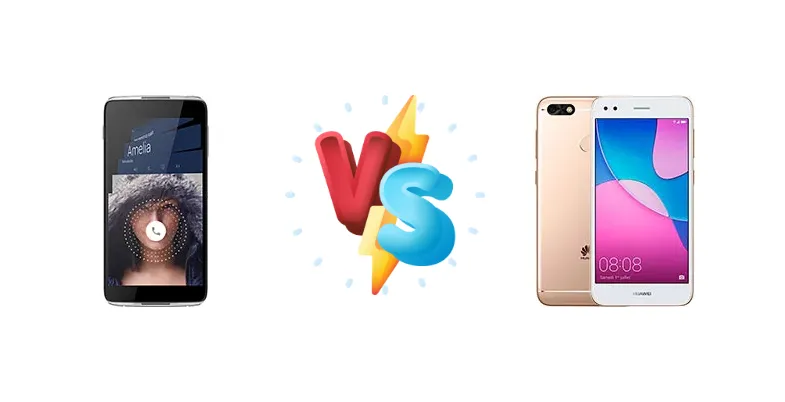
The Alcatel Idol 4 and Huawei P9 Lite Mini represent a segment of the market where value is paramount. Both devices aimed to deliver a smartphone experience without breaking the bank, but they took different approaches to achieving this. The Idol 4, with its Snapdragon 617, offered an octa-core processor, while the P9 Lite Mini opted for the more economical Snapdragon 425. This comparison dissects the key differences to help you determine which phone provides the best experience for your needs.
🏆 Quick Verdict
For the average user prioritizing responsiveness and multitasking, the Alcatel Idol 4 emerges as the better choice. Its Snapdragon 617, with its eight cores, provides a noticeable performance advantage over the Huawei P9 Lite Mini’s quad-core Snapdragon 425, making it more suitable for demanding apps and light gaming. However, the P9 Lite Mini may offer slightly better battery life due to its less powerful processor.
| Network |
|---|
| 2G bands | GSM 850 / 900 / 1800 / 1900 - SIM 1 & SIM 2 (optional) | GSM 850 / 900 / 1800 / 1900 - SIM 1 & SIM 2 |
| 3G bands | HSDPA 850 / 900 / 1900 / 2100 - 6055Y, 6055K, 6055B, 6055I | HSDPA 850 / 900 / 1900 / 2100 |
| 4G bands | 1, 3, 7, 8, 20, 28 - 6055K | 1, 3, 5, 7, 8, 20 |
| Speed | HSPA 42.2/5.76 Mbps, LTE Cat4 150/50 Mbps or LTE (2CA) Cat6 300/50 Mbps | HSPA 42.2/5.76 Mbps, LTE Cat4 150/50 Mbps |
| Technology | GSM / HSPA / LTE | GSM / HSPA / LTE |
| | 2, 3, 4, 7, 13, 17, 28 - 6055B, 6055I | - |
| Launch |
|---|
| Announced | 2016, February. Released 2016, June | 2017, August. Released 2017, September |
| Status | Discontinued | Discontinued |
| Body |
|---|
| Build | - | Glass front, aluminum back, aluminum frame |
| Dimensions | 147 x 72.5 x 7.1 mm (5.79 x 2.85 x 0.28 in) | 143.5 x 71 x 8.1 mm (5.65 x 2.80 x 0.32 in) |
| SIM | Nano-SIM + Nano-SIM (6055K, 6055I) | Nano-SIM + Nano-SIM |
| Weight | 135 g (4.76 oz) | 145 g (5.11 oz) |
| Display |
|---|
| Resolution | 1080 x 1920 pixels, 16:9 ratio (~424 ppi density) | 720 x 1280 pixels, 16:9 ratio (~294 ppi density) |
| Size | 5.2 inches, 74.5 cm2 (~69.9% screen-to-body ratio) | 5.0 inches, 68.9 cm2 (~67.6% screen-to-body ratio) |
| Type | IPS LCD | IPS LCD |
| Platform |
|---|
| CPU | Octa-core (4x1.7 GHz Cortex-A53 & 4x1.2 GHz Cortex-A53) | Quad-core 1.4 GHz Cortex-A53 |
| Chipset | Qualcomm MSM8952 Snapdragon 617 (28 nm) | Qualcomm MSM8917 Snapdragon 425 (28 nm) |
| GPU | Adreno 405 | Adreno 308 |
| OS | Android 6.0.1 (Marshmallow) | Android 7.0 (Nougat), EMUI 5.1 |
| Memory |
|---|
| Card slot | microSDXC (uses shared SIM slot) | microSDXC |
| Internal | 16GB 2GB RAM (6055Y,6055K), 16GB 3GB RAM (6055B,6055H,6055I) | 16GB 2GB RAM |
| | eMMC 5.1 | eMMC 5.1 |
| Main Camera |
|---|
| Features | Dual-LED dual-tone flash, panorama, HDR | LED flash |
| Single | 13 MP, f/2.0, PDAF | 13 MP, AF |
| Video | 1080p@30fps | 1080p@30fps |
| Selfie camera |
|---|
| Features | LED flash | - |
| Single | 8 MP | 5 MP |
| Video | 1080p@30fps | - |
| Sound |
|---|
| 3.5mm jack | Yes | Yes |
| 35mm jack | Yes | Yes |
| Loudspeaker | Yes, with stereo speakers | Yes |
| | Hi-Fi audio
| - |
| Comms |
|---|
| Bluetooth | 4.2, A2DP, LE | v4.1, A2DP, LE |
| NFC | Yes | No |
| Positioning | GPS | GPS, GLONASS |
| Radio | FM radio, RDS | FM radio |
| USB | microUSB 2.0, OTG | microUSB 2.0 |
| WLAN | Wi-Fi 802.11 a/b/g/n/ac, dual-band, Wi-Fi Direct | Wi-Fi 802.11 b/g/n, Wi-Fi Direct |
| Features |
|---|
| Sensors | Accelerometer, gyro, proximity, compass | Fingerprint (rear-mounted), accelerometer, proximity |
| Battery |
|---|
| Charging | 18W wired, QC2 | - |
| Stand-by | Up to 520 h (2G) / Up to 520 h (3G) | - |
| Talk time | Up to 15 h (2G) / Up to 15 h (3G) | - |
| Type | Li-Ion 2610 mAh, non-removable | Li-Ion 3020 mAh, non-removable |
| Misc |
|---|
| Colors | Gold, Dark Gray, Rose Gold, Metal Silver | Silver, black, gold |
| Models | 6055K, 6055P, 6055B, 6055U, 6055I, 6055H, 6055Y | SLA-L02, SLA-L22, SLA-L03, SLA-L23 |
| Price | About 200 EUR | About 150 EUR |
alcatel Idol 4
- Faster octa-core processor for smoother performance
- Quick Charge 2.0 support for faster charging
- Better multitasking capabilities
- Potentially shorter battery life compared to the P9 Lite Mini
- May generate more heat under heavy load
Huawei P9 lite mini
- More power-efficient processor for longer battery life
- Simpler user experience for basic tasks
- Likely more affordable
- Slower processor for demanding apps and games
- Slower charging speeds
- Limited multitasking capabilities
Display Comparison
Neither device is known for a standout display. Given the context data focuses on processing power, we can infer both likely utilized LCD panels common in this price bracket. The absence of specifications like resolution or brightness suggests neither phone aimed to compete on display quality. Bezels were likely substantial on both, typical of phones from this era. Color accuracy would have been standard for the time, prioritizing cost over fidelity.
Camera Comparison
Without detailed camera specifications, a direct comparison is difficult. However, given the market segment, it’s safe to assume both phones featured basic camera setups. The Idol 4, being slightly higher positioned, may have had a marginally better sensor or image processing algorithm. The focus would have been on providing acceptable image quality in good lighting conditions, with performance likely degrading significantly in low light. The inclusion of a 2MP macro camera on either device would have offered limited practical benefit due to its low resolution.
Performance
The core difference lies in the chipset: the Alcatel Idol 4 boasts the Qualcomm MSM8952 Snapdragon 617, an octa-core processor split into two quad-core clusters (4x1.7 GHz Cortex-A53 & 4x1.2 GHz Cortex-A53). This architecture allows for efficient task management, with the faster cores handling demanding processes and the slower cores managing background tasks. In contrast, the Huawei P9 Lite Mini utilizes the Qualcomm MSM8917 Snapdragon 425, a quad-core 1.4 GHz Cortex-A53 processor. The Idol 4’s octa-core configuration provides a significant advantage in multitasking and overall responsiveness. While both are built on a 28nm process, the increased core count and clock speeds of the Snapdragon 617 translate to a demonstrably faster user experience. The Idol 4 will handle app switching and moderately demanding games with greater ease.
Battery Life
Battery capacity isn’t specified, but the Snapdragon 425 in the P9 Lite Mini is inherently more power-efficient due to its simpler architecture and lower clock speeds. This suggests the P9 Lite Mini would likely offer longer battery life under similar usage conditions. However, the Idol 4’s 18W charging with Quick Charge 2.0 support provides a significant advantage in terms of charging speed. While the P9 Lite Mini likely charged at a slower rate, the difference in overall runtime might be offset by the Idol 4’s faster charging capabilities for users who frequently need to top up their battery.
Buying Guide
Buy the Alcatel Idol 4 if you need a phone capable of handling more demanding tasks, such as running multiple apps simultaneously or playing less intensive mobile games. Its octa-core processor provides a smoother user experience. Buy the Huawei P9 Lite Mini if you prioritize simplicity and extended battery life for basic tasks like calling, texting, and light social media browsing. It’s a good option for users who don’t require significant processing power.
Frequently Asked Questions
❓ Will the Alcatel Idol 4 struggle with modern apps like TikTok or Instagram?
While the Snapdragon 617 is capable, running the latest versions of demanding apps like TikTok or Instagram on the Alcatel Idol 4 may result in occasional lag or slowdowns, especially with multiple apps open simultaneously. It's not a flagship processor, so expect some compromises.
❓ Is the Huawei P9 Lite Mini suitable for someone who primarily uses their phone for calls, texts, and WhatsApp?
Absolutely. The Snapdragon 425 is perfectly adequate for basic communication tasks like calls, texts, and WhatsApp. The P9 Lite Mini’s strength lies in its simplicity and power efficiency, making it a good choice for users with minimal smartphone needs.
❓ Does the Alcatel Idol 4's Quick Charge 2.0 support require a specific charger?
Yes, to take full advantage of the Idol 4’s 18W Quick Charge 2.0 capabilities, you’ll need a charger that also supports the Quick Charge 2.0 standard. Using a standard 5W charger will still charge the phone, but at a significantly slower rate.