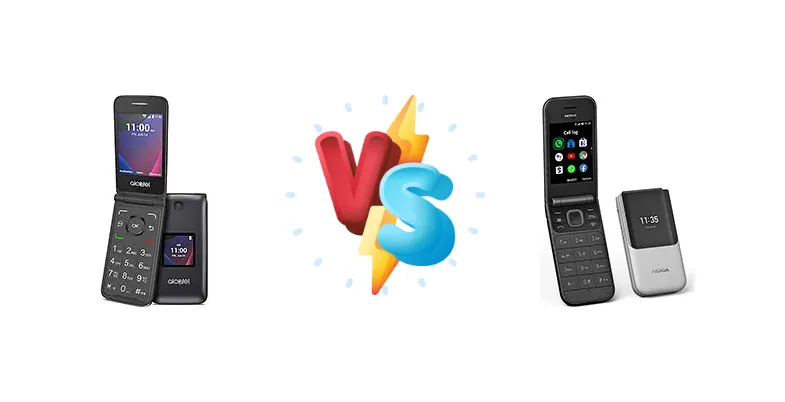
In a market dominated by smartphones, the flip phone is experiencing a resurgence, particularly among users seeking simplicity and extended battery life. The Alcatel Go Flip V and Nokia 2720 Flip represent two of the most popular options, both powered by Qualcomm Snapdragon processors. However, a closer look reveals a key difference: the Alcatel utilizes the Snapdragon 210, while the Nokia opts for the Snapdragon 205. This comparison will dissect the implications of this chipset difference and other features to determine which device best suits your needs.
🏆 Quick Verdict
For the average user prioritizing slightly smoother performance and potential for future software updates, the Alcatel Go Flip V emerges as the better choice. Its quad-core Snapdragon 210 offers a tangible advantage over the Nokia 2720 Flip’s dual-core Snapdragon 205, despite both being built on the same 28nm process. However, the Nokia remains a viable option for those seeking extreme simplicity.
| Network |
|---|
| 2G bands | GSM 850 / 1900 | GSM 850 / 900 / 1800 / 1900 |
| 3G bands | HSDPA 850 / 1700(AWS) / 1900 | HSDPA 850 / 900 / 2100 |
| 4G bands | 2, 4, 5, 13 | 1, 3, 5, 7, 8, 20 - EU |
| Speed | HSPA, LTE | HSPA 42.2/5.76 Mbps, LTE Cat4 150/50 Mbps |
| Technology | GSM / HSPA / LTE | GSM / HSPA / LTE |
| | - | 1, 3, 5, 7, 8, 20, 28, 38, 39, 40, 41 - MENA, APAC, GCR |
| Launch |
|---|
| Announced | 2019, July 11. Released 2019, July 11 | 2019, September 05. Released 2019, September 05 |
| Status | Discontinued | Discontinued |
| Body |
|---|
| Dimensions | 104.9 x 52.8 x 18.7 mm (4.13 x 2.08 x 0.74 in) | 192.7 x 54.5 x 11.6 mm (7.59 x 2.15 x 0.46 in) |
| SIM | Nano-SIM | · Nano-SIM· Nano-SIM + Nano-SIM |
| Weight | 118 g (4.16 oz) | 118 g (4.16 oz) |
| Display |
|---|
| Resolution | 240 x 320 pixels, 4:3 ratio (~143 ppi density) | 240 x 320 pixels, 4:3 ratio (~143 ppi density) |
| Size | 2.8 inches, 24.3 cm2 (~43.8% screen-to-body ratio) | 2.8 inches, 24.3 cm2 (~23.1% screen-to-body ratio) |
| Type | TN TFT LCD | TFT LCD, 256K colors |
| | Second external TN TFT display, 1.44 inches, 128 x 128 pixels | Second external TFT display, 240 x 240 pixels, 1.3 inches |
| Platform |
|---|
| CPU | Quad-core 1.1 GHz Cortex-A7 | Dual-core (2x1.1 GHz Cortex-A7) |
| Chipset | Qualcomm MSM8909 Snapdragon 210 (28 nm) | Qualcomm MSM8905 Snapdragon 205 (28 nm) |
| GPU | Adreno 304 | Adreno 304 |
| OS | KaiOS 2.5.2 | KaiOS 2.5.2 |
| Memory |
|---|
| Card slot | microSDHC (dedicated slot) | microSDHC (dedicated slot) |
| Internal | 8GB 1GB RAM | 4GB 512MB |
| | - | eMMC 4.5 |
| Main Camera |
|---|
| Features | - | LED flash |
| Single | 2 MP | 2 MP |
| Video | 720p@30fps | Yes |
| Sound |
|---|
| 3.5mm jack | Yes | Yes |
| 35mm jack | Yes | Yes |
| Loudspeaker | Yes | Yes |
| Comms |
|---|
| Bluetooth | 4.2, A2DP | 4.2, A2DP, LE |
| NFC | No | No |
| Positioning | No | GPS, GLONASS |
| Radio | FM radio | FM radio |
| USB | microUSB 2.0 | microUSB 2.0 |
| WLAN | Wi-Fi 802.11 b/g/n, hotspot | Wi-Fi 802.11 b/g/n, hotspot |
| Features |
|---|
| | - | SNS applications
MP4/H.264 player
MP3/WAV/AAC player
Organizer
Voice memo
Predictive text input |
| Battery |
|---|
| Stand-by | - | Up to 700 h (3G) |
| Type | Li-Ion 1350 mAh, removable | Li-Ion 1500 mAh, removable |
| Misc |
|---|
| Colors | Black | Black, Gray, Red |
| Models | 4051S | TA-1175, TA-1173, TA-1170, TA-1168 |
| Price | About 80 EUR | About 140 EUR |
| SAR | 1.08 W/kg (head) 1.32 W/kg (body) | 0.87 W/kg (head) 1.10 W/kg (body) |
| SAR EU | - | 1.03 W/kg (head) 1.69 W/kg (body) |
alcatel Go Flip V
- More powerful quad-core processor for smoother performance.
- Potential for better software support and updates.
- Slightly more responsive user interface.
- Potentially slightly shorter battery life during active use.
- May be slightly more expensive than the Nokia 2720 Flip.
Nokia 2720 Flip
- Extremely simple and easy to use.
- Potentially longer standby battery life.
- Often available at a lower price point.
- Slower dual-core processor can feel sluggish.
- Limited multitasking capabilities.
- May receive fewer software updates.
Display Comparison
Both the Alcatel Go Flip V and Nokia 2720 Flip feature internal displays designed for basic functionality, and detailed display specs are not readily available. However, given their target market, we can assume both utilize TN panels prioritizing power efficiency over color accuracy. The external displays serve primarily for caller ID and notifications. The real difference lies in the software optimization for these displays, which is difficult to quantify without extensive testing. Bezels are substantial on both devices, a common characteristic of flip phones.
Camera Comparison
Both phones feature basic cameras intended for casual snapshots. Detailed camera specifications are scarce, but given the target market, image quality is unlikely to be a primary concern. The focus is on functionality rather than photographic excellence. It's safe to assume both cameras utilize relatively small sensors and fixed-focus lenses. Any differences in image processing are likely minimal and won't significantly impact the user experience.
Performance
The core distinction between these phones is the chipset. The Alcatel Go Flip V’s Qualcomm MSM8909 Snapdragon 210, with its quad-core 1.1 GHz Cortex-A7 CPU, demonstrably outperforms the Nokia 2720 Flip’s Qualcomm MSM8905 Snapdragon 205, which features a dual-core 1.1 GHz Cortex-A7 CPU. While both are based on the 28nm process, the additional cores in the Snapdragon 210 allow for better multitasking and a more fluid user interface. This translates to quicker app switching and a less laggy experience when navigating menus. The Snapdragon 210 also benefits from a slightly more capable Adreno 304 GPU, though neither phone is intended for graphically intensive tasks. RAM capacity is likely similar on both devices, further emphasizing the CPU as the primary performance differentiator.
Battery Life
Both the Alcatel Go Flip V and Nokia 2720 Flip prioritize long battery life, a key selling point for flip phones. While specific battery capacities aren't always published, the power-efficient Snapdragon 205 in the Nokia 2720 Flip *could* translate to slightly longer standby times. However, the Alcatel Go Flip V’s more powerful processor may consume more power during active use. Charging times are likely similar, relying on micro-USB connectivity and relatively low wattage chargers. The real-world battery performance will depend heavily on usage patterns, with standby time being the dominant factor for both devices.
Buying Guide
Buy the Alcatel Go Flip V if you need a slightly more responsive user experience for basic tasks like texting and making calls, and appreciate the potential for a more future-proofed device. Buy the Nokia 2720 Flip if you prioritize absolute simplicity, a minimalist interface, and are less concerned with multitasking or running more demanding applications. The Nokia is ideal for users who want a phone that 'just works' without any frills.
Frequently Asked Questions
❓ Will the Alcatel Go Flip V struggle with modern VoLTE and Wi-Fi calling requirements?
While the Snapdragon 210 is an older chipset, it generally supports the necessary protocols for VoLTE and Wi-Fi calling on most major carriers. However, compatibility can vary, so it's crucial to check with your carrier to ensure the Alcatel Go Flip V is certified for their network before purchasing.
❓ Is the Nokia 2720 Flip a good choice for someone completely unfamiliar with smartphones?
Absolutely. The Nokia 2720 Flip’s minimalist interface and lack of complex features make it an ideal choice for individuals transitioning from traditional feature phones or those who prefer a simple, straightforward mobile experience. It focuses on core functionality – calls and texts – without the distractions of apps and internet browsing.
❓ Can I easily transfer contacts from an old phone to either the Alcatel Go Flip V or Nokia 2720 Flip?
Transferring contacts can be done via Bluetooth from compatible phones, or by syncing with a Google account if the old phone supports it. Both phones also support importing contacts from a SIM card. However, the process may be less intuitive than on a smartphone, and may require some manual input.