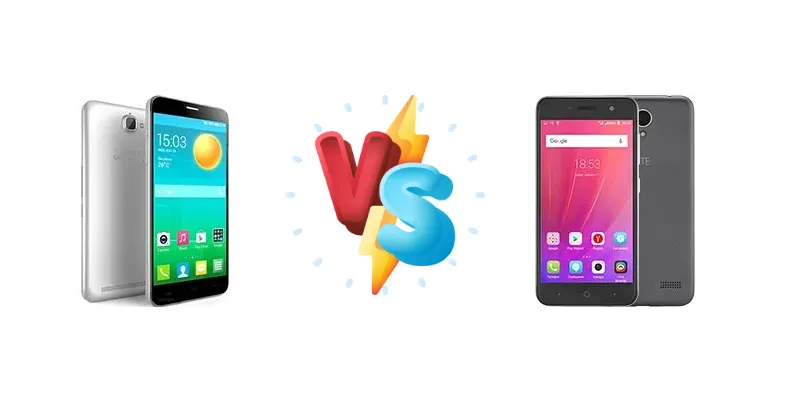
The Alcatel Flash and ZTE Blade A520 represent a segment of the market where value is paramount. Both devices aim to provide a functional smartphone experience at an accessible price point, but they take different approaches to achieving this. The Flash prioritizes core count with its Mediatek MT6592M, while the A520 opts for a newer, though less densely populated, Mediatek MT6737. This comparison will dissect these differences to determine which phone best suits your needs.
🏆 Quick Verdict
For the average user prioritizing multitasking and responsiveness, the Alcatel Flash emerges as the better choice. Its octa-core CPU, despite being based on the older Cortex-A7 architecture, provides a noticeable performance advantage over the ZTE Blade A520’s quad-core Cortex-A53, making it more suitable for running multiple apps simultaneously.
| Network |
|---|
| 2G bands | GSM 900 / 1800 / 1900 | GSM 850 / 900 / 1800 / 1900 - SIM 1 & SIM 2 |
| 3G bands | HSDPA 900 / 2100 | HSDPA 900 / 1900 / 2100 |
| 4G bands | - | 1, 3, 5, 7, 8, 20 |
| Speed | HSPA | HSPA 42.2/5.76 Mbps, LTE Cat4 150/50 Mbps |
| Technology | GSM / HSPA | GSM / HSPA / LTE |
| | - | HSDPA 850 / 900 / 2100 |
| Launch |
|---|
| Announced | 2014, September. Released 2014, September | 2017, March. Released 2017, May |
| Status | Discontinued | Discontinued |
| Body |
|---|
| Dimensions | 152.1 x 76.2 x 8.1 mm (5.99 x 3.00 x 0.32 in) | 144 x 71 x 8.4 mm (5.67 x 2.80 x 0.33 in) |
| SIM | Micro-SIM | Nano-SIM + Nano-SIM |
| Weight | - | 130 g (4.59 oz) |
| Display |
|---|
| Resolution | 720 x 1280 pixels, 16:9 ratio (~267 ppi density) | 720 x 1280 pixels, 16:9 ratio (~294 ppi density) |
| Size | 5.5 inches, 83.4 cm2 (~72.0% screen-to-body ratio) | 5.0 inches, 68.9 cm2 (~67.4% screen-to-body ratio) |
| Type | IPS LCD | IPS LCD |
| Platform |
|---|
| CPU | Octa-core 1.4 GHz Cortex-A7 | Quad-core 1.25 GHz Cortex-A53 |
| Chipset | Mediatek MT6592M (28 nm) | Mediatek MT6737 (28 nm) |
| GPU | Mali-450MP4 | Mali-T720MP2 |
| OS | Android 4.4 (KitKat) | Android 7.0 (Nougat) |
| Memory |
|---|
| Card slot | microSDHC (dedicated slot) | microSDXC (uses shared SIM slot) |
| Internal | 8GB 1GB RAM | 8GB 1GB RAM, 16GB 2GB RAM |
| | - | eMMC 5.0 |
| Main Camera |
|---|
| Features | LED flash, HDR, panorama | LED flash, HDR, panorama |
| Single | 13 MP, AF | 8 MP, AF |
| Video | 1080p@30fps | 1080p@30fps |
| Selfie camera |
|---|
| Single | 5 MP | 8 MP or 2 MP |
| Sound |
|---|
| 3.5mm jack | Yes | Yes |
| 35mm jack | Yes | Yes |
| Loudspeaker | Yes | Yes |
| Comms |
|---|
| Bluetooth | 4.0, A2DP | 4.1, A2DP, LE |
| NFC | No | No |
| Positioning | GPS | GPS |
| Radio | FM radio | FM radio |
| USB | microUSB 2.0 | microUSB 2.0 |
| WLAN | Wi-Fi 802.11 b/g/n, hotspot | Wi-Fi 802.11 b/g/n, Wi-Fi Direct |
| Features |
|---|
| Sensors | Accelerometer, proximity, compass | Accelerometer |
| Battery |
|---|
| Type | Li-Ion 3200 mAh, removable | Li-Ion 2400 mAh, removable |
| Misc |
|---|
| Colors | Slate/white | Gray |
| Models | 6042D | BLADE A520, BA520 |
| Price | - | About 80 EUR |
alcatel Flash
- Octa-core CPU offers better multitasking performance.
- Potentially smoother experience with multiple apps open.
- May handle more demanding applications better.
- Older Cortex-A7 architecture may limit single-core performance.
- Likely lacks future software updates.
ZTE Blade A520
- More modern Cortex-A53 architecture offers improved efficiency.
- Potentially longer standby times.
- May receive more software updates due to newer chipset.
- Quad-core CPU struggles with multitasking.
- Slower overall performance compared to the Alcatel Flash.
Display Comparison
Neither device’s display specifications are provided, so a direct comparison is impossible. However, given their market segment, both likely feature 720p LCD panels. The absence of information regarding panel technology (IPS, TFT) or brightness levels suggests a focus on cost reduction. Users should expect standard viewing angles and color reproduction, adequate for everyday use but not ideal for media consumption in bright sunlight.
Camera Comparison
Without specific camera sensor details, a meaningful comparison is limited. Both phones likely feature basic camera setups geared towards casual photography. The absence of information regarding aperture sizes or optical image stabilization suggests image quality will be heavily reliant on software processing. Users should not expect exceptional low-light performance or detailed images. Any 2MP or lower resolution secondary cameras are likely present for feature completion rather than genuine photographic utility.
Performance
The core difference lies in the chipsets. The Alcatel Flash’s Mediatek MT6592M boasts an octa-core Cortex-A7 CPU clocked at 1.4 GHz, while the ZTE Blade A520 utilizes a quad-core Cortex-A53 clocked at 1.25 GHz. While the Cortex-A53 is a more modern architecture, the sheer number of cores in the MT6592M provides a significant advantage in multi-threaded tasks. The A53’s efficiency gains are offset by the lower core count. Both chipsets are fabricated on a 28nm process, indicating similar power consumption characteristics. The MT6737 in the A520 *may* offer slightly better GPU performance, but the CPU difference will be more noticeable in daily use.
Battery Life
Battery capacity and charging wattage are not specified. Given the similar chipsets (both 28nm) and likely comparable display resolutions, battery life should be relatively similar. The MT6737’s potentially more efficient architecture *could* translate to slightly longer standby times, but real-world usage will be the determining factor. Without fast charging support, expect charge times to be in the 2-3 hour range for a full charge.
Buying Guide
Buy the Alcatel Flash if you frequently switch between applications, enjoy light multitasking, or anticipate running more demanding apps. Its octa-core processor offers a smoother experience in these scenarios. Buy the ZTE Blade A520 if your primary use case is basic communication – calls, texts, and light web browsing – and you prioritize potential future software support due to the newer chipset, even at the cost of immediate performance.
Frequently Asked Questions
❓ Will the Alcatel Flash struggle with newer Android updates if they become available?
Given the age of the MT6592M chipset and the Alcatel Flash’s position in the budget segment, it’s unlikely to receive significant Android version updates. Any updates released will likely be limited to security patches, and even those may be infrequent. The older architecture may also lead to performance degradation with newer Android versions.
❓ Is the MT6737 in the ZTE Blade A520 sufficient for playing popular mobile games like PUBG Mobile or Call of Duty Mobile?
The MT6737 is likely capable of running PUBG Mobile or Call of Duty Mobile, but only at the lowest graphics settings and potentially with frame rate drops. The quad-core CPU and limited GPU power will struggle with the demands of these games. Expect a less-than-optimal gaming experience, even with reduced settings.
❓ Which phone is better for running multiple social media apps simultaneously without lag?
The Alcatel Flash, with its octa-core processor, is significantly better suited for running multiple social media apps simultaneously. The increased core count allows for smoother multitasking and reduces the likelihood of lag when switching between apps like Facebook, Instagram, and Twitter.