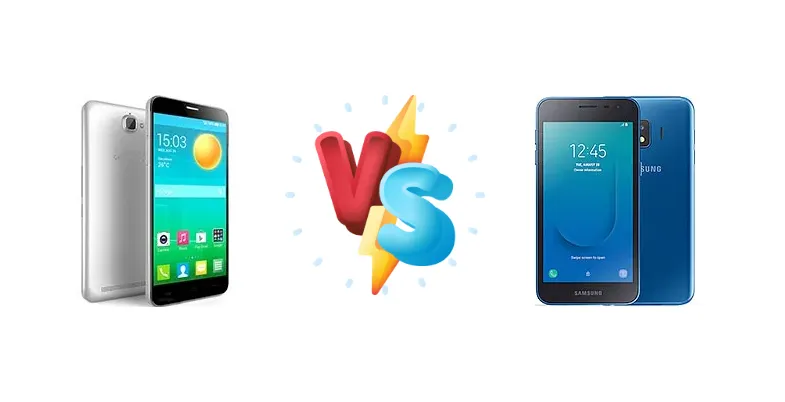
Both the Alcatel Flash and the Samsung Galaxy J2 Core (2020) represent the entry-level segment of the smartphone market, targeting users prioritizing affordability. However, they take different approaches to achieving this, with the Alcatel Flash leveraging an octa-core Mediatek processor while the Samsung opts for a quad-core Qualcomm Snapdragon. This comparison dissects these core differences to determine which device delivers the best experience for everyday tasks.
🏆 Quick Verdict
For the average user seeking a basic smartphone for calls, messaging, and light app usage, the Alcatel Flash offers a slight edge. Its octa-core processor, despite sharing the same 28nm process as the Snapdragon, provides a theoretical advantage in multitasking and responsiveness, making it a better choice for those wanting a smoother experience.
| Network |
|---|
| 2G bands | GSM 900 / 1800 / 1900 | GSM 850 / 900 / 1800 / 1900 |
| 3G bands | HSDPA 900 / 2100 | HSDPA 850 / 900 / 2100 |
| 4G bands | - | 1, 3, 5, 8, 40, 41 |
| Speed | HSPA | HSPA 42.2/5.76 Mbps, LTE Cat4 150/50 Mbps |
| Technology | GSM / HSPA | GSM / HSPA / LTE |
| Launch |
|---|
| Announced | 2014, September. Released 2014, September | 2020, April 27. Released 2020, April 27 |
| Status | Discontinued | Discontinued |
| Body |
|---|
| Build | - | Glass front, plastic back, plastic frame |
| Dimensions | 152.1 x 76.2 x 8.1 mm (5.99 x 3.00 x 0.32 in) | 143.4 x 72.1 x 8.9 mm (5.65 x 2.84 x 0.35 in) |
| SIM | Micro-SIM | Dual SIM (Micro-SIM, dual stand-by) |
| Weight | - | 154 g (5.43 oz) |
| Display |
|---|
| Resolution | 720 x 1280 pixels, 16:9 ratio (~267 ppi density) | 540 x 960 pixels, 16:9 ratio (~220 ppi density) |
| Size | 5.5 inches, 83.4 cm2 (~72.0% screen-to-body ratio) | 5.0 inches, 68.9 cm2 (~66.7% screen-to-body ratio) |
| Type | IPS LCD | PLS LCD |
| Platform |
|---|
| CPU | Octa-core 1.4 GHz Cortex-A7 | Quad-core 1.4 GHz Cortex-A53 |
| Chipset | Mediatek MT6592M (28 nm) | Qualcomm MSM8917 Snapdragon 425 (28 nm) |
| GPU | Mali-450MP4 | Adreno 308 |
| OS | Android 4.4 (KitKat) | Android 8.1 Oreo (Go edition) |
| Memory |
|---|
| Card slot | microSDHC (dedicated slot) | microSDXC (dedicated slot) |
| Internal | 8GB 1GB RAM | 16GB 1GB RAM |
| | - | eMMC 5.0 |
| Main Camera |
|---|
| Features | LED flash, HDR, panorama | LED flash, HDR, panorama |
| Single | 13 MP, AF | 8 MP, f/2.2, AF |
| Video | 1080p@30fps | 1080p@30fps |
| Selfie camera |
|---|
| Single | 5 MP | 5 MP, f/2.2 |
| Sound |
|---|
| 3.5mm jack | Yes | Yes |
| 35mm jack | Yes | Yes |
| Loudspeaker | Yes | Yes |
| Comms |
|---|
| Bluetooth | 4.0, A2DP | 4.2, A2DP |
| NFC | No | No |
| Positioning | GPS | GPS, GLONASS, BDS |
| Radio | FM radio | FM radio |
| USB | microUSB 2.0 | microUSB 2.0, OTG |
| WLAN | Wi-Fi 802.11 b/g/n, hotspot | Wi-Fi 802.11 b/g/n, Wi-Fi Direct |
| Features |
|---|
| Sensors | Accelerometer, proximity, compass | Accelerometer, proximity |
| Battery |
|---|
| Type | Li-Ion 3200 mAh, removable | Li-Ion 2600 mAh, removable |
| Misc |
|---|
| Colors | Slate/white | Black, Gold, Blue |
| Models | 6042D | SM-J260GU, SM-J260GU/DS, SM-J260FU, SM-J260MU |
| Price | - | About 130 EUR |
| SAR | - | 0.99 W/kg (head) |
alcatel Flash
- Octa-core processor offers potential for better multitasking.
- Potentially more responsive UI due to increased core count.
- Lower price point may make it more accessible.
- Older Cortex-A7 architecture is less efficient per core.
- Mediatek chipsets sometimes have less consistent software support.
- Likely limited camera performance.
Samsung Galaxy J2 Core (2020)
- Qualcomm Snapdragon offers generally better software optimization.
- Potentially better power efficiency per core.
- Samsung brand recognition and support network.
- Quad-core processor may struggle with multitasking.
- Potentially slower app loading times.
- May be slightly more expensive than the Alcatel Flash.
Display Comparison
Neither device boasts a standout display. Given the shared target market, both likely feature similar LCD panels with resolutions around 480x854. Without specific brightness or color gamut data, it's safe to assume both offer adequate, but not exceptional, viewing experiences. The focus here isn't on media consumption, but basic usability.
Camera Comparison
Camera performance on both devices will be limited. Without sensor size or aperture information, it’s difficult to make definitive claims. However, given the price point, both likely feature basic sensors. Image processing will be a key differentiator, and Samsung generally has a slight advantage in software optimization. Expect acceptable results in good lighting conditions, but poor performance in low light. The presence of a 2MP macro camera on either device is largely a marketing gimmick and unlikely to deliver significant improvements in image quality.
Performance
The core difference lies in the chipset. The Alcatel Flash’s Mediatek MT6592M features an octa-core Cortex-A7 CPU clocked at 1.4 GHz, while the Samsung Galaxy J2 Core (2020) utilizes a quad-core Cortex-A53 Snapdragon 425, also at 1.4 GHz. While clock speeds are identical, the Cortex-A7 architecture in the MT6592M is older and less efficient *per core* than the Cortex-A53. However, the sheer number of cores in the Alcatel Flash *could* translate to better multitasking performance, especially with Android Go Edition potentially optimizing resource allocation. The 28nm fabrication process is shared, meaning thermal efficiency will be comparable, and neither phone is expected to excel in sustained, demanding tasks.
Battery Life
Battery life will depend heavily on usage patterns. Both phones likely feature batteries in the 2000-2600 mAh range. The Snapdragon 425 is generally more power-efficient per core than the MT6592M, potentially giving the J2 Core a slight edge in standby time. However, the Alcatel Flash’s octa-core processor might be more efficient when handling multiple tasks concurrently. Charging speeds are likely to be slow on both devices, utilizing standard micro-USB charging.
Buying Guide
Buy the Alcatel Flash if you need a phone capable of handling a few more apps simultaneously without significant slowdown, and if you anticipate occasionally using more demanding applications. Buy the Samsung Galaxy J2 Core (2020) if you prioritize brand recognition, a potentially more optimized software experience (depending on regional software builds), and are primarily focused on core communication features with minimal app usage.
Frequently Asked Questions
❓ Will the Alcatel Flash struggle with popular social media apps like Facebook and WhatsApp?
While the Alcatel Flash can run these apps, expect some slowdown when switching between them or when the apps are heavily loaded with media. The octa-core processor helps, but it's still an entry-level device. Closing unused apps will improve performance.
❓ Is the Samsung Galaxy J2 Core (2020) a good choice for someone who primarily makes calls and sends texts?
Yes, the Samsung Galaxy J2 Core (2020) is well-suited for basic communication. Its quad-core processor is sufficient for these tasks, and Samsung's reliable network connectivity ensures clear call quality. The focus on core functionality makes it a solid choice for users with minimal smartphone needs.
❓ Can either of these phones handle basic mobile games like Candy Crush or Subway Surfers?
Both phones can handle simple 2D games like Candy Crush or Subway Surfers, but don't expect high frame rates or detailed graphics. The Snapdragon 425 might offer slightly smoother performance in these scenarios due to its more modern architecture, but neither phone is designed for gaming.