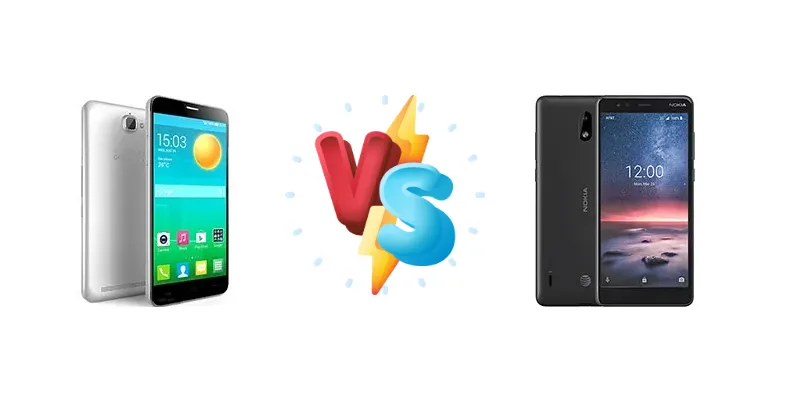
The Alcatel Flash and Nokia 3.1 A represent distinct approaches to the budget smartphone market. The Flash, utilizing an older but octa-core Mediatek chipset, aims for multitasking prowess. Conversely, the Nokia 3.1 A leverages Qualcomm’s Snapdragon 429, prioritizing efficiency and a more modern manufacturing process. This comparison dissects these choices to determine which device delivers the best user experience.
🏆 Quick Verdict
For the average user prioritizing long-term efficiency and a smoother, more responsive experience, the Nokia 3.1 A is the better choice. While the Alcatel Flash boasts more cores, the Snapdragon 429’s superior architecture and 12nm process translate to better real-world performance and battery life.
| Network |
|---|
| 2G bands | GSM 900 / 1800 / 1900 | GSM 850 / 900 / 1800 / 1900 |
| 3G bands | HSDPA 900 / 2100 | HSDPA 850 / 1700(AWS) / 1900 |
| 4G bands | - | 2, 4, 5, 12, 14, 29, 30 |
| Speed | HSPA | HSPA 42.2/5.76 Mbps, LTE Cat4 150/50 Mbps |
| Technology | GSM / HSPA | GSM / HSPA / LTE |
| Launch |
|---|
| Announced | 2014, September. Released 2014, September | 2019, June. Released 2019, June |
| Status | Discontinued | Discontinued |
| Body |
|---|
| Dimensions | 152.1 x 76.2 x 8.1 mm (5.99 x 3.00 x 0.32 in) | 152.7 x 71.9 x 9.4 mm (6.01 x 2.83 x 0.37 in) |
| SIM | Micro-SIM | Nano-SIM |
| Weight | - | 156 g (5.50 oz) |
| Display |
|---|
| Resolution | 720 x 1280 pixels, 16:9 ratio (~267 ppi density) | 720 x 1440 pixels, 18:9 ratio (~295 ppi density) |
| Size | 5.5 inches, 83.4 cm2 (~72.0% screen-to-body ratio) | 5.45 inches, 76.7 cm2 (~69.8% screen-to-body ratio) |
| Type | IPS LCD | IPS LCD |
| Platform |
|---|
| CPU | Octa-core 1.4 GHz Cortex-A7 | Quad-core 1.8 GHz Cortex-A53 |
| Chipset | Mediatek MT6592M (28 nm) | Qualcomm SDM429 Snapdragon 429 (12 nm) |
| GPU | Mali-450MP4 | Adreno 504 |
| OS | Android 4.4 (KitKat) | Android 9.0 (Pie) |
| Memory |
|---|
| Card slot | microSDHC (dedicated slot) | microSDXC (dedicated slot) |
| Internal | 8GB 1GB RAM | 32GB 2GB RAM |
| | - | eMMC 5.1 |
| Main Camera |
|---|
| Features | LED flash, HDR, panorama | LED flash, HDR, panorama |
| Single | 13 MP, AF | 8 MP, f/2.0, AF |
| Video | 1080p@30fps | 1080p@30fps |
| Selfie camera |
|---|
| Features | - | HDR |
| Single | 5 MP | 5 MP, f/2.2 |
| Video | - | 720p@30fps |
| Sound |
|---|
| 3.5mm jack | Yes | Yes |
| 35mm jack | Yes | Yes |
| Loudspeaker | Yes | Yes |
| Comms |
|---|
| Bluetooth | 4.0, A2DP | 5.0, A2DP, LE |
| NFC | No | No |
| Positioning | GPS | GPS, GLONASS, BDS |
| Radio | FM radio | FM radio |
| USB | microUSB 2.0 | USB Type-C 2.0 |
| WLAN | Wi-Fi 802.11 b/g/n, hotspot | Wi-Fi 802.11 b/g/n |
| Features |
|---|
| Sensors | Accelerometer, proximity, compass | Accelerometer, gyro, proximity |
| Battery |
|---|
| Charging | - | 10W wired |
| Type | Li-Ion 3200 mAh, removable | Li-Ion 2990 mAh, non-removable |
| Misc |
|---|
| Colors | Slate/white | Black |
| Models | 6042D | TA1140 |
| SAR | - | 1.11 W/kg (head) 0.81 W/kg (body) |
alcatel Flash
- Octa-core processor offers theoretical multitasking benefits.
- Potentially lower initial cost due to older chipset.
- May be found with larger storage options.
- Older 28nm process leads to lower power efficiency.
- Cortex-A7 architecture is less performant than Cortex-A53.
- Prone to thermal throttling under sustained load.
Nokia 3.1 A
- More efficient 12nm Snapdragon 429 chipset.
- Modern Cortex-A53 architecture delivers smoother performance.
- Better thermal management reduces throttling.
- 10W wired charging support.
- Quad-core processor may struggle with extremely demanding multitasking.
- Potentially higher initial cost.
- May have limited storage options.
Display Comparison
Display specifications are not provided for either device. However, given their market segment, both likely feature 720p LCD panels. The Nokia 3.1 A’s more modern design may offer slightly slimmer bezels. Without specific brightness or color accuracy data, it’s difficult to definitively declare a winner, but the Nokia’s newer design suggests a potentially more refined visual experience.
Camera Comparison
Camera details are absent beyond the devices themselves. Given the price point, both likely feature basic camera setups. It’s reasonable to assume the Nokia 3.1 A benefits from Qualcomm’s image signal processing (ISP), potentially offering slightly better image quality and faster processing times. Without sensor size or aperture information, a definitive camera comparison is impossible, but Qualcomm’s ISP generally provides an edge in software-based image enhancement.
Performance
The core difference lies in the chipsets. The Alcatel Flash’s Mediatek MT6592M, built on a 28nm process, features eight Cortex-A7 cores clocked at 1.4 GHz. While the core count is higher, the Cortex-A7 architecture is significantly older and less efficient than the Cortex-A53 cores found in the Nokia 3.1 A’s Snapdragon 429. The Snapdragon 429, fabricated on a 12nm process, delivers better performance-per-watt. This means the Nokia 3.1 A will likely exhibit smoother app launches, less lag during multitasking, and better sustained performance under load. The 12nm process also generates less heat, reducing the likelihood of thermal throttling, a common issue with the older 28nm MT6592M.
Battery Life
Battery capacity is not specified for either device. However, the Nokia 3.1 A’s Snapdragon 429, with its 12nm process, is significantly more power-efficient than the Alcatel Flash’s MT6592M. This translates to longer battery life on a single charge, even with a similar battery capacity. The Nokia 3.1 A also supports 10W wired charging, which, while not fast, is a standard offering in this price range. The Alcatel Flash’s charging speed is unknown, but likely comparable or slower due to the less efficient chipset.
Buying Guide
Buy the Alcatel Flash if you absolutely need the theoretical advantage of eight cores for heavily multi-threaded tasks, and are willing to accept potential thermal throttling and reduced battery life. Buy the Nokia 3.1 A if you prioritize a consistently smooth user experience, better power efficiency for all-day use, and a more modern chipset architecture, even with fewer cores.
Frequently Asked Questions
❓ Will the Alcatel Flash struggle with modern mobile games?
The Alcatel Flash’s MT6592M chipset, while having eight cores, is based on an older architecture. While it can run some less demanding games, expect low frame rates and potential stuttering in more graphically intensive titles. The Snapdragon 429 in the Nokia 3.1 A will provide a more consistent, albeit still modest, gaming experience.
❓ Is the Snapdragon 429 sufficient for everyday tasks like browsing and social media?
Yes, the Snapdragon 429 is perfectly adequate for everyday tasks. Its Cortex-A53 cores and efficient 12nm process ensure smooth performance for browsing, social media, messaging, and basic app usage. It’s a significant step up from the older Mediatek chipset in the Alcatel Flash for these common scenarios.
❓ Does the Nokia 3.1 A support fast charging?
The Nokia 3.1 A supports 10W wired charging, which is a standard charging speed for budget smartphones. It's not 'fast charging' in the modern sense (like 25W or higher), but it will still charge the device adequately overnight or during downtime.
❓ How much does the older chipset in the Alcatel Flash affect long-term performance?
The MT6592M’s 28nm process generates more heat, which can lead to thermal throttling over time. This means that sustained performance will decrease as the phone heats up, impacting app responsiveness and overall usability. The Nokia 3.1 A’s Snapdragon 429 is less susceptible to this issue.