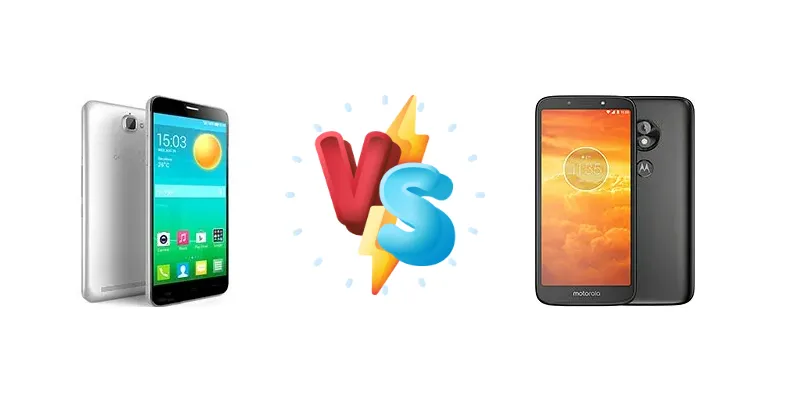
Both the Alcatel Flash and Motorola Moto E5 Play Go represent the ultra-budget end of the smartphone spectrum. While both aim to deliver essential smartphone functionality at a low price point, they take fundamentally different approaches to processing power. The Alcatel Flash leverages an octa-core Mediatek chipset, while the Moto E5 Play Go opts for a quad-core Qualcomm Snapdragon. This comparison dissects these architectural choices to determine which device offers the best user experience.
🏆 Quick Verdict
For users prioritizing multitasking and responsiveness, the Alcatel Flash emerges as the better choice. Its octa-core Mediatek MT6592M processor, despite sharing the same 28nm process as the Snapdragon 425, offers a theoretical performance advantage. However, the Moto E5 Play Go may provide slightly better power efficiency for basic tasks.
| Network |
|---|
| 2G bands | GSM 900 / 1800 / 1900 | GSM 850 / 900 / 1800 / 1900 |
| 3G bands | HSDPA 900 / 2100 | HSDPA 850 / 900 / 1700(AWS) / 1900 / 2100 |
| 4G bands | - | 2, 4, 5, 13 |
| Speed | HSPA | HSPA, LTE |
| Technology | GSM / HSPA | GSM / CDMA / HSPA / LTE |
| | - | CDMA 800 / 1900 |
| Launch |
|---|
| Announced | 2014, September. Released 2014, September | 2018, July. Released 2018, August |
| Status | Discontinued | Discontinued |
| Body |
|---|
| Dimensions | 152.1 x 76.2 x 8.1 mm (5.99 x 3.00 x 0.32 in) | 7.6 mm thickness |
| SIM | Micro-SIM | Nano-SIM |
| Weight | - | 150.3 g (5.29 oz) |
| Display |
|---|
| Resolution | 720 x 1280 pixels, 16:9 ratio (~267 ppi density) | 480 x 960 pixels, 18:9 ratio (~206 ppi density) |
| Size | 5.5 inches, 83.4 cm2 (~72.0% screen-to-body ratio) | 5.2 inches, 69.8 cm2 |
| Type | IPS LCD | IPS LCD |
| Platform |
|---|
| CPU | Octa-core 1.4 GHz Cortex-A7 | Quad-core 1.4 GHz Cortex-A53 |
| Chipset | Mediatek MT6592M (28 nm) | Qualcomm MSM8917 Snapdragon 425 (28 nm) |
| GPU | Mali-450MP4 | Adreno 308 |
| OS | Android 4.4 (KitKat) | Android 8.0 Oreo (Go edition) |
| Memory |
|---|
| Card slot | microSDHC (dedicated slot) | microSDXC (dedicated slot) |
| Internal | 8GB 1GB RAM | 16GB 1GB RAM |
| | - | eMMC 5.1 |
| Main Camera |
|---|
| Features | LED flash, HDR, panorama | LED flash, panorama, HDR |
| Single | 13 MP, AF | 8 MP, f/2.0, 1.12 µm, AF |
| Video | 1080p@30fps | 1080p@30fps |
| Selfie camera |
|---|
| Features | - | LED flash |
| Single | 5 MP | 5 MP |
| Sound |
|---|
| 3.5mm jack | Yes | Yes |
| 35mm jack | Yes | Yes |
| Loudspeaker | Yes | Yes |
| Comms |
|---|
| Bluetooth | 4.0, A2DP | 4.2, A2DP |
| NFC | No | No |
| Positioning | GPS | GPS, GLONASS |
| Radio | FM radio | FM radio |
| USB | microUSB 2.0 | microUSB 2.0 |
| WLAN | Wi-Fi 802.11 b/g/n, hotspot | Wi-Fi 802.11 b/g/n |
| Features |
|---|
| Sensors | Accelerometer, proximity, compass | Accelerometer |
| Battery |
|---|
| Type | Li-Ion 3200 mAh, removable | Li-Ion 2800 mAh battery |
| Misc |
|---|
| Colors | Slate/white | Black, Dark lake, Flash gray |
| Models | 6042D | XT1921, MOTXT19218PP |
| Price | - | About 70 EUR |
alcatel Flash
- Octa-core processor offers better multitasking capabilities.
- Potentially faster app loading times.
- More responsive user interface for demanding tasks.
- Older Cortex-A7 architecture is less efficient per core.
- May experience more heat under sustained load.
- Battery life could be shorter than the Moto E5 Play Go.
Motorola Moto E5 Play Go
- Qualcomm Snapdragon 425 is power-efficient.
- Potentially longer battery life for basic usage.
- Stable and reliable performance for everyday tasks.
- Quad-core processor may struggle with multitasking.
- Slower app loading times compared to the Alcatel Flash.
- Less responsive user interface under heavy load.
Display Comparison
Neither device's display specifications are provided, so a direct comparison is impossible. However, given their market segment, both likely feature 720p LCD panels. The user experience will likely be similar, with color accuracy and brightness being the primary differentiators, which are unknown. Bezels are also likely to be substantial on both devices, reflecting their budget nature.
Camera Comparison
Without specific camera sensor details, a meaningful comparison is limited. Both devices likely feature basic camera setups geared towards casual photography. The absence of information prevents analysis of aperture, sensor size, or image stabilization. It's reasonable to assume both will struggle in low-light conditions. Any 2MP or lower resolution secondary cameras on either device are unlikely to provide significant value.
Performance
The core difference lies in the CPU architecture. The Alcatel Flash’s Mediatek MT6592M boasts eight Cortex-A7 cores clocked at 1.4 GHz. This contrasts with the Motorola Moto E5 Play Go’s Qualcomm MSM8917 Snapdragon 425, which utilizes four Cortex-A53 cores at the same clock speed. While clock speed is identical, the Cortex-A7 architecture is older and less efficient per core than the Cortex-A53. However, the sheer number of cores in the Alcatel Flash should translate to better performance in multi-threaded applications and multitasking. The Snapdragon 425 benefits from Qualcomm’s optimizations, potentially offering smoother performance in certain scenarios despite having fewer cores. Both chipsets are fabricated on a 28nm process, meaning thermal efficiency will be comparable.
Battery Life
Battery capacity is not specified for either device. However, the Qualcomm Snapdragon 425 is known for its power efficiency. This suggests the Moto E5 Play Go might offer slightly longer battery life during typical usage, even if the Alcatel Flash has a larger battery. Charging wattage is also unknown, making it impossible to compare 0-100% charging times.
Buying Guide
Buy the Alcatel Flash if you frequently switch between apps, enjoy light gaming, or anticipate needing to run multiple processes simultaneously. Its octa-core CPU provides a noticeable advantage in these scenarios. Buy the Motorola Moto E5 Play Go if your primary needs are basic communication – calls, texts, and light social media – and you prioritize potentially longer battery life during those simple tasks. The Snapdragon 425 is optimized for efficiency, even if it lacks the raw power of the Mediatek.
Frequently Asked Questions
❓ Will the Alcatel Flash struggle with graphically intensive games?
The Mediatek MT6592M's GPU is relatively basic. While it can handle some light gaming, demanding titles will likely require significantly reduced graphics settings and may still experience frame rate drops. The Snapdragon 425 would likely perform similarly or slightly worse.
❓ Is the difference in processor cores noticeable in everyday use?
For basic tasks like browsing the web or checking email, the difference will be minimal. However, when switching between multiple apps, editing photos, or running more demanding applications, the Alcatel Flash's octa-core processor should provide a smoother and more responsive experience.
❓ Which phone is better for someone who primarily uses their phone for calls and texts?
The Motorola Moto E5 Play Go is likely the better choice. Its power-efficient Snapdragon 425 processor will contribute to longer battery life during these basic tasks, and the quad-core configuration is sufficient for handling calls and texts without issue.