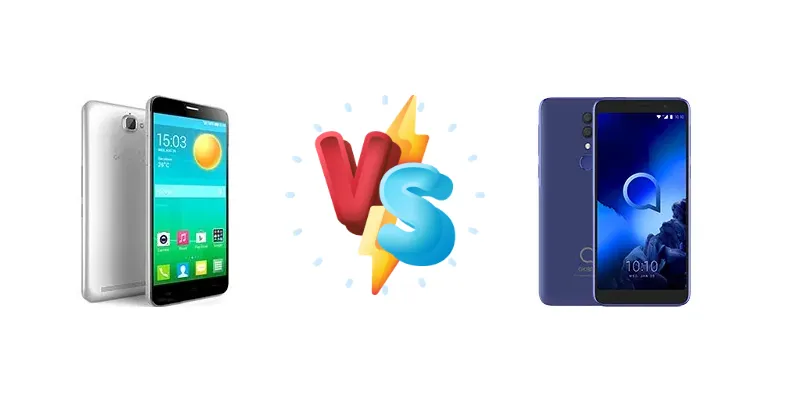
The alcatel Flash and 1x (2019) represent alcatel’s attempts to deliver affordable smartphones. While both target the budget-conscious consumer, they diverge significantly in their core processing power. The Flash boasts an older, octa-core Mediatek MT6592M, while the 1x (2019) opts for the more recent, quad-core MT6739. This comparison dissects these chipset choices to determine which phone offers the better user experience.
🏆 Quick Verdict
For users prioritizing multitasking and potentially more demanding apps, the alcatel Flash is the better choice due to its octa-core processor. However, the alcatel 1x (2019) offers a more efficient chipset, potentially leading to better battery life and smoother performance in less intensive tasks. The 1x is the winner for the average user.
| Network |
|---|
| 2G bands | GSM 900 / 1800 / 1900 | GSM 850 / 900 / 1800 / 1900 |
| 3G bands | HSDPA 900 / 2100 | HSDPA 850 / 900 / 1700(AWS) / 1900 / 2100 - 5059A |
| 4G bands | - | 1, 3, 5, 7, 8, 28, 38, 40 - 5008T |
| Speed | HSPA | HSPA 42.2/5.76 Mbps, LTE Cat4 150/50 Mbps |
| Technology | GSM / HSPA | GSM / HSPA / LTE |
| | - | 1, 3, 7, 8, 20, 28 - 5008Y |
| Launch |
|---|
| Announced | 2014, September. Released 2014, September | 2019, January. Released 2019, Q1 |
| Status | Discontinued | Discontinued |
| Body |
|---|
| Dimensions | 152.1 x 76.2 x 8.1 mm (5.99 x 3.00 x 0.32 in) | 146.4 x 68.8 x 8.3 mm (5.76 x 2.71 x 0.33 in) |
| SIM | Micro-SIM | · Nano-SIM· Nano-SIM + Nano-SIM |
| Weight | - | 130 g (4.59 oz) |
| Display |
|---|
| Resolution | 720 x 1280 pixels, 16:9 ratio (~267 ppi density) | 720 x 1440 pixels, 18:9 ratio (~293 ppi density) |
| Size | 5.5 inches, 83.4 cm2 (~72.0% screen-to-body ratio) | 5.5 inches, 78.1 cm2 (~77.5% screen-to-body ratio) |
| Type | IPS LCD | IPS LCD |
| Platform |
|---|
| CPU | Octa-core 1.4 GHz Cortex-A7 | Quad-core 1.5 GHz Cortex-A53 |
| Chipset | Mediatek MT6592M (28 nm) | Mediatek MT6739 (28 nm) |
| GPU | Mali-450MP4 | PowerVR GE8100 |
| OS | Android 4.4 (KitKat) | Android 8.1 (Oreo) |
| Memory |
|---|
| Card slot | microSDHC (dedicated slot) | microSDXC |
| Internal | 8GB 1GB RAM | 16GB 2GB RAM |
| | - | eMMC 5.1 |
| Main Camera |
|---|
| Dual | - | 13 MP
2 MP |
| Features | LED flash, HDR, panorama | LED flash, HDR |
| Single | 13 MP, AF | - |
| Video | 1080p@30fps | 1080p@30fps |
| Selfie camera |
|---|
| Features | - | LED flash |
| Single | 5 MP | 5 MP |
| Video | - | 720p |
| Sound |
|---|
| 3.5mm jack | Yes | Yes |
| 35mm jack | Yes | Yes |
| Loudspeaker | Yes | Yes |
| Comms |
|---|
| Bluetooth | 4.0, A2DP | 4.2, A2DP, LE |
| NFC | No | No |
| Positioning | GPS | GPS |
| Radio | FM radio | FM radio |
| USB | microUSB 2.0 | microUSB 2.0 |
| WLAN | Wi-Fi 802.11 b/g/n, hotspot | Wi-Fi 802.11 b/g/n, Wi-Fi Direct |
| Features |
|---|
| Sensors | Accelerometer, proximity, compass | Fingerprint (rear-mounted, 5008T only), accelerometer, proximity |
| Battery |
|---|
| Type | Li-Ion 3200 mAh, removable | Li-Ion 3000 mAh, removable |
| Misc |
|---|
| Colors | Slate/white | Pebble Blue, Pebble Black |
| Models | 6042D | 5008T, 5008Y, 5008U, 5008R, 5008D_EEA, 5008Y_EEA, 5008D |
| Price | - | About 120 EUR |
alcatel Flash
- Octa-core processor offers potential for better multitasking.
- May handle more demanding apps and future updates better.
- Potentially better performance in heavily threaded applications.
- Older Cortex-A7 architecture is less efficient.
- Likely higher power consumption compared to the 1x (2019).
- May experience more thermal throttling under sustained load.
alcatel 1x (2019)
- More efficient Cortex-A53 architecture.
- Likely better battery life.
- Potentially smoother performance in everyday tasks.
- Quad-core processor may struggle with heavy multitasking.
- Lower peak performance compared to the Flash.
- May not age as gracefully with future software demands.
Display Comparison
Neither device’s display specifications are available in the provided data. However, given their market segment, it’s reasonable to assume both utilize LCD panels with 720p resolutions. The lack of information prevents a comparison of brightness, color accuracy, or viewing angles. The 28nm fabrication process of both chipsets suggests neither phone will drive a particularly demanding display.
Camera Comparison
No camera specifications are provided. Given the price point, both phones likely feature basic camera setups. Without sensor size, aperture, or image processing details, a meaningful comparison is impossible. It’s safe to assume image quality will be adequate for casual snapshots but not competitive with higher-end devices.
Performance
The core difference lies in the chipsets. The alcatel Flash’s Mediatek MT6592M features eight Cortex-A7 cores clocked at 1.4 GHz. While the core count is higher, the Cortex-A7 architecture is older and less efficient than the Cortex-A53 found in the alcatel 1x (2019). The 1x (2019) utilizes a quad-core MT6739 with cores clocked slightly higher at 1.5 GHz. This means the 1x (2019) will likely exhibit better single-core performance, crucial for responsive UI navigation, while the Flash may excel in heavily multi-threaded tasks. Both chipsets are built on a 28nm process, indicating similar thermal characteristics, but the A53’s efficiency could give the 1x a slight edge in sustained performance.
Battery Life
Battery capacity data is absent. However, the MT6739 in the alcatel 1x (2019) is generally more power-efficient than the MT6592M. This, combined with the Cortex-A53’s lower power draw, suggests the 1x (2019) will likely offer longer battery life, even with a similar capacity battery. Charging wattage is also unknown, making it difficult to assess charging speeds.
Buying Guide
Buy the alcatel Flash if you frequently switch between apps, enjoy light gaming, or anticipate needing the extra processing headroom for future software updates. Buy the alcatel 1x (2019) if you primarily use your phone for calls, texts, social media, and basic web browsing, and prioritize battery life and a potentially more responsive experience within those limited tasks.
Frequently Asked Questions
❓ Will the alcatel Flash struggle with modern app updates due to its older processor?
The alcatel Flash’s Mediatek MT6592M, while having eight cores, utilizes the older Cortex-A7 architecture. As apps become more demanding, the Flash may experience slowdowns or compatibility issues with future updates, especially those optimized for newer processor designs. The 1x (2019) is likely to handle updates more gracefully.
❓ Is the quad-core processor in the alcatel 1x (2019) sufficient for basic social media and web browsing?
Yes, the quad-core Mediatek MT6739 and Cortex-A53 cores in the alcatel 1x (2019) are perfectly adequate for everyday tasks like social media, web browsing, and messaging. The A53 architecture is designed for efficiency, providing a smooth experience for these less demanding applications.
❓ Which phone is better for playing casual mobile games?
While neither phone is a gaming powerhouse, the alcatel Flash’s octa-core processor *might* offer a slight advantage in some games. However, the older architecture could limit sustained performance. The 1x (2019) will likely provide a more consistent, albeit less powerful, gaming experience.