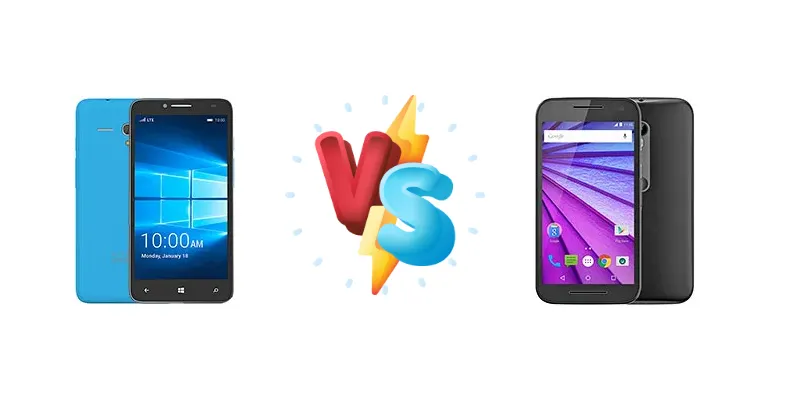
In a market dominated by iOS and Android, the Alcatel Fierce XL represented a dwindling effort to maintain a Windows Phone presence. We revisit this device alongside the popular Motorola Moto G (3rd gen) to understand the trade-offs between the two platforms and their underlying hardware, particularly for users seeking a low-cost smartphone experience.
🏆 Quick Verdict
For the average user in 2024, the Motorola Moto G (3rd gen) is the clear winner. While both phones offer similar battery endurance at 76 hours, the Moto G’s Snapdragon 410 provides a significantly more capable processing experience, and benefits from continued software support, unlike the abandoned Windows ecosystem.
| Network |
|---|
| 2G bands | GSM 850 / 900 / 1800 / 1900 | GSM 850 / 900 / 1800 / 1900 |
| 3G bands | HSDPA 850 / 1700(AWS) / 1900 / 2100 | HSDPA 900 / 2100 - XT1541 |
| 4G bands | 2, 4, 12 | 1, 3, 7, 8, 20 - XT1541 |
| Speed | HSPA 42.2/5.76 Mbps, LTE Cat4 150/50 Mbps | HSPA 42.2/5.76 Mbps, LTE Cat4 150/50 Mbps |
| Technology | GSM / HSPA / LTE | GSM / CDMA / HSPA / LTE |
| | - | 2, 4, 5, 12, 17, 25, 26, 41 - XT1548 |
| Launch |
|---|
| Announced | 2016, January. Released 2016, February | 2015, July. Released 2015, July |
| Status | Discontinued | Discontinued |
| Body |
|---|
| Build | - | Glass front (Gorilla Glass 3), plastic back, plastic frame |
| Dimensions | 151.9 x 77.8 x 9.5 mm (5.98 x 3.06 x 0.37 in) | 142.1 x 72.4 x 11.6 mm (5.59 x 2.85 x 0.46 in) |
| SIM | Micro-SIM | Micro-SIM |
| Weight | 174 g (6.14 oz) | 155 g (5.47 oz) |
| | Splash and dust resistant | IPX7 water resistant up to 1 meter and 30 minutes |
| Display |
|---|
| Protection | Asahi Dragontrail Glass | Corning Gorilla Glass 3 |
| Resolution | 720 x 1280 pixels, 16:9 ratio (~267 ppi density) | 720 x 1280 pixels, 16:9 ratio (~294 ppi density) |
| Size | 5.5 inches, 83.4 cm2 (~70.6% screen-to-body ratio) | 5.0 inches, 68.9 cm2 (~67.0% screen-to-body ratio) |
| Type | IPS LCD | IPS LCD |
| Platform |
|---|
| CPU | Quad-core 1.1 GHz Cortex-A7 | Quad-core 1.4 GHz Cortex-A53 |
| Chipset | Qualcomm MSM8909 Snapdragon 210 (28 nm) | Qualcomm MSM8916 Snapdragon 410 (28 nm) |
| GPU | Adreno 304 | Adreno 306 |
| OS | Microsoft Windows 10 | Android 5.1.1 (Lollipop), upgradable to 6.0 (Marshmallow) |
| Memory |
|---|
| Card slot | microSDHC (dedicated slot) | microSDHC (dedicated slot) |
| Internal | 16GB 2GB RAM | 8GB 1GB RAM, 16GB 2GB RAM |
| | eMMC 4.5 | eMMC 4.5 |
| Main Camera |
|---|
| Features | LED flash | Dual-LED dual-tone flash, panorama |
| Single | 8 MP, AF | 13 MP, f/2.0, AF |
| Video | 720p@30fps | 1080p@30fps, HDR |
| Selfie camera |
|---|
| Features | - | HDR |
| Single | 2 MP | 5 MP, f/2.2 |
| Sound |
|---|
| 3.5mm jack | Yes | Yes |
| 35mm jack | Yes | Yes |
| Loudspeaker | Yes | Yes |
| Comms |
|---|
| Bluetooth | 4.1, A2DP | 4.0, A2DP, LE, aptX |
| NFC | No | No |
| Positioning | GPS, GLONASS | GPS, GLONASS, BDS |
| Radio | FM radio | FM radio |
| USB | microUSB 2.0 | microUSB 2.0, OTG |
| WLAN | Wi-Fi 802.11 b/g/n, hotspot | Wi-Fi 802.11 b/g/n, hotspot |
| Features |
|---|
| Sensors | Accelerometer, proximity, compass | Accelerometer, proximity |
| Battery |
|---|
| Stand-by | Up to 820 h (3G) | - |
| Talk time | Up to 14 h (3G) | - |
| Type | Li-Ion 2500 mAh, non-removable | Li-Ion 2470 mAh, non-removable |
| Misc |
|---|
| Colors | Light Blue | Black, White |
| Models | - | XT1541, XT1540, XT1548, Moto G3 |
| Price | - | About 170 EUR |
| SAR | - | 1.06 W/kg (head) 1.13 W/kg (body) |
| SAR EU | - | 0.68 W/kg (head) 0.60 W/kg (body) |
| Tests |
|---|
| Audio quality | - |
Noise -91.5dB / Crosstalk -92.6dB |
| Battery life | - |
Endurance rating 76h
|
| Camera | - |
Photo / Video |
| Display | - |
Contrast ratio: 1009:1 (nominal), 2.026 (sunlight) |
| Loudspeaker | - |
Voice 75dB / Noise 69dB / Ring 75dB
|
| Performance | - |
Basemark X: 1866 |
alcatel Fierce XL (Windows)
- Unique Windows Phone experience (for collectors)
- Potentially lower price point (due to age and discontinued support)
- Compact form factor (likely, given the era)
- Discontinued software support and security updates
- Significantly weaker processor performance
- Limited app availability
Motorola Moto G (3rd gen)
- Continued Android software support and updates (though aging)
- More powerful Snapdragon 410 processor
- Access to the Google Play Store and a vast app ecosystem
- Battery life, while good, isn't exceptional by modern standards
- Camera performance is likely basic
- May show its age in demanding applications
Display Comparison
Both devices share a contrast ratio of 1009:1 (nominal) and 2.026 (sunlight), suggesting similar outdoor visibility. However, the context data lacks specifics on resolution or panel type. Given the price points, both likely utilize IPS LCDs. The Moto G’s larger market share likely benefited from more rigorous display calibration, potentially resulting in slightly more accurate color reproduction, though this is speculative without further data. The shared contrast ratio indicates a similar viewing experience in direct sunlight.
Camera Comparison
Both devices are listed as having 'Photo / Video' capabilities, but lack any specific details regarding sensor size, aperture, or image processing. Given the budget nature of both phones, image quality is likely to be comparable – adequate for casual snapshots in good lighting conditions, but struggling in low light. The absence of details suggests neither phone prioritizes camera performance as a key selling point. The lack of information prevents a meaningful comparison beyond acknowledging both offer basic photographic functionality.
Performance
The Motorola Moto G (3rd gen) holds a distinct advantage in processing power. Its Qualcomm MSM8916 Snapdragon 410, featuring quad-core 1.4 GHz Cortex-A53 cores, outperforms the Alcatel Fierce XL’s Snapdragon 210 (quad-core 1.1 GHz Cortex-A7). The Cortex-A53 architecture is a significant step up from the A7, offering improved instruction set efficiency and overall performance. This translates to faster app loading times, smoother multitasking, and a more responsive user interface on the Moto G. The 28nm fabrication process is shared, meaning thermal differences will be primarily driven by workload and software optimization, favoring the Moto G due to its more efficient CPU.
Battery Life
Both the Alcatel Fierce XL and Motorola Moto G (3rd gen) achieve an endurance rating of 76 hours, indicating similar battery life under comparable usage scenarios. This suggests that despite the Moto G’s more powerful processor, its power efficiency and software optimization effectively offset the increased power draw. Without knowing the battery capacity (mAh) of either device, it’s difficult to determine if one is more efficient in absolute terms, but the equal endurance rating suggests a balanced approach to power management.
Buying Guide
Buy the Alcatel Fierce XL (Windows) if you are a collector of mobile operating systems or specifically require legacy Windows Phone functionality for a niche application. Buy the Motorola Moto G (3rd gen) if you prioritize a functional, supported Android experience with better performance for everyday tasks, media consumption, and access to a vast app library.
Frequently Asked Questions
❓ Is the Windows Phone operating system on the Alcatel Fierce XL still secure?
No. Microsoft officially ended support for Windows 10 Mobile in January 2020. This means the Alcatel Fierce XL no longer receives security updates, making it vulnerable to potential threats. Using it for sensitive data is strongly discouraged.
❓ Can I install modern apps on the Alcatel Fierce XL?
The app ecosystem for Windows Phone is severely limited. While some legacy apps may still be available through the Windows Store, the vast majority of modern applications are designed for Android or iOS and are not compatible with the Alcatel Fierce XL.
❓ Will the Snapdragon 410 in the Moto G handle basic gaming?
The Snapdragon 410 is capable of handling less demanding 2D games and older 3D titles at lower settings. However, it will struggle with graphically intensive modern games. Expect reduced frame rates and potential lag in more demanding titles.
❓ Is the Motorola Moto G (3rd gen) still receiving software updates?
While the Moto G (3rd gen) is an older device, it received updates to Android 6.0 Marshmallow. However, it is no longer receiving major Android version updates or regular security patches. It's considered end-of-life from a software support perspective.