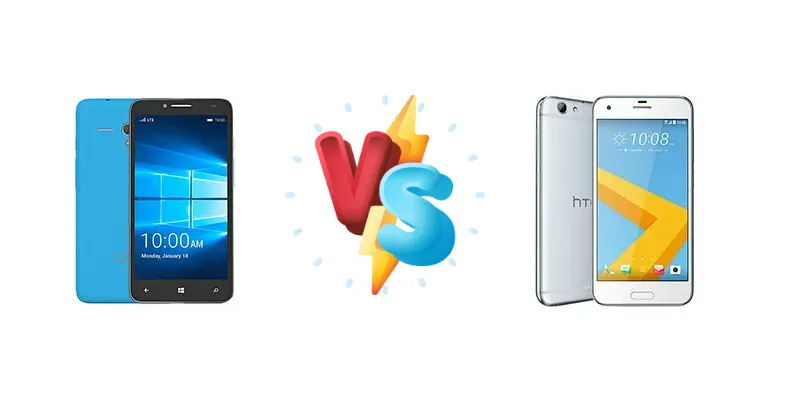
The Alcatel Fierce XL, running Windows, and the HTC One A9s, an Android device, represent different approaches to the budget smartphone market of their time. While both aimed for affordability, they differed significantly in their operating systems and, crucially, their underlying hardware. This comparison dissects the Qualcomm Snapdragon 210 in the Alcatel versus the MediaTek Helio P10 in the HTC, revealing which offered a better user experience given their respective strengths and weaknesses.
🏆 Quick Verdict
For the average user seeking a smoother, more versatile experience, the HTC One A9s is the clear winner. The Helio P10’s octa-core architecture provides a substantial performance advantage over the Snapdragon 210’s quad-core setup, making everyday tasks and even light multitasking noticeably faster. While the Alcatel’s Windows OS might appeal to a niche audience, the A9s’ Android ecosystem and superior processing power offer broader functionality.
| Network |
|---|
| 2G bands | GSM 850 / 900 / 1800 / 1900 | GSM 850 / 900 / 1800 / 1900 |
| 3G bands | HSDPA 850 / 1700(AWS) / 1900 / 2100 | HSDPA 850 / 900 / 1900 / 2100 |
| 4G bands | 2, 4, 12 | 1, 2, 3, 4, 5, 7, 8, 12, 17, 28, 38, 40 |
| Speed | HSPA 42.2/5.76 Mbps, LTE Cat4 150/50 Mbps | HSPA 42.2/5.76 Mbps, LTE (2CA) Cat6 300/50 Mbps |
| Technology | GSM / HSPA / LTE | GSM / HSPA / LTE |
| Launch |
|---|
| Announced | 2016, January. Released 2016, February | 2016, September. Released 2016, November |
| Status | Discontinued | Discontinued |
| Body |
|---|
| Dimensions | 151.9 x 77.8 x 9.5 mm (5.98 x 3.06 x 0.37 in) | 146.5 x 71.5 x 8 mm (5.77 x 2.81 x 0.31 in) |
| SIM | Micro-SIM | Nano-SIM |
| Weight | 174 g (6.14 oz) | 149.8 g (5.29 oz) |
| | Splash and dust resistant | - |
| Display |
|---|
| Protection | Asahi Dragontrail Glass | Corning Gorilla Glass (unspecified version) |
| Resolution | 720 x 1280 pixels, 16:9 ratio (~267 ppi density) | 720 x 1280 pixels, 16:9 ratio (~294 ppi density) |
| Size | 5.5 inches, 83.4 cm2 (~70.6% screen-to-body ratio) | 5.0 inches, 68.9 cm2 (~65.8% screen-to-body ratio) |
| Type | IPS LCD | Super LCD |
| Platform |
|---|
| CPU | Quad-core 1.1 GHz Cortex-A7 | Octa-core (4x1.8 GHz Cortex-A53 & 4x1.0 GHz Cortex-A53) |
| Chipset | Qualcomm MSM8909 Snapdragon 210 (28 nm) | Mediatek MT6755 Helio P10 (28 nm) |
| GPU | Adreno 304 | Mali-T860MP2 |
| OS | Microsoft Windows 10 | Android 6.0 (Marshmallow), Sense UI |
| Memory |
|---|
| Card slot | microSDHC (dedicated slot) | microSDXC (dedicated slot) |
| Internal | 16GB 2GB RAM | 16GB 2GB RAM, 32GB 3GB RAM |
| | eMMC 4.5 | eMMC 5.1 |
| Main Camera |
|---|
| Features | LED flash | LED flash, panorama, HDR |
| Single | 8 MP, AF | 13 MP, f/2.2, 28mm (wide), 1.12µm, AF |
| Video | 720p@30fps | 1080p@30fps |
| Selfie camera |
|---|
| Single | 2 MP | 5 MP, f/2.8, 34mm (standard), 1/5.0", 1.12µm |
| Sound |
|---|
| 3.5mm jack | Yes | Yes |
| 35mm jack | Yes | Yes |
| Loudspeaker | Yes | Yes |
| Comms |
|---|
| Bluetooth | 4.1, A2DP | 4.2, A2DP |
| NFC | No | Yes (payments only) |
| Positioning | GPS, GLONASS | GPS, GLONASS |
| Radio | FM radio | FM radio |
| USB | microUSB 2.0 | microUSB 2.0 |
| WLAN | Wi-Fi 802.11 b/g/n, hotspot | Wi-Fi 802.11 a/b/g/n |
| Features |
|---|
| Sensors | Accelerometer, proximity, compass | Fingerprint (front-mounted), accelerometer, proximity, compass |
| Battery |
|---|
| Charging | - | 10W wired |
| Stand-by | Up to 820 h (3G) | Up to 432 h (3G) |
| Talk time | Up to 14 h (3G) | Up to 13 h (3G) |
| Type | Li-Ion 2500 mAh, non-removable | Li-Ion 2300 mAh, non-removable |
| Misc |
|---|
| Colors | Light Blue | Black, Silver, Gold |
| Models | - | One A9s |
| Price | - | About 150 EUR |
alcatel Fierce XL (Windows)
- Unique Windows Phone OS (for niche users)
- Potentially lower price point (at launch)
- Simple and straightforward user interface
- Significantly weaker performance compared to the A9s
- Limited app ecosystem due to Windows Phone’s decline
- Outdated processor architecture
HTC One A9s
- Faster and more responsive performance with the Helio P10
- Access to the vast Android app ecosystem
- 10W wired charging for quicker top-ups
- May have been slightly more expensive at launch
- Android OS can be more resource-intensive than Windows Phone
- Potential for bloatware (depending on carrier/region)
Display Comparison
Neither device boasts a standout display. Both utilize 28nm chipsets, suggesting a focus on cost reduction rather than visual fidelity. Specific display specs (resolution, panel type) are missing, but given the market segment, both likely featured 720p LCD panels. The A9s, being a slightly more premium offering, *may* have had marginally better color accuracy and viewing angles, but this is speculative. The absence of information on PWM dimming rates prevents assessment of potential eye strain.
Camera Comparison
Camera performance is likely similar – underwhelming. Without specific sensor details, it’s safe to assume both phones featured basic camera modules suitable for casual snapshots. The presence of a 2MP macro camera on either device is largely marketing fluff; its image quality would be severely limited. The Helio P10 *may* offer slightly better image processing capabilities due to its more powerful CPU, but the overall camera experience will be constrained by the sensor quality and lens aperture.
Performance
The core difference lies in the chipsets. The Alcatel Fierce XL’s Qualcomm MSM8909 Snapdragon 210, with its quad-core 1.1 GHz Cortex-A7 CPU, is a decidedly entry-level processor. In contrast, the HTC One A9s’ MediaTek MT6755 Helio P10 features an octa-core configuration (4x1.8 GHz Cortex-A53 & 4x1.0 GHz Cortex-A53). This architectural difference is critical; the Helio P10’s eight cores, even with varying clock speeds, provide significantly more processing power for multitasking and demanding applications. The Cortex-A53 cores in the Helio P10 are also more efficient than the Cortex-A7 cores in the Snapdragon 210, potentially leading to better battery life under load. The 28nm fabrication process is shared, meaning thermal efficiency differences will be primarily driven by workload and software optimization.
Battery Life
Battery capacity is not specified for either device. However, the HTC One A9s benefits from 10W wired charging, a feature likely absent on the Alcatel Fierce XL. While charging speed isn’t everything, 10W allows for a faster top-up, reducing downtime. The more efficient Helio P10 chipset in the A9s also contributes to potentially longer battery life, especially during moderate usage. Without knowing the mAh ratings, it’s difficult to definitively declare a winner, but the A9s’ charging capability and chipset efficiency give it an edge.
Buying Guide
Buy the Alcatel Fierce XL (Windows) if you specifically require a Windows Phone experience and prioritize simplicity over performance. Its appeal is limited to users deeply invested in the Microsoft ecosystem. Buy the HTC One A9s if you prefer the flexibility and app availability of Android, and need a phone capable of handling more than just basic calling and texting. The A9s offers a significantly better user experience for the vast majority of smartphone tasks.
Frequently Asked Questions
❓ Is the Windows Phone operating system on the Alcatel Fierce XL still supported with security updates?
No. Microsoft officially ended support for Windows Phone in January 2020. This means the Alcatel Fierce XL no longer receives security updates, making it vulnerable to potential threats. Using it for sensitive tasks is strongly discouraged.
❓ Can the HTC One A9s handle modern Android apps and updates?
The HTC One A9s, while an older device, can generally run most modern Android apps. However, performance may be sluggish with demanding games or resource-intensive applications. It likely received updates to Android 7.0 Nougat or 8.0 Oreo, but is unlikely to receive further major Android version updates.
❓ Would the Alcatel Fierce XL be a good choice for someone completely new to smartphones?
While its simplicity might appeal to a first-time smartphone user, the lack of app availability and security updates make it a poor choice. The limited functionality and potential security risks outweigh the benefits of a simplified interface.
❓ Does the Helio P10 in the HTC One A9s support 4G LTE connectivity?
Yes, the MediaTek Helio P10 is a 4G LTE-enabled chipset. The HTC One A9s supports 4G LTE bands, allowing for fast data speeds where available. Specific band compatibility will vary by region and carrier.