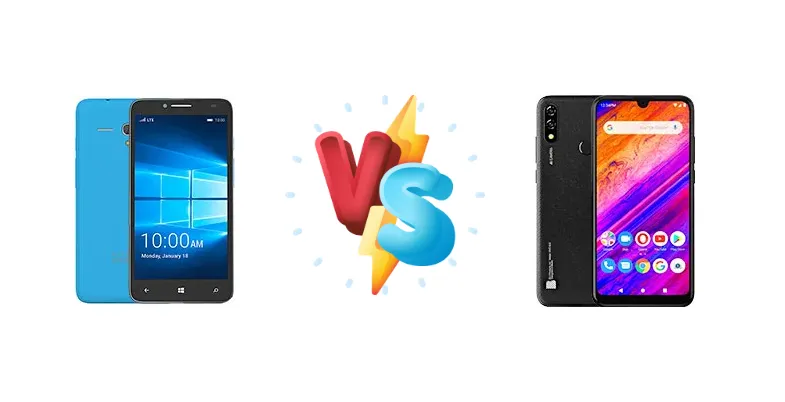
The Alcatel Fierce XL, running Windows, represents a dwindling breed of devices, while the BLU Vivo XL5 is a contemporary Android offering. This comparison isn't about flagship features; it's about understanding where each phone delivers the most value for users prioritizing basic functionality and affordability. The core difference lies in their processors: a dated Qualcomm Snapdragon 210 versus a more modern octa-core Cortex-A55.
🏆 Quick Verdict
For the average user in 2024, the BLU Vivo XL5 is the clear winner. Its octa-core Cortex-A55 CPU provides a significantly more responsive experience than the Alcatel Fierce XL’s quad-core Snapdragon 210, especially for multitasking and modern app usage. While the Fierce XL’s Windows OS might appeal to a niche audience, the Vivo XL5’s Android ecosystem and superior processing power offer broader utility.
| Network |
|---|
| 2G bands | GSM 850 / 900 / 1800 / 1900 | GSM 850 / 900 / 1800 / 1900 |
| 3G bands | HSDPA 850 / 1700(AWS) / 1900 / 2100 | HSDPA 850 / 1700(AWS) / 1900 |
| 4G bands | 2, 4, 12 | 2, 4, 5, 12, 17 |
| Speed | HSPA 42.2/5.76 Mbps, LTE Cat4 150/50 Mbps | HSPA 42.2/11.5 Mbps, LTE Cat4 150/50 Mbps |
| Technology | GSM / HSPA / LTE | GSM / HSPA / LTE |
| Launch |
|---|
| Announced | 2016, January. Released 2016, February | 2019, July. Released 2019, July |
| Status | Discontinued | Discontinued |
| Body |
|---|
| Dimensions | 151.9 x 77.8 x 9.5 mm (5.98 x 3.06 x 0.37 in) | 161.4 x 78 x 9.6 mm (6.35 x 3.07 x 0.38 in) |
| SIM | Micro-SIM | Nano-SIM + Nano-SIM |
| Weight | 174 g (6.14 oz) | 181 g (6.38 oz) |
| | Splash and dust resistant | - |
| Display |
|---|
| Protection | Asahi Dragontrail Glass | - |
| Resolution | 720 x 1280 pixels, 16:9 ratio (~267 ppi density) | 720 x 1520 pixels, 19:9 ratio (~267 ppi density) |
| Size | 5.5 inches, 83.4 cm2 (~70.6% screen-to-body ratio) | 6.3 inches, 99.1 cm2 (~78.7% screen-to-body ratio) |
| Type | IPS LCD | IPS LCD |
| Platform |
|---|
| CPU | Quad-core 1.1 GHz Cortex-A7 | Octa-core 1.6 GHz Cortex-A55 |
| Chipset | Qualcomm MSM8909 Snapdragon 210 (28 nm) | - |
| GPU | Adreno 304 | IMG8322 |
| OS | Microsoft Windows 10 | Android 9.0 (Pie) |
| Memory |
|---|
| Card slot | microSDHC (dedicated slot) | microSDXC |
| Internal | 16GB 2GB RAM | 64GB 3GB RAM |
| | eMMC 4.5 | - |
| Main Camera |
|---|
| Dual | - | 13 MP, AF
Auxiliary lens |
| Features | LED flash | LED flash |
| Single | 8 MP, AF | - |
| Video | 720p@30fps | 1080p@30fps |
| Selfie camera |
|---|
| Features | - | LED flash |
| Single | 2 MP | 13 MP |
| Video | - | 1080p@30fps |
| Sound |
|---|
| 3.5mm jack | Yes | Yes |
| 35mm jack | Yes | Yes |
| Loudspeaker | Yes | Yes |
| Comms |
|---|
| Bluetooth | 4.1, A2DP | 4.1, A2DP |
| NFC | No | No |
| Positioning | GPS, GLONASS | GPS |
| Radio | FM radio | FM radio |
| USB | microUSB 2.0 | microUSB 2.0 |
| WLAN | Wi-Fi 802.11 b/g/n, hotspot | Wi-Fi 802.11 b/g/n, Wi-Fi Direct |
| Features |
|---|
| Sensors | Accelerometer, proximity, compass | Fingerprint (rear-mounted), accelerometer, proximity |
| Battery |
|---|
| Stand-by | Up to 820 h (3G) | Up to 750 h (2G) / Up to 650 h (3G) |
| Talk time | Up to 14 h (3G) | Up to 30 h (2G) / Up to 24 h (3G) |
| Type | Li-Ion 2500 mAh, non-removable | Li-Po 4000 mAh, non-removable |
| Misc |
|---|
| Colors | Light Blue | Black |
alcatel Fierce XL (Windows)
- Runs Windows OS (for legacy compatibility)
- Potentially lower price point (due to age)
- May appeal to users specifically seeking a Windows phone
- Outdated processor (Snapdragon 210)
- Limited app availability (Windows Store)
- Slower performance and multitasking
- Less efficient power consumption
BLU Vivo XL5
- More powerful octa-core processor (Cortex-A55)
- Access to the Google Play Store and a wider range of apps
- Smoother multitasking and app performance
- More efficient power consumption
- Runs Android (may not appeal to Windows users)
- Potentially higher price point than the Fierce XL
- Camera quality likely still limited by budget constraints
Display Comparison
Neither device's display specifications are provided, so a direct comparison is limited. However, given the target market, both likely utilize LCD panels. The Fierce XL, being an older device, may suffer from narrower viewing angles and lower color accuracy. The Vivo XL5, being a more recent model, likely benefits from improvements in display technology, potentially offering better brightness and color reproduction. Bezels are also likely to be more substantial on the Fierce XL due to its age.
Camera Comparison
Without specific camera sensor details, a detailed comparison is impossible. However, given the price points of both devices, it’s safe to assume both feature basic camera setups. The Vivo XL5 likely benefits from more advanced image processing algorithms due to its newer chipset, potentially resulting in better image quality in various lighting conditions. The Fierce XL’s camera will likely be limited by its older processor and image signal processor (ISP).
Performance
The performance gap is the most significant differentiator. The BLU Vivo XL5’s octa-core 1.6 GHz Cortex-A55 CPU represents a substantial leap over the Alcatel Fierce XL’s quad-core 1.1 GHz Cortex-A7 processor. The Cortex-A55 architecture is significantly more efficient and offers higher instructions per clock cycle than the older Cortex-A7. This translates to faster app loading times, smoother multitasking, and a more responsive overall user experience on the Vivo XL5. The Snapdragon 210’s 28nm process node is also less efficient than the likely smaller node used in the Vivo XL5’s chipset, leading to potentially higher power consumption and heat generation. The Fierce XL will struggle with modern, demanding applications.
Battery Life
Battery capacity isn't specified for either device. However, the Snapdragon 210’s less efficient 28nm process could lead to faster battery drain on the Alcatel Fierce XL, even with a comparable battery size. The Vivo XL5’s more efficient octa-core processor and potentially optimized software could result in longer battery life. Charging wattage is also unknown, but the Vivo XL5 is more likely to support faster charging technologies.
Buying Guide
Buy the Alcatel Fierce XL (Windows) if you specifically require the Windows operating system for legacy application compatibility or have a strong preference for the Windows interface. However, be prepared for limited app availability and slower performance. Buy the BLU Vivo XL5 if you prioritize a smoother, more versatile user experience with access to the Google Play Store, better multitasking capabilities, and a more future-proofed platform for everyday tasks.
Frequently Asked Questions
❓ Is the Alcatel Fierce XL's Windows OS still receiving security updates?
Given the age of the Alcatel Fierce XL and the decline of Windows Phone, it's highly unlikely that the device is receiving regular security updates. This poses a significant security risk, making it vulnerable to malware and exploits. The BLU Vivo XL5, running Android, benefits from Google's ongoing security updates.
❓ Will the Snapdragon 210 in the Alcatel Fierce XL struggle with modern social media apps like TikTok or Instagram?
Yes, the Snapdragon 210 is likely to struggle significantly with modern social media apps. The processor's limited processing power and RAM will result in slow loading times, laggy performance, and potential crashes. The BLU Vivo XL5’s octa-core processor will provide a much smoother and more enjoyable experience with these apps.
❓ Can I easily transfer my data from an older Android phone to the BLU Vivo XL5?
Yes, Android offers several easy methods for transferring data from older devices, including using the Google Drive backup and restore feature, or using a USB cable and file transfer. BLU also likely provides its own data transfer tools or guides.