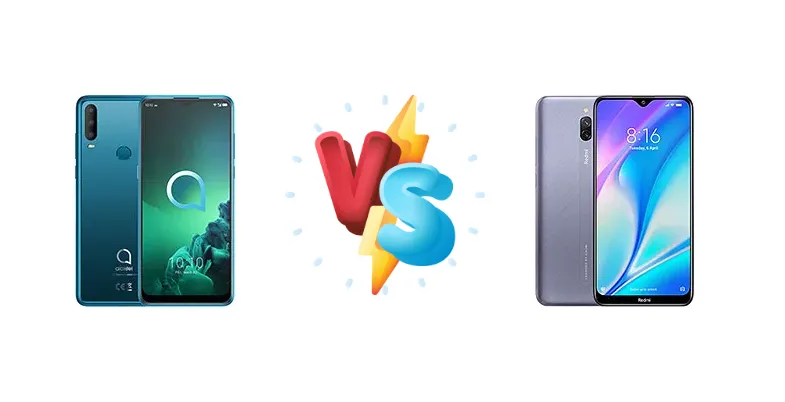
The Alcatel 3x (2019) and Xiaomi Redmi 8A Pro represent two compelling options in the ultra-budget smartphone space. While both aim to deliver essential smartphone functionality at a low price point, they diverge significantly in their core hardware choices, particularly in their chipsets and charging capabilities. This comparison dissects these differences to determine which device offers the best value for users prioritizing performance, battery life, or convenience.
🏆 Quick Verdict
For the average user, the Xiaomi Redmi 8A Pro emerges as the superior choice. Its Qualcomm Snapdragon 439, built on a more efficient 12nm process, offers a slight performance edge and notably faster 18W charging, including reverse wired charging, making it a more versatile and future-proof option.
| Network |
|---|
| 2G bands | GSM 850 / 900 / 1800 / 1900 | GSM 850 / 900 / 1800 / 1900 |
| 3G bands | HSDPA 850 / 900 / 1900 / 2100 - 5048Y | HSDPA 850 / 900 / 1900 / 2100 |
| 4G bands | 1, 3, 5, 7, 8, 20, 28, 38, 40 - 5048Y | 1, 3, 5, 8, 40, 41 |
| Speed | HSPA 42.2/11.5 Mbps, LTE Cat4 150/50 Mbps | HSPA, LTE |
| Technology | GSM / HSPA / LTE | GSM / HSPA / LTE |
| | 1, 2, 3, 4, 5, 7, 8, 12, 13, 17, 28, 66 - 5048A | - |
| Launch |
|---|
| Announced | 2019, September. Released 2019, Q4 | 2020, April 02. Released 2020, April 02 |
| Status | Discontinued | Discontinued |
| Body |
|---|
| Build | Glass front, plastic back, plastic frame | Glass front (Gorilla Glass 5), plastic back, plastic frame |
| Dimensions | 164.9 x 75.8 x 8.4 mm (6.49 x 2.98 x 0.33 in) | 156.5 x 75.4 x 9.4 mm (6.16 x 2.97 x 0.37 in) |
| SIM | · Nano-SIM· Nano-SIM + Nano-SIM | Nano-SIM + Nano-SIM |
| Weight | 178 g (6.28 oz) | 188 g (6.63 oz) |
| | - | Water-repellent coating |
| Display |
|---|
| Protection | - | Corning Gorilla Glass 5 |
| Resolution | 720 x 1600 pixels, 20:9 ratio (~269 ppi density) | 720 x 1520 pixels, 19:9 ratio (~270 ppi density) |
| Size | 6.52 inches, 102.6 cm2 (~82.1% screen-to-body ratio) | 6.22 inches, 96.6 cm2 (~81.8% screen-to-body ratio) |
| Type | IPS LCD | IPS LCD, 400 nits (typ) |
| Platform |
|---|
| CPU | Octa-core (4x2.0 GHz Cortex-A53 & 4x1.5 GHz Cortex-A53) | Octa-core (4x1.95 GHz Cortex-A53 & 4x1.45 GHz Cortex A53) |
| Chipset | Mediatek MT6763V Helio P23 (16 nm) | Qualcomm SDM439 Snapdragon 439 (12 nm) |
| GPU | Mali-G71 MP2 | Adreno 505 |
| OS | Android 9.0 (Pie) | Android 9.0 (Pie), planned upgrade to Android 10, MIUI 12 |
| Memory |
|---|
| Card slot | microSDXC (dedicated slot) | microSDXC (dedicated slot) |
| Internal | 64GB 4GB RAM, 128GB 6GB RAM | 32GB 2GB RAM, 32GB 3GB RAM |
| | eMMC 5.1 | eMMC 5.1 |
| Main Camera |
|---|
| Dual | - | 13 MP, f/2.2, (wide), 1/3.1", 1.12µm, PDAF
Auxiliary lens |
| Features | Dual-LED dual-tone flash, HDR, panorama | LED flash, HDR, panorama |
| Triple | 16 MP, f/1.8, 27mm (wide), 1/2.8", 1.12µm, PDAF
8 MP, f/2.2, 17mm (ultrawide), 1/4.0", 1.12µm
Auxiliary lens | - |
| Video | 1080p@30fps | 1080p@30fps |
| Selfie camera |
|---|
| Features | - | HDR |
| Single | 8 MP, f/2.0, 25mm (wide), 1/4.0", 1.12µm | 8 MP, f/2.0, 1/4.0", 1.12µm |
| Video | 1080p@30fps | 1080p@30fps |
| Sound |
|---|
| 3.5mm jack | Yes | Yes |
| 35mm jack | Yes | Yes |
| Loudspeaker | Yes | Yes |
| Comms |
|---|
| Bluetooth | 4.2, A2DP, LE | 4.2, A2DP, LE |
| NFC | Yes | No |
| Positioning | GPS | GPS, GLONASS, BDS |
| Radio | FM radio | FM Radio, built-in antenna |
| USB | USB Type-C 2.0 | USB Type-C 2.0, OTG |
| WLAN | Wi-Fi 802.11 b/g/n, Wi-Fi Direct | Wi-Fi 802.11 b/g/n, Wi-Fi Direct |
| Features |
|---|
| Sensors | Fingerprint (rear-mounted), accelerometer, proximity | Accelerometer, proximity, compass |
| Battery |
|---|
| Charging | 10W wired | 18W wired
2.5W reverse wired |
| Type | Li-Po 4000 mAh, non-removable | Li-Po 5000 mAh |
| Misc |
|---|
| Colors | Jewelry Black, Jewelry Green, Jewelry Rose | Sky White, Sea Blue, Midnight Grey |
| Models | 5048Y, 5048A, 5048Y_EEA, 5048I, 5048U_EEA | - |
| Price | About 150 EUR | About 90 EUR |
alcatel 3x (2019)
- Potentially lower price point
- Functional for basic smartphone tasks
- Simple and straightforward user experience
- Less efficient chipset (16nm)
- Slower 10W charging
- No reverse charging capability
Xiaomi Redmi 8A Pro
- More efficient chipset (12nm)
- Faster 18W charging
- Reverse wired charging for accessories
- Slightly better performance for multitasking
- May be slightly more expensive
- Similar camera performance to Alcatel 3x
Display Comparison
Neither device boasts a standout display. Both likely feature LCD panels, typical for this price bracket. However, detailed display specs (resolution, brightness) are unavailable. The focus here is on internal components. The absence of high refresh rates or advanced panel technologies is expected, making display quality a secondary consideration for potential buyers.
Camera Comparison
Camera performance is likely similar, given the market segment. Both phones likely feature a primary camera and depth sensor. Without specific sensor size or aperture information, it’s difficult to definitively declare a winner. However, Qualcomm’s image signal processor (ISP) within the Snapdragon 439 generally offers superior image processing capabilities, potentially resulting in slightly better dynamic range and noise reduction in photos taken with the Redmi 8A Pro. The prevalence of 2MP macro lenses on both devices suggests limited utility; these are often included for marketing purposes rather than significant photographic improvement.
Performance
The core difference lies in the chipsets. The Xiaomi Redmi 8A Pro’s Qualcomm Snapdragon 439 (12nm) benefits from a smaller fabrication process compared to the Alcatel 3x’s MediaTek Helio P23 (16nm). This 12nm process generally translates to improved power efficiency and slightly better sustained performance under load. While both CPUs utilize an octa-core configuration with Cortex-A53 cores, the Snapdragon 439’s clock speeds (4x1.95 GHz & 4x1.45 GHz) are marginally higher than the Helio P23’s (4x2.0 GHz & 4x1.5 GHz). This difference, combined with the process node advantage, suggests the Redmi 8A Pro will handle multitasking and moderately demanding apps with greater ease. The GPU within the Snapdragon 439 will also provide a smoother experience for light gaming.
Battery Life
While battery capacity isn't specified, the Redmi 8A Pro’s 18W wired charging is a significant advantage over the Alcatel 3x’s 10W charging. This faster charging speed drastically reduces the time required to replenish the battery, a crucial benefit for users who rely heavily on their smartphones throughout the day. Furthermore, the Redmi 8A Pro includes 2.5W reverse wired charging, allowing it to act as a power bank for accessories like wireless earbuds or smartwatches – a feature absent on the Alcatel 3x.
Buying Guide
Buy the Alcatel 3x (2019) if you need a basic, functional smartphone for essential tasks like calls, texts, and light social media use, and are primarily concerned with minimizing upfront cost. Buy the Xiaomi Redmi 8A Pro if you prioritize slightly better performance for app switching and occasional gaming, faster charging speeds, and the added convenience of reverse wired charging to top up accessories.
Frequently Asked Questions
❓ Will the Redmi 8A Pro's Snapdragon 439 handle popular games like PUBG Mobile?
While not a gaming powerhouse, the Snapdragon 439 in the Redmi 8A Pro can run PUBG Mobile at lower settings (balanced graphics, medium frame rate). Expect occasional frame drops during intense action, but it's playable for casual gaming sessions. The Alcatel 3x's Helio P23 will likely struggle more with consistent performance in demanding titles.
❓ How much faster is the 18W charging on the Redmi 8A Pro compared to the Alcatel 3x's 10W charging?
The 18W charging on the Redmi 8A Pro can reduce charging times by approximately 40-50% compared to the Alcatel 3x's 10W charging. This means a full charge could take around 2-2.5 hours on the Redmi 8A Pro, while the Alcatel 3x might require 4+ hours.
❓ Is the reverse charging feature on the Redmi 8A Pro useful in everyday scenarios?
Yes, the 2.5W reverse charging is surprisingly practical. It's ideal for topping up accessories like wireless earbuds, smartwatches, or even a friend's phone in an emergency. While it won't fully charge a device quickly, it provides a convenient boost when you're on the go.