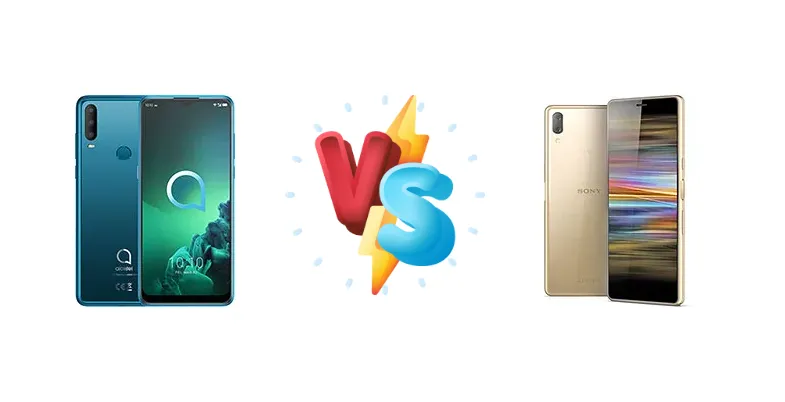
The Alcatel 3x (2019) and Sony Xperia L3 represent a segment of the smartphone market focused on affordability and essential functionality. Both devices aim to deliver a usable experience without breaking the bank, but they achieve this through different approaches to chipset selection and feature prioritization. This comparison dissects their key specifications to determine which device offers the best value for specific user needs.
🏆 Quick Verdict
For the average user prioritizing sustained performance in basic tasks, the Alcatel 3x (2019) edges out the Sony Xperia L3. Its Helio P23, built on a 16nm process, offers a slight performance advantage over the 12nm Helio P22 in the Xperia L3, despite both having identical CPU core configurations. However, the Xperia L3's USB Power Delivery support is a notable convenience.
| Network |
|---|
| 2G bands | GSM 850 / 900 / 1800 / 1900 | GSM 850 / 900 / 1800 / 1900 |
| 3G bands | HSDPA 850 / 900 / 1900 / 2100 - 5048Y | HSDPA 850 / 900 / 1900 / 2100 - I3312, I4312, I4332 |
| 4G bands | 1, 3, 5, 7, 8, 20, 28, 38, 40 - 5048Y | 1, 2, 3, 5, 7, 8, 20, 38 - I3312, I4312 |
| Speed | HSPA 42.2/11.5 Mbps, LTE Cat4 150/50 Mbps | HSPA 42.2/5.76 Mbps, LTE (2CA) Cat6 300/50 Mbps |
| Technology | GSM / HSPA / LTE | GSM / HSPA / LTE |
| | 1, 2, 3, 4, 5, 7, 8, 12, 13, 17, 28, 66 - 5048A | 1, 2, 4, 5, 7, 8, 12, 13, 17, 28, 29 - I3322 |
| Launch |
|---|
| Announced | 2019, September. Released 2019, Q4 | 2019, February. Released 2019, February |
| Status | Discontinued | Discontinued |
| Body |
|---|
| Build | Glass front, plastic back, plastic frame | Glass front (Gorilla Glass 5), plastic back, plastic frame |
| Dimensions | 164.9 x 75.8 x 8.4 mm (6.49 x 2.98 x 0.33 in) | 154 x 72 x 8.9 mm (6.06 x 2.83 x 0.35 in) |
| SIM | · Nano-SIM· Nano-SIM + Nano-SIM | · Nano-SIM· Nano-SIM + Nano-SIM |
| Weight | 178 g (6.28 oz) | 156 g (5.50 oz) |
| Display |
|---|
| Protection | - | Corning Gorilla Glass 5 |
| Resolution | 720 x 1600 pixels, 20:9 ratio (~269 ppi density) | 720 x 1440 pixels, 18:9 ratio (~282 ppi density) |
| Size | 6.52 inches, 102.6 cm2 (~82.1% screen-to-body ratio) | 5.7 inches, 83.8 cm2 (~75.6% screen-to-body ratio) |
| Type | IPS LCD | IPS LCD |
| Platform |
|---|
| CPU | Octa-core (4x2.0 GHz Cortex-A53 & 4x1.5 GHz Cortex-A53) | Octa-core 2.0 GHz Cortex-A53 |
| Chipset | Mediatek MT6763V Helio P23 (16 nm) | Mediatek MT6762 Helio P22 (12 nm) |
| GPU | Mali-G71 MP2 | PowerVR GE8320 |
| OS | Android 9.0 (Pie) | Android 8.0 (Oreo) |
| Memory |
|---|
| Card slot | microSDXC (dedicated slot) | microSDXC (uses shared SIM slot) |
| Internal | 64GB 4GB RAM, 128GB 6GB RAM | 32GB 3GB RAM |
| | eMMC 5.1 | eMMC 5.1 |
| Main Camera |
|---|
| Dual | - | 13 MP, f/2.2, 26mm (wide), 1/3.0", PDAF
Auxiliary lens |
| Features | Dual-LED dual-tone flash, HDR, panorama | LED flash, HDR, panorama |
| Triple | 16 MP, f/1.8, 27mm (wide), 1/2.8", 1.12µm, PDAF
8 MP, f/2.2, 17mm (ultrawide), 1/4.0", 1.12µm
Auxiliary lens | - |
| Video | 1080p@30fps | 1080p@30fps |
| Selfie camera |
|---|
| Single | 8 MP, f/2.0, 25mm (wide), 1/4.0", 1.12µm | 8 MP, f/2.0, 24mm (wide), 1/4.0", 1.12µm |
| Video | 1080p@30fps | 1080p@30fps |
| Sound |
|---|
| 3.5mm jack | Yes | Yes |
| 35mm jack | Yes | Yes |
| Loudspeaker | Yes | Yes |
| Comms |
|---|
| Bluetooth | 4.2, A2DP, LE | 5.0, A2DP, LE |
| NFC | Yes | Yes |
| Positioning | GPS | GPS, GLONASS |
| Radio | FM radio | FM radio |
| USB | USB Type-C 2.0 | USB Type-C 2.0 |
| WLAN | Wi-Fi 802.11 b/g/n, Wi-Fi Direct | Wi-Fi 802.11 a/b/g/n, dual-band, Wi-Fi Direct |
| Features |
|---|
| Sensors | Fingerprint (rear-mounted), accelerometer, proximity | Fingerprint (side-mounted), accelerometer, proximity, compass |
| Battery |
|---|
| Charging | 10W wired | USB Power Delivery |
| Type | Li-Po 4000 mAh, non-removable | Li-Ion 3300 mAh, non-removable |
| Misc |
|---|
| Colors | Jewelry Black, Jewelry Green, Jewelry Rose | Black, Gold, Silver |
| Models | 5048Y, 5048A, 5048Y_EEA, 5048I, 5048U_EEA | I3312, I4312, I4332, I3322 |
| Price | About 150 EUR | About 230 EUR |
| Tests |
|---|
| Audio quality | - |
Noise -91.9dB / Crosstalk -89.3dB |
| Battery life | - |
Endurance rating 80h
|
| Camera | - |
Photo / Video |
| Display | - |
Contrast ratio: 1818:1 (nominal) |
| Loudspeaker | - |
Voice 70dB / Noise 73dB / Ring 81dB
|
| Performance | - |
AnTuTu: 78894 (v7)
GFXBench: 5fps (ES 3.1 onscreen) |
alcatel 3x (2019)
- Slightly better CPU performance due to the Helio P23.
- More affordable price point (likely).
- Acceptable battery life for basic usage.
- Slower 10W charging.
- Less efficient 16nm chipset.
- Limited camera details suggest basic image quality.
Sony Xperia L3
- USB Power Delivery for faster and versatile charging.
- Potentially better power efficiency with the 12nm Helio P22.
- 80h endurance rating provides confidence in battery life.
- Slightly lower CPU performance compared to the Alcatel 3x.
- Limited camera details suggest basic image quality.
- May be slightly more expensive.
Display Comparison
Both the Alcatel 3x (2019) and Sony Xperia L3 share a nominal contrast ratio of 1818:1, suggesting similar display quality in terms of black levels and color depth. However, detailed information regarding screen resolution, brightness (in nits), and color gamut coverage is missing. Given Sony’s historical focus on display technology, it’s reasonable to assume the Xperia L3 may offer slightly better color accuracy and viewing angles, but without concrete data, this remains speculative. The absence of information on PWM dimming frequency prevents assessment of potential eye strain for sensitive users.
Camera Comparison
Both devices are listed as having 'Photo / Video' capabilities, but lack specific details regarding sensor size, aperture, or image processing features. This suggests both cameras are likely entry-level, focusing on basic image capture rather than high-quality photography. The absence of information regarding Optical Image Stabilization (OIS) implies neither phone offers this feature, meaning low-light performance will likely be limited. Any claims of superior image quality would be difficult to substantiate without detailed camera specifications.
Performance
The core difference lies in the chipsets: the Alcatel 3x (2019) utilizes the Mediatek MT6763V Helio P23 (16nm), while the Sony Xperia L3 features the MT6762 Helio P22 (12nm). While both CPUs are octa-core with the same 2.0 GHz Cortex-A53 configuration, the 12nm process of the P22 *should* theoretically offer better power efficiency. However, the P23’s slightly higher clock speeds and potentially more aggressive CPU governor could translate to snappier performance in short bursts. The 16nm node of the P23 may lead to more heat generation under sustained load, potentially causing throttling. Neither chipset is designed for demanding gaming or intensive multitasking.
Battery Life
Both the Alcatel 3x (2019) and Sony Xperia L3 boast an endurance rating of 80 hours, indicating comparable battery life under typical usage scenarios. However, the charging capabilities differ significantly. The Alcatel 3x (2019) supports only 10W wired charging, while the Sony Xperia L3 utilizes USB Power Delivery. USB Power Delivery allows for faster charging speeds and compatibility with a wider range of chargers, offering greater convenience. While both phones offer similar battery capacity (implied by the 80h rating), the Xperia L3’s charging standard provides a tangible advantage.
Buying Guide
Buy the Alcatel 3x (2019) if you need a phone for everyday tasks like social media, messaging, and light web browsing, and value a slightly more responsive experience. Buy the Sony Xperia L3 if you prioritize battery longevity and appreciate the convenience of USB Power Delivery for faster and more versatile charging, even if it means a marginal performance trade-off.
Frequently Asked Questions
❓ Does the Helio P22 chipset in the Sony Xperia L3 struggle with multitasking?
The Helio P22 is a budget-oriented chipset. While capable of handling basic multitasking (switching between messaging, web browsing, and music apps), it will likely exhibit slowdowns with more demanding applications or numerous apps running simultaneously. It's best suited for users who primarily engage in single-tasking or light multitasking.
❓ Is the 10W charging on the Alcatel 3x (2019) significantly slower than USB Power Delivery?
Yes, 10W charging is considerably slower than USB Power Delivery. While a full charge will still occur overnight, topping up the battery quickly requires a longer connection time. USB Power Delivery allows for variable wattage, potentially charging the Xperia L3 much faster with a compatible charger.
❓ Given the lack of detailed camera specs, should I expect good low-light performance from either phone?
No. The absence of OIS and detailed sensor information suggests that low-light performance on both the Alcatel 3x (2019) and Sony Xperia L3 will be limited. Expect noisy images and a lack of detail in dimly lit environments. These cameras are best suited for well-lit conditions.