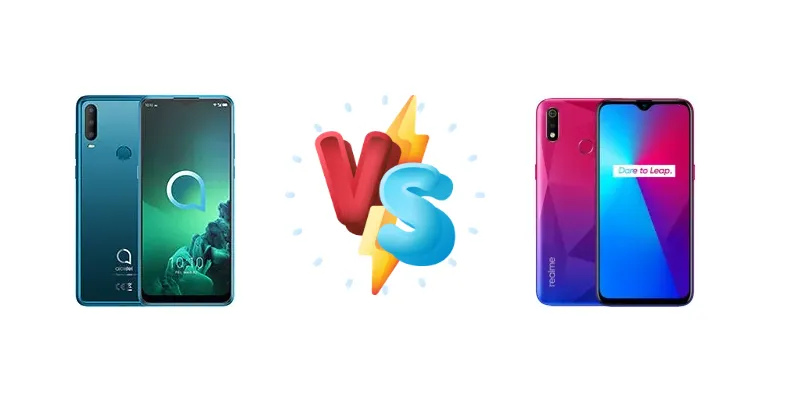
Both the Alcatel 3x (2019) and the Realme 3i targeted the ultra-budget smartphone market, offering essential features at incredibly competitive prices. However, a closer look reveals a key difference in their underlying hardware, specifically the chipset, which significantly impacts performance and user experience. This comparison dissects these differences to help you choose the best option for your needs.
🏆 Quick Verdict
For the average user prioritizing responsiveness and multitasking, the Realme 3i is the clear winner. Its Helio P60 chipset, built on a more efficient 12nm process, provides a noticeable performance advantage over the Alcatel 3x’s Helio P23. While both offer 10W charging, the Realme 3i’s superior processing power justifies its slightly higher price point.
| Network |
|---|
| 2G bands | GSM 850 / 900 / 1800 / 1900 | GSM 850 / 900 / 1800 / 1900 |
| 3G bands | HSDPA 850 / 900 / 1900 / 2100 - 5048Y | HSDPA 850 / 900 / 2100 |
| 4G bands | 1, 3, 5, 7, 8, 20, 28, 38, 40 - 5048Y | 1, 3, 5, 8, 38, 40, 41 |
| Speed | HSPA 42.2/11.5 Mbps, LTE Cat4 150/50 Mbps | HSPA 42.2/5.76 Mbps, LTE (2CA) Cat12 600/50 Mbps |
| Technology | GSM / HSPA / LTE | GSM / HSPA / LTE |
| | 1, 2, 3, 4, 5, 7, 8, 12, 13, 17, 28, 66 - 5048A | - |
| Launch |
|---|
| Announced | 2019, September. Released 2019, Q4 | 2019, July. Released 2019, July |
| Status | Discontinued | Discontinued |
| Body |
|---|
| Build | Glass front, plastic back, plastic frame | Glass front (Gorilla Glass 3), plastic back, plastic frame |
| Dimensions | 164.9 x 75.8 x 8.4 mm (6.49 x 2.98 x 0.33 in) | 156.1 x 75.6 x 8.3 mm (6.15 x 2.98 x 0.33 in) |
| SIM | · Nano-SIM· Nano-SIM + Nano-SIM | Nano-SIM + Nano-SIM |
| Weight | 178 g (6.28 oz) | 175 g (6.17 oz) |
| Display |
|---|
| Protection | - | Corning Gorilla Glass 3 |
| Resolution | 720 x 1600 pixels, 20:9 ratio (~269 ppi density) | 720 x 1520 pixels, 19:9 ratio (~271 ppi density) |
| Size | 6.52 inches, 102.6 cm2 (~82.1% screen-to-body ratio) | 6.2 inches, 95.9 cm2 (~81.3% screen-to-body ratio) |
| Type | IPS LCD | IPS LCD |
| Platform |
|---|
| CPU | Octa-core (4x2.0 GHz Cortex-A53 & 4x1.5 GHz Cortex-A53) | Octa-core (4x2.0 GHz Cortex-A73 & 4x2.0 GHz Cortex-A53) |
| Chipset | Mediatek MT6763V Helio P23 (16 nm) | Mediatek MT6771 Helio P60 (12 nm) |
| GPU | Mali-G71 MP2 | Mali-G72 MP3 |
| OS | Android 9.0 (Pie) | Android 9.0 (Pie), upgradable to Android 10, Realme UI |
| Memory |
|---|
| Card slot | microSDXC (dedicated slot) | microSDXC (dedicated slot) |
| Internal | 64GB 4GB RAM, 128GB 6GB RAM | 32GB 3GB RAM, 64GB 4GB RAM |
| | eMMC 5.1 | eMMC 5.1 |
| Main Camera |
|---|
| Dual | - | 13 MP, f/1.8, 1/3.1", 1.12µm, PDAF
Auxiliary lens |
| Features | Dual-LED dual-tone flash, HDR, panorama | LED flash, HDR |
| Triple | 16 MP, f/1.8, 27mm (wide), 1/2.8", 1.12µm, PDAF
8 MP, f/2.2, 17mm (ultrawide), 1/4.0", 1.12µm
Auxiliary lens | - |
| Video | 1080p@30fps | 1080p@30fps |
| Selfie camera |
|---|
| Features | - | HDR |
| Single | 8 MP, f/2.0, 25mm (wide), 1/4.0", 1.12µm | 13 MP, f/2.0, (wide), 1/3.1", 1.12µm |
| Video | 1080p@30fps | 1080p@30fps |
| Sound |
|---|
| 3.5mm jack | Yes | Yes |
| 35mm jack | Yes | Yes |
| Loudspeaker | Yes | Yes |
| Comms |
|---|
| Bluetooth | 4.2, A2DP, LE | 4.2, A2DP, LE |
| NFC | Yes | No |
| Positioning | GPS | GPS, GLONASS |
| Radio | FM radio | FM radio |
| USB | USB Type-C 2.0 | microUSB 2.0, OTG |
| WLAN | Wi-Fi 802.11 b/g/n, Wi-Fi Direct | Wi-Fi 802.11 b/g/n |
| Features |
|---|
| Sensors | Fingerprint (rear-mounted), accelerometer, proximity | Fingerprint (rear-mounted), accelerometer, proximity |
| Battery |
|---|
| Charging | 10W wired | 10W wired |
| Type | Li-Po 4000 mAh, non-removable | 4230 mAh, non-removable |
| Misc |
|---|
| Colors | Jewelry Black, Jewelry Green, Jewelry Rose | Diamond Blue, Diamond Red, Diamond Black |
| Models | 5048Y, 5048A, 5048Y_EEA, 5048I, 5048U_EEA | RMX1827 |
| Price | About 150 EUR | About 8000 INR |
alcatel 3x (2019)
- Potentially lower price point
- Simple and straightforward user experience
- Reliable for basic communication tasks
- Significantly weaker performance
- Less efficient chipset
- Limited multitasking capabilities
Realme 3i
- Superior performance with Helio P60
- More efficient 12nm process
- Better multitasking and gaming capabilities
- Improved camera image processing
- Slightly higher price
- May not be significantly better for extremely basic use cases
Display Comparison
Neither Alcatel nor Realme provided detailed display specifications beyond resolution in marketing materials. However, both likely utilized IPS LCD panels common in this price bracket. The key difference lies under the hood; the Realme 3i benefits from the more efficient Helio P60, potentially allowing for slightly better color reproduction and brightness control due to reduced thermal constraints. Bezels are expected to be similar on both devices, reflecting the budget nature of the phones.
Camera Comparison
Both phones likely featured similar camera setups focused on basic photography. Detailed sensor information is scarce, but the Realme 3i’s image signal processor (ISP) within the Helio P60 likely offers more advanced image processing capabilities, resulting in better dynamic range and noise reduction compared to the Alcatel 3x. The presence of a dedicated AI scene detection feature on the Realme 3i further enhances its camera performance. Focusing on the primary sensor is crucial, as any secondary sensors (like 2MP depth sensors) are unlikely to provide significant value.
Performance
The Realme 3i’s Mediatek Helio P60 (12nm) represents a substantial upgrade over the Alcatel 3x’s Helio P23 (16nm). The P60 utilizes a more modern CPU architecture – Cortex-A73 cores alongside A53s – compared to the P23’s all-A53 configuration. This translates to a significant performance boost in CPU-intensive tasks and a more fluid user experience. The 12nm process also contributes to better power efficiency, potentially leading to slightly longer battery life under load. While both phones likely feature similar RAM configurations, the P60’s superior processing power will allow it to handle more demanding applications and multitasking scenarios.
Battery Life
Both the Alcatel 3x and Realme 3i support 10W wired charging, meaning similar charging speeds. While battery capacity isn't specified for the Alcatel 3x, the Realme 3i typically came with a 4230mAh battery. The Helio P60’s improved power efficiency in the Realme 3i could offset any potential capacity difference, resulting in comparable real-world battery life. Users should expect around a full day of moderate use from either device, but the Realme 3i may hold up better during demanding tasks.
Buying Guide
Buy the Alcatel 3x (2019) if you need a basic smartphone for essential tasks like calls, texts, and light social media browsing, and are on an extremely tight budget. Buy the Realme 3i if you prefer a smoother, more responsive experience for multitasking, occasional gaming, and generally demand more from your phone without breaking the bank.
Frequently Asked Questions
❓ Will the Realme 3i handle popular games like PUBG Mobile?
The Realme 3i, with its Helio P60, can run PUBG Mobile at medium settings with reasonable frame rates. While it won't deliver a flagship gaming experience, it's significantly more capable than the Alcatel 3x for gaming due to the P60's more powerful GPU.
❓ Is the Alcatel 3x a good choice for someone who primarily uses WhatsApp and makes calls?
Yes, the Alcatel 3x is perfectly adequate for basic tasks like WhatsApp messaging and phone calls. Its Helio P23 chipset is sufficient for these simple functions, and its lower price point makes it a viable option for users with minimal smartphone needs.
❓ Does either phone support fast charging beyond 10W?
Neither the Alcatel 3x nor the Realme 3i support fast charging beyond 10W. Both devices utilize the standard Micro-USB port and 10W charging adapter, resulting in similar charging times.
❓ How does the Realme 3i's processor affect app loading times compared to the Alcatel 3x?
The Realme 3i's Helio P60 will noticeably reduce app loading times compared to the Alcatel 3x's Helio P23. The P60's more powerful CPU and GPU contribute to a smoother and more responsive user experience when launching and using applications.