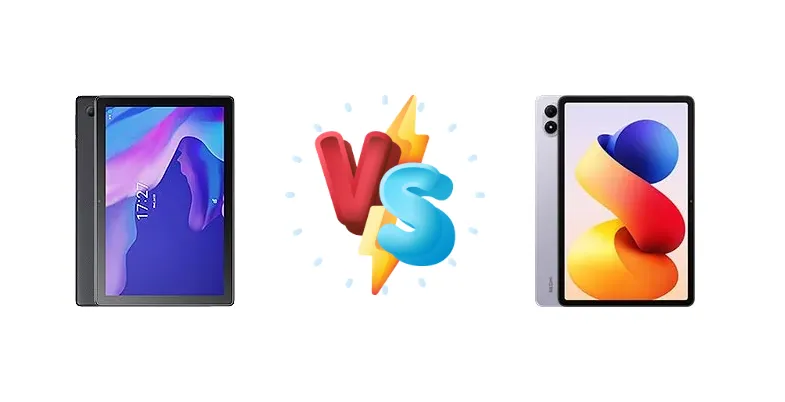
The tablet market offers a wide range of options, but finding the right balance between price and performance can be challenging. We're pitting the entry-level Alcatel 3T10 2020 against the more modern Xiaomi Redmi Pad 2 Pro to determine which tablet delivers the best experience for everyday tasks, streaming, and light productivity.
🏆 Quick Verdict
For most users, the Xiaomi Redmi Pad 2 Pro is the clear winner. Its significantly more powerful Qualcomm Snapdragon 7s Gen 4 chipset, coupled with impressive 103-hour endurance, provides a smoother and more responsive experience than the Alcatel 3T10's aging MediaTek MT8766B. While the Alcatel is cheaper, the Redmi Pad 2 Pro offers a far superior value proposition.
| Network |
|---|
| 2G bands | GSM 850 / 900 / 1800 / 1900 | N/A |
| 3G bands | HSDPA 850 / 900 / 1900 / 2100 | N/A |
| 4G bands | 1, 3, 5, 7, 8, 20, 28, 38, 40, 41 | - |
| EDGE | - | N/A |
| GPRS | - | N/A |
| Speed | HSPA, LTE | - |
| Technology | GSM / HSPA / LTE | No cellular connectivity |
| Launch |
|---|
| Announced | 2020, Q4. Released 2020, Q4 | 2025, September 24 |
| Status | Discontinued | Available. Released 2025, September 24 |
| Body |
|---|
| Build | - | Glass front, aluminum frame, aluminum back |
| Dimensions | 243.3 x 161.2 x 9.4 mm (9.58 x 6.35 x 0.37 in) | 279.8 x 181.7 x 7.5 mm (11.02 x 7.15 x 0.30 in) |
| SIM | Nano-SIM | No |
| Weight | 475 g (1.05 lb) | 610 g (1.34 lb) |
| Display |
|---|
| Protection | - | Mohs level 6 |
| Resolution | 800 x 1280 pixels, 16:10 ratio (~149 ppi density) | 1600 x 2560 pixels, 16:10 ratio (~249 ppi density) |
| Size | 10.1 inches, 295.8 cm2 (~75.4% screen-to-body ratio) | 12.1 inches, 424.5 cm2 (~83.5% screen-to-body ratio) |
| Type | IPS LCD | IPS LCD, 1B colors, 120Hz, Dolby Vision, 600 nits (HBM) |
| Platform |
|---|
| CPU | Quad-core 1.8 GHz | Octa-core (1x2.7 GHz Cortex-A720 & 3x2.4 GHz Cortex-A720 & 4x1.8 GHz Cortex-A520) |
| Chipset | MediaTek MT8766B | Qualcomm SM7635-AC Snapdragon 7s Gen 4 (4 nm) |
| GPU | - | Adreno 810 |
| OS | Android 10 | Android 15, HyperOS 2 |
| Memory |
|---|
| Card slot | microSDXC (dedicated slot) | microSDXC (dedicated slot) |
| Internal | 32GB 2GB RAM | 128GB 6GB RAM, 256GB 8GB RAM |
| Main Camera |
|---|
| Features | - | Color spectrum sensor, LED flash, HDR |
| Single | 5 MP | 8 MP, f/2.0, (wide), 1/4.0", 1.12µm |
| Video | 720p@30fps | 1080p@30fps |
| Selfie camera |
|---|
| Single | 5 MP | 8 MP, f/2.3, (wide), 1/4.0", 1.12µm |
| Video | 720p@30fps | 1080p@30fps |
| Sound |
|---|
| 3.5mm jack | Yes | - |
| 35mm jack | Yes | Yes |
| Loudspeaker | Yes, with dual speakers | Yes, with stereo speakers, Dolby Atmos (4 speakers) |
| Comms |
|---|
| Bluetooth | 5.0, A2DP, LE | 5.4, A2DP, LE, aptX HD, aptX Adaptive |
| NFC | No | No |
| Positioning | No | No |
| Radio | No | No |
| USB | USB Type-C 2.0, OTG | USB Type-C 2.0, OTG |
| WLAN | Wi-Fi 802.11 a/b/g/n | Wi-Fi 802.11 a/b/g/n/a/6, dual-band, Wi-Fi Direct |
| Features |
|---|
| Sensors | Accelerometer, proximity | Accelerometer, gyro, proximity (accessories only), compass |
| Battery |
|---|
| Charging | - | 33W wired, PD3.0, QC3+
27W reverse wired |
| Type | Li-Po 5500 mAh | 12000 mAh |
| Misc |
|---|
| Colors | Black | Graphite Gray, Silver, Lavender Purple, Matte Glass Version |
| Models | - | 25099RP13G |
| Price | About 170 EUR | About 300 EUR |
| EU LABEL |
|---|
| Battery | - | 103:18h endurance, 1000 cycles |
| Energy | - | Class G |
| Free fall | - | Class A (208 falls) |
| Repairability | - | Class C |
alcatel 3T10 2020
- Extremely affordable price point
- Lightweight and portable
- Suitable for basic tasks
- Outdated processor
- Limited performance
- Likely poor battery life
Xiaomi Redmi Pad 2 Pro
- Powerful Snapdragon 7s Gen 4 chipset
- Excellent battery life (103h endurance)
- Fast 33W charging with PD3.0/QC3+
- Reverse wired charging
- Higher price than Alcatel 3T10 2020
- May be overkill for very basic users
Display Comparison
The context data lacks display specifics for both devices. However, given the price point of the Alcatel 3T10 2020, it likely features a standard LCD panel with a 60Hz refresh rate. The Redmi Pad 2 Pro, being a newer device, likely boasts a higher resolution display and potentially a higher refresh rate, contributing to a sharper and smoother visual experience. The Redmi Pad 2 Pro's likely higher brightness will also improve outdoor visibility.
Camera Comparison
Neither device is expected to excel in photography. The Alcatel 3T10 2020's camera specifications are unknown, but likely feature a basic sensor. The Redmi Pad 2 Pro's camera details are also missing, but the focus should be on video conferencing capabilities rather than high-quality photography. The Redmi Pad 2 Pro's more modern ISP (Image Signal Processor) within the Snapdragon chipset will likely deliver slightly better image quality in good lighting conditions.
Performance
The performance gap between these two tablets is substantial. The Alcatel 3T10 2020 relies on the MediaTek MT8766B, a quad-core processor designed for basic functionality. In contrast, the Xiaomi Redmi Pad 2 Pro is powered by the Qualcomm SM7635-AC Snapdragon 7s Gen 4, an octa-core chip built on a more efficient 4nm process. This translates to significantly faster processing speeds, improved multitasking capabilities, and better graphics performance on the Redmi Pad 2 Pro. The Snapdragon's Cortex-A720 cores provide a substantial uplift in single-core performance, crucial for responsive app launches and UI navigation.
Battery Life
The Xiaomi Redmi Pad 2 Pro shines in the battery department. Its reported 103-hour endurance and 12:55-hour active use score are impressive, indicating excellent power efficiency. The 33W wired charging with PD3.0 and QC3+ support allows for rapid recharging. The Alcatel 3T10 2020's battery capacity and charging speed are unknown, but are likely significantly lower, resulting in shorter usage times and slower charging.
Buying Guide
Buy the Alcatel 3T10 2020 if you need an extremely affordable tablet for basic tasks like reading ebooks, simple web browsing, and occasional video calls, and are willing to accept noticeable performance limitations. Buy the Xiaomi Redmi Pad 2 Pro if you prioritize a fluid user experience, longer battery life, faster charging, and the ability to handle more demanding apps and multitasking without significant slowdowns.
Frequently Asked Questions
❓ Is the Snapdragon 7s Gen 4 in the Redmi Pad 2 Pro capable of handling demanding games?
While not a flagship-level chip, the Snapdragon 7s Gen 4 is a significant step up from the Alcatel's processor. It can handle many popular mobile games at medium settings, providing a playable experience. However, for graphically intensive titles, you may need to lower the settings further.
❓ Does the Redmi Pad 2 Pro support expandable storage via microSD card?
Unfortunately, the context data does not specify microSD card support for the Redmi Pad 2 Pro. However, many Xiaomi tablets do *not* include microSD slots, so it's likely you'll need to rely on the internal storage option you choose at purchase.
❓ How does the 33W charging on the Redmi Pad 2 Pro translate to real-world charging times?
With 33W charging, the Redmi Pad 2 Pro can likely charge from 0% to 100% in approximately 1.5 to 2 hours, depending on usage during charging. This is considerably faster than the charging speeds typically found on tablets in the Alcatel 3T10 2020's price range.