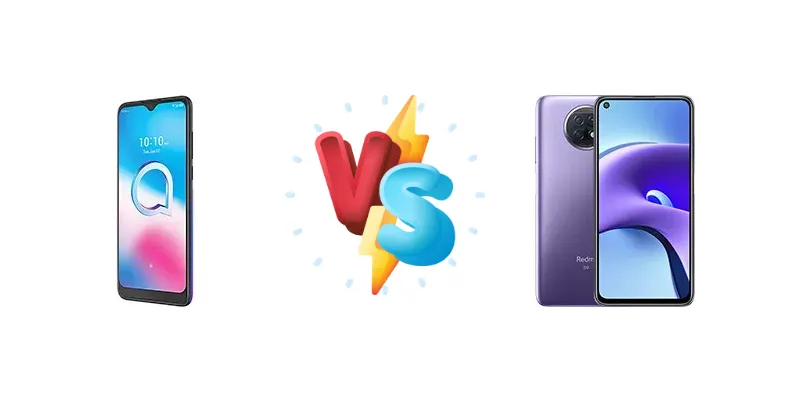
The budget smartphone market is fiercely competitive, offering incredible value for money. Today, we're pitting two contenders against each other: the Alcatel 3L (2020) and the Xiaomi Redmi Note 9T. Both aim to deliver a solid experience without breaking the bank, but which one comes out on top?
🏆 Quick Verdict
The Xiaomi Redmi Note 9T is the clear winner. Its superior chipset, faster charging, brighter display, and longer battery life offer a significantly better overall experience than the Alcatel 3L, despite both being budget-friendly options.
| Network |
|---|
| 2G bands | GSM 850 / 900 / 1800 / 1900 | GSM 850 / 900 / 1800 / 1900 |
| 3G bands | HSDPA 850 / 900 / 1900 / 2100 | HSDPA 850 / 900 / 1700(AWS) / 1900 / 2100 |
| 4G bands | 1, 3, 5, 7, 8, 20, 28, 38, 40 | 1, 2, 3, 4, 5, 7, 8, 12, 17, 18, 19, 20, 26, 28, 32, 38, 40, 41, 42 |
| 5G bands | - | 1, 3, 5, 7, 8, 20, 28, 38, 41, 77, 78, 79 SA/NSA/Sub6 |
| Speed | HSPA 42.2/5.76 Mbps, LTE Cat4 150/50 Mbps | HSPA, LTE, 5G |
| Technology | GSM / HSPA / LTE | GSM / HSPA / LTE / 5G |
| Launch |
|---|
| Announced | 2020, January. Released 2020, May | 2021, January 08 |
| Status | Discontinued | Available. Released 2021, January 18 |
| Body |
|---|
| Build | Glass front, plastic back, plastic frame | Glass front (Gorilla Glass 5), plastic back, plastic frame |
| Dimensions | 158.7 x 74.6 x 8.5 mm (6.25 x 2.94 x 0.33 in) | 161.2 x 77.3 x 9.1 mm (6.35 x 3.04 x 0.36 in) |
| SIM | Nano-SIM + Nano-SIM | Nano-SIM + Nano-SIM |
| Weight | 165 g (5.82 oz) | 199 g (7.02 oz) |
| | - | Water-repellent coating |
| Display |
|---|
| Protection | - | Corning Gorilla Glass 5 |
| Resolution | 720 x 1520 pixels, 19:9 ratio (~270 ppi density) | 1080 x 2340 pixels, 19.5:9 ratio (~395 ppi density) |
| Size | 6.22 inches, 96.6 cm2 (~81.6% screen-to-body ratio) | 6.53 inches, 104.7 cm2 (~84.0% screen-to-body ratio) |
| Type | IPS LCD | IPS LCD, 450 nits (typ) |
| Platform |
|---|
| CPU | Octa-core 2.0 GHz Cortex-A53 | Octa-core (2x2.4 GHz Cortex-A76 & 6x2.0 GHz Cortex-A55) |
| Chipset | Mediatek MT6762 Helio P22 (12 nm) | Mediatek Dimensity 800U (7 nm) |
| GPU | PowerVR GE8320 | Mali-G57 MC3 |
| OS | Android 10 | Android 10, MIUI 12 |
| Memory |
|---|
| Card slot | microSDXC (uses shared SIM slot) | microSDXC (dedicated slot) |
| Internal | 64GB 4GB RAM | 64GB 4GB RAM, 128GB 4GB RAM, 128GB 6GB RAM |
| | eMMC 5.1 | UFS 2.1 - 64GB
UFS 2.2 - 128GB |
| Main Camera |
|---|
| Features | LED flash, HDR, panorama | LED flash, HDR, panorama |
| Single | 8 MP, f/2.0, (wide), 1/4", 1.12µm | - |
| Triple | 48 MP, f/1.8, (wide), 1/2.25", 0.8µm, PDAF
5 MP, f/2.4, (ultrawide/depth sensor), 1/5.0", 1.12µm
2 MP (macro) | 48 MP, f/1.8, 26mm (wide), 1/2.0", 0.8µm, PDAF
2 MP (macro)
Auxiliary lens |
| Video | 1080p@30fps | 4K@30fps, 1080p@30/60fps |
| Selfie camera |
|---|
| Features | HDR | - |
| Single | 8 MP, f/2.0, (wide), 1/4.0", 1.12µm | 13 MP, f/2.3, 29mm (standard), 1/3.1", 1.12µm |
| Video | 1080p@30fps | 1080p@30fps |
| Sound |
|---|
| 3.5mm jack | Yes | Yes |
| 35mm jack | Yes | Yes |
| Loudspeaker | Yes | Yes, with stereo speakers |
| | - | 24-bit/192kHz audio |
| Comms |
|---|
| Bluetooth | 5.0, A2DP, LE | 5.1, A2DP, LE |
| Infrared port | - | Yes |
| NFC | No | Yes |
| Positioning | GPS | GPS, GLONASS, GALILEO, BDS |
| Radio | FM radio | FM radio, recording |
| USB | microUSB 2.0 | USB Type-C 2.0 |
| WLAN | Wi-Fi 802.11 b/g/n, Wi-Fi Direct | Wi-Fi 802.11 a/b/g/n/ac, dual-band, Wi-Fi Direct |
| Features |
|---|
| Sensors | Fingerprint (rear-mounted), accelerometer, proximity, compass | Fingerprint (side-mounted), accelerometer, gyro, proximity, compass |
| Battery |
|---|
| Charging | 10W wired | 18W wired, 33% in 30 min |
| Type | Li-Po 4000 mAh | Li-Po 5000 mAh |
| Misc |
|---|
| Colors | Chameleon Blue, Dark Chrome, Agate Green | Nightfall Black, Daybreak Purple |
| Models | 5029Y, 5029, 5029D, 5029D_EEA, 5029Y_EEA | M2007J22G, J22 |
| Price | About 150 EUR | About 130 EUR |
| SAR | - | 1.07 W/kg (head) 1.05 W/kg (body) |
| SAR EU | - | 0.59 W/kg (head) 0.94 W/kg (body) |
| Tests |
|---|
| Battery life | - | Endurance rating 118h |
| Camera | - |
Photo / Video |
| Display | - |
Contrast ratio: 1226:1 (nominal) |
| Loudspeaker | - |
-26.3 LUFS (Good) |
| Performance | - |
AnTuTu: 288732 (v8)
GeekBench: 1775 (v5.1) |
alcatel 3L (2020)
- Very affordable
- Simple and easy to use
- Decent basic functionality
- Weak performance
- Slow charging
- Mediocre camera
- Lower brightness display
Xiaomi Redmi Note 9T
- Powerful chipset
- Fast charging
- Excellent battery life
- Bright and vibrant display
- Better camera
- Can be slightly more expensive than the Alcatel 3L
- Software updates may be slower compared to some brands
Display Comparison
The Redmi Note 9T boasts a noticeably brighter display (471 nits vs. likely lower on the 3L) and a similar contrast ratio (1226:1). While both offer decent viewing angles, the Redmi Note 9T's improved brightness makes it more usable outdoors. The 3L likely uses a standard LCD panel, while the Redmi Note 9T may have a slightly improved panel for better color reproduction.
Camera Comparison
While both phones offer 'Photo / Video' capabilities, the Redmi Note 9T is expected to deliver superior image quality. The Dimensity 800U chipset typically supports more advanced camera features and image processing. The 3L's camera is likely adequate for basic snapshots, but the Redmi Note 9T should offer more detail, better dynamic range, and improved low-light performance.
Performance
Here, the Redmi Note 9T shines. The Mediatek Dimensity 800U (7nm) is significantly more powerful than the Helio P22 (12nm) in the Alcatel 3L. Expect smoother multitasking, faster app loading times, and better gaming performance on the Redmi Note 9T. The Cortex-A76 cores in the Dimensity 800U provide a substantial performance boost.
Battery Life
The Redmi Note 9T's endurance rating of 118h is exceptional, suggesting significantly longer battery life than the Alcatel 3L. Furthermore, the 18W fast charging on the Redmi Note 9T allows for a 33% charge in just 30 minutes, a feature absent in the Alcatel 3L's 10W charging.
Buying Guide
The Alcatel 3L (2020) is best suited for users on an extremely tight budget who prioritize basic functionality and a simple user experience. The Xiaomi Redmi Note 9T is ideal for those seeking a more powerful phone with a better camera, faster performance, and longer battery life, even within a budget.
Frequently Asked Questions
❓ Is the Alcatel 3L good for gaming?
No, the Alcatel 3L's chipset is not powerful enough for demanding games. It can handle basic games, but expect lag and low frame rates.
❓ How much storage do both phones offer?
The Alcatel 3L typically comes with 32GB of storage, expandable via microSD. The Redmi Note 9T usually offers 64GB or 128GB, also expandable via microSD.