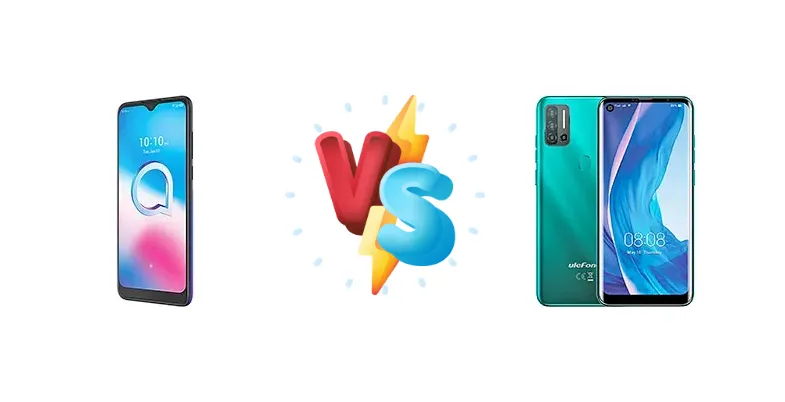
Both the Ulefone Note 11P and the Alcatel 3L (2020) occupy the ultra-budget smartphone space, but cater to slightly different needs. The Alcatel 3L represents a baseline offering, while the Ulefone Note 11P attempts to deliver a more robust experience with a more powerful chipset. This comparison dissects the key differences to help you determine which device best suits your requirements.
🏆 Quick Verdict
For the average user prioritizing responsiveness and multitasking, the Ulefone Note 11P is the clear winner. Its Helio P60 chipset, featuring Cortex-A73 cores, provides a noticeable performance uplift over the Alcatel 3L’s Helio P22, making it better suited for running multiple apps and handling more demanding tasks. Both offer similar charging speeds and basic functionality.
| Network |
|---|
| 2G bands | GSM 850 / 900 / 1800 / 1900 | GSM 850 / 900 / 1800 / 1900 |
| 3G bands | HSDPA 850 / 900 / 1900 / 2100 | HSDPA 850 / 900 / 1700(AWS) / 1900 / 2100 |
| 4G bands | 1, 3, 5, 7, 8, 20, 28, 38, 40 | 1, 2, 3, 4, 5, 7, 8, 12, 17, 19, 20, 28 |
| Speed | HSPA 42.2/5.76 Mbps, LTE Cat4 150/50 Mbps | HSPA, LTE |
| Technology | GSM / HSPA / LTE | GSM / HSPA / LTE |
| Launch |
|---|
| Announced | 2020, January. Released 2020, May | 2021, January 09 |
| Status | Discontinued | Available. Released 2021, March 08 |
| Body |
|---|
| Build | Glass front, plastic back, plastic frame | Glass front, plastic back, plastic frame |
| Dimensions | 158.7 x 74.6 x 8.5 mm (6.25 x 2.94 x 0.33 in) | 166.9 x 77.2 x 10 mm (6.57 x 3.04 x 0.39 in) |
| SIM | Nano-SIM + Nano-SIM | Nano-SIM + Nano-SIM |
| Weight | 165 g (5.82 oz) | 184 g (6.49 oz) |
| Display |
|---|
| Resolution | 720 x 1520 pixels, 19:9 ratio (~270 ppi density) | 720 x 1600 pixels, 20:9 ratio (~268 ppi density) |
| Size | 6.22 inches, 96.6 cm2 (~81.6% screen-to-body ratio) | 6.55 inches, 103.6 cm2 (~80.4% screen-to-body ratio) |
| Type | IPS LCD | IPS LCD |
| Platform |
|---|
| CPU | Octa-core 2.0 GHz Cortex-A53 | Octa-core (4x2.0 GHz Cortex-A73 & 4x2.0 GHz Cortex-A53) |
| Chipset | Mediatek MT6762 Helio P22 (12 nm) | Mediatek MT6771 Helio P60 (12 nm) |
| GPU | PowerVR GE8320 | Mali-G72 MP3 |
| OS | Android 10 | Android 11 |
| Memory |
|---|
| Card slot | microSDXC (uses shared SIM slot) | microSDXC (dedicated slot) |
| Internal | 64GB 4GB RAM | 128GB 8GB RAM |
| | eMMC 5.1 | - |
| Main Camera |
|---|
| Features | LED flash, HDR, panorama | Dual-LED flash |
| Quad | - | 48 MP, f/1.8, (wide), PDAF
8 MP, f/2.2, (ultrawide)
2 MP (macro)
Auxiliary lens |
| Single | 8 MP, f/2.0, (wide), 1/4", 1.12µm | 8 MP, f/1.8 |
| Triple | 48 MP, f/1.8, (wide), 1/2.25", 0.8µm, PDAF
5 MP, f/2.4, (ultrawide/depth sensor), 1/5.0", 1.12µm
2 MP (macro) | - |
| Video | 1080p@30fps | 1080p@30fps |
| Selfie camera |
|---|
| Features | HDR | - |
| Single | 8 MP, f/2.0, (wide), 1/4.0", 1.12µm | 8 MP, f/1.8 |
| Video | 1080p@30fps | 1080p@30fps |
| Sound |
|---|
| 3.5mm jack | Yes | Yes |
| 35mm jack | Yes | Yes |
| Loudspeaker | Yes | Yes |
| Comms |
|---|
| Bluetooth | 5.0, A2DP, LE | 5.0, A2DP, LE |
| NFC | No | No |
| Positioning | GPS | GPS, GLONASS, BDS, GALILEO |
| Radio | FM radio | FM radio |
| USB | microUSB 2.0 | USB Type-C 2.0, OTG |
| WLAN | Wi-Fi 802.11 b/g/n, Wi-Fi Direct | Wi-Fi 802.11 a/b/g/n/ac, dual-band, Wi-Fi Direct |
| Features |
|---|
| Sensors | Fingerprint (rear-mounted), accelerometer, proximity, compass | Fingerprint (rear-mounted), accelerometer, gyro, proximity, compass |
| | - | 24-bit/192kHz audio |
| Battery |
|---|
| Charging | 10W wired | 10W wired |
| Type | Li-Po 4000 mAh | Li-Po 4500 mAh |
| Misc |
|---|
| Colors | Chameleon Blue, Dark Chrome, Agate Green | Black, Red, Green |
| Models | 5029Y, 5029, 5029D, 5029D_EEA, 5029Y_EEA | - |
| Price | About 150 EUR | About 160 EUR |
alcatel 3L (2020)
- Extremely affordable price point
- Simple and easy-to-use interface
- Reliable for basic communication tasks
- Underpowered processor for multitasking
- Likely limited storage options
- Basic camera performance
Ulefone Note 11P
- More powerful Helio P60 processor
- Improved multitasking capabilities
- Potentially better camera image processing
- Still a budget device with limitations
- 10W charging is relatively slow
- May be slightly more expensive than the Alcatel 3L
Display Comparison
Neither device boasts a standout display. Both are likely to feature 720p+ resolution panels, typical for this price bracket. However, detailed panel technology (IPS, TFT) and brightness levels are not specified. The focus here is on the internal hardware, as display quality is unlikely to be a deciding factor. Bezels are expected to be substantial on both, reflecting their budget nature.
Camera Comparison
Camera details are sparse, but it's safe to assume both phones feature basic camera setups. Without specific sensor size or aperture information, it’s difficult to make a definitive judgment. However, the image signal processor (ISP) within the Helio P60 is more advanced, potentially leading to better image processing and slightly improved photo quality on the Ulefone Note 11P. Expect both to struggle in low-light conditions. The presence of 2MP macro lenses on either device is largely marketing fluff and shouldn't influence purchasing decisions.
Performance
The core difference lies in the chipsets. The Ulefone Note 11P’s Mediatek Helio P60 (MT6771) is a significant upgrade over the Alcatel 3L’s Helio P22 (MT6762). The P60 utilizes a combination of four Cortex-A73 cores clocked at 2.0 GHz and four Cortex-A53 cores, providing a substantial boost in multi-core performance compared to the P22’s eight Cortex-A53 cores at the same clock speed. The A73 architecture is demonstrably more efficient and powerful. This translates to faster app loading times, smoother scrolling, and a more responsive user experience on the Ulefone Note 11P. While both are built on a 12nm process, the architectural advantage of the P60 is paramount.
Battery Life
Both devices are equipped with 10W wired charging, indicating similar charging speeds. Battery capacity isn't specified, but typical capacities for this segment range from 3000mAh to 4000mAh. The more efficient Helio P60 in the Ulefone Note 11P *may* translate to slightly better battery life, but this will depend heavily on usage patterns. Expect roughly a full day of light use from either device.
Buying Guide
Buy the Alcatel 3L (2020) if you need a basic, extremely affordable smartphone for essential tasks like calls, texts, and light web browsing. Buy the Ulefone Note 11P if you prefer a device capable of smoother multitasking, running more apps simultaneously, and handling occasional gaming without significant lag. The Note 11P is the better choice for users who anticipate pushing their phone beyond the bare minimum.
Frequently Asked Questions
❓ Will the Ulefone Note 11P handle popular social media apps like Facebook and Instagram smoothly?
Yes, the Helio P60 in the Ulefone Note 11P is significantly more capable of handling social media apps without lag compared to the Alcatel 3L’s Helio P22. The Cortex-A73 cores provide the necessary processing power for a smoother experience, even with multiple apps open.
❓ Is the Ulefone Note 11P a good choice for playing mobile games?
While neither phone is a gaming powerhouse, the Ulefone Note 11P is the better option for casual gaming. The Helio P60’s GPU offers a noticeable performance improvement over the P22, allowing for playable frame rates in less demanding titles. Expect to lower graphics settings for optimal performance.
❓ How much storage does each phone typically offer, and can it be expanded?
Storage configurations aren't explicitly stated, but both phones likely start with 32GB of internal storage. Both are expected to support microSD card expansion, allowing you to increase storage capacity for photos, videos, and apps. Check specific retailer listings for confirmed storage options.
❓ What Android version do these phones ship with, and will they receive software updates?
Both devices likely ship with Android 11 or 12 (Go Edition), optimized for lower-end hardware. Software update support is typically limited on ultra-budget phones like these. Don't expect frequent or long-term updates.