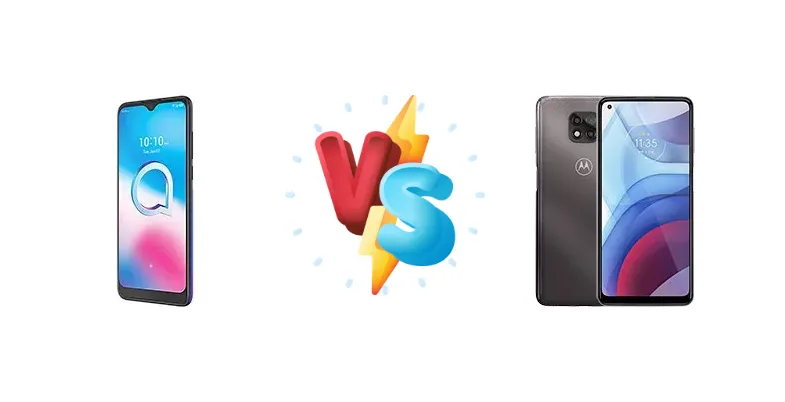
The Alcatel 3L (2020) and Motorola Moto G Power (2021) represent distinct approaches to the budget smartphone market. The Alcatel aims for affordability, while the Motorola prioritizes battery life and a slightly more refined experience. This comparison dissects their core components to determine which device delivers the best value for your money.
🏆 Quick Verdict
For the average user, the Motorola Moto G Power (2021) is the better choice. Its Qualcomm Snapdragon 662 chipset, built on an 11nm process, offers a noticeable performance advantage and improved power efficiency compared to the Alcatel 3L’s MediaTek Helio P22. While both phones are budget-focused, the Moto G Power provides a smoother, more responsive experience.
| Network |
|---|
| 2G bands | GSM 850 / 900 / 1800 / 1900 | GSM 850 / 900 / 1800 / 1900 |
| 3G bands | HSDPA 850 / 900 / 1900 / 2100 | HSDPA 850 / 900 / 1700(AWS) / 1900 / 2100 |
| 4G bands | 1, 3, 5, 7, 8, 20, 28, 38, 40 | 1, 2, 3, 4, 5, 7, 8, 12, 13, 14, 17, 25, 26, 29, 30, 38, 41, 66, 71 |
| Speed | HSPA 42.2/5.76 Mbps, LTE Cat4 150/50 Mbps | HSPA, LTE |
| Technology | GSM / HSPA / LTE | GSM / CDMA / HSPA / EVDO / LTE |
| | - | CDMA2000 1xEV-DO |
| Launch |
|---|
| Announced | 2020, January. Released 2020, May | 2021, January 08 |
| Status | Discontinued | Available. Released 2021, January 14 |
| Body |
|---|
| Build | Glass front, plastic back, plastic frame | Glass front, plastic back, plastic frame |
| Dimensions | 158.7 x 74.6 x 8.5 mm (6.25 x 2.94 x 0.33 in) | 165.3 x 75.9 x 9.5 mm (6.51 x 2.99 x 0.37 in) |
| SIM | Nano-SIM + Nano-SIM | Nano-SIM |
| Weight | 165 g (5.82 oz) | 206.5 g (7.30 oz) |
| | - | Water-repellent coating |
| Display |
|---|
| Resolution | 720 x 1520 pixels, 19:9 ratio (~270 ppi density) | 720 x 1600 pixels, 20:9 ratio (~266 ppi density) |
| Size | 6.22 inches, 96.6 cm2 (~81.6% screen-to-body ratio) | 6.6 inches, 105.2 cm2 (~83.8% screen-to-body ratio) |
| Type | IPS LCD | IPS LCD |
| Platform |
|---|
| CPU | Octa-core 2.0 GHz Cortex-A53 | Octa-core (4x2.0 GHz Kryo 260 Gold & 4x1.8 GHz Kryo 260 Silver) |
| Chipset | Mediatek MT6762 Helio P22 (12 nm) | Qualcomm SM6115 Snapdragon 662 (11 nm) |
| GPU | PowerVR GE8320 | Adreno 610 |
| OS | Android 10 | Android 10 |
| Memory |
|---|
| Card slot | microSDXC (uses shared SIM slot) | microSDXC (dedicated slot) |
| Internal | 64GB 4GB RAM | 32GB 3GB RAM, 64GB 4GB RAM |
| | eMMC 5.1 | eMMC 5.1 |
| Main Camera |
|---|
| Features | LED flash, HDR, panorama | LED flash, HDR, panorama |
| Single | 8 MP, f/2.0, (wide), 1/4", 1.12µm | - |
| Triple | 48 MP, f/1.8, (wide), 1/2.25", 0.8µm, PDAF
5 MP, f/2.4, (ultrawide/depth sensor), 1/5.0", 1.12µm
2 MP (macro) | 48 MP, f/1.7, (wide), 1/2.0", 0.8µm, PDAF
2 MP (macro)
Auxiliary lens |
| Video | 1080p@30fps | 1080p@30/60fps, gyro-EIS |
| Selfie camera |
|---|
| Features | HDR | HDR |
| Single | 8 MP, f/2.0, (wide), 1/4.0", 1.12µm | 8 MP, f/2.0, 1.12µm |
| Video | 1080p@30fps | 1080p@30fps, gyro-EIS |
| Sound |
|---|
| 3.5mm jack | Yes | Yes |
| 35mm jack | Yes | Yes |
| Loudspeaker | Yes | Yes |
| Comms |
|---|
| Bluetooth | 5.0, A2DP, LE | 5.0, A2DP, LE |
| NFC | No | No |
| Positioning | GPS | GPS, GLONASS, GALILEO |
| Radio | FM radio | FM radio |
| USB | microUSB 2.0 | USB Type-C 2.0 |
| WLAN | Wi-Fi 802.11 b/g/n, Wi-Fi Direct | Wi-Fi 802.11 a/b/g/n/ac, dual-band, Wi-Fi Direct |
| Features |
|---|
| Sensors | Fingerprint (rear-mounted), accelerometer, proximity, compass | Fingerprint (side-mounted), accelerometer, gyro, proximity, compass, barometer |
| Battery |
|---|
| Charging | 10W wired | 15W wired |
| Type | Li-Po 4000 mAh | Li-Po 5000 mAh |
| Misc |
|---|
| Colors | Chameleon Blue, Dark Chrome, Agate Green | Flash Gray, Polar Silver |
| Models | 5029Y, 5029, 5029D, 5029D_EEA, 5029Y_EEA | - |
| Price | About 150 EUR | About 60 EUR |
alcatel 3L (2020)
- Extremely affordable price point
- Simple and straightforward user experience
- Acceptable for basic communication tasks
- Underpowered processor limits performance
- Slower charging speed (10W)
- Likely limited software support
Motorola Moto G Power (2021)
- More powerful Snapdragon 662 processor
- Faster 15W charging
- Improved power efficiency for longer battery life
- Slightly higher price than the Alcatel 3L
- May still lack advanced features found in higher-end phones
- Software updates may be limited, but likely better than Alcatel
Display Comparison
Neither device boasts a standout display. Both likely utilize LCD panels, common in this price bracket. The key difference lies under the hood: processing power impacts UI responsiveness. While specific display specs (resolution, brightness) are unavailable, the more powerful Snapdragon 662 in the Moto G Power will contribute to smoother scrolling and animations, making the user experience feel more fluid, even if the panel itself is similar.
Camera Comparison
Without detailed camera specifications, a direct comparison is difficult. However, given the market positioning, it’s safe to assume both phones feature basic camera systems. The Motorola likely benefits from Qualcomm’s image signal processor (ISP) within the Snapdragon 662, which generally provides better image processing capabilities than the ISP found in the Helio P22. This could result in slightly improved image quality, particularly in low-light conditions. The presence of a dedicated ISP on the Motorola is a key advantage.
Performance
The Motorola Moto G Power (2021) holds a significant advantage in performance. Its Qualcomm Snapdragon 662 (11nm) utilizes a hybrid architecture with 4x2.0 GHz Kryo 260 Gold and 4x1.8 GHz Kryo 260 Silver cores, offering a more efficient and powerful solution than the Alcatel 3L’s MediaTek Helio P22 (12nm) and its homogenous octa-core 2.0 GHz Cortex-A53 setup. The 11nm process node of the Snapdragon 662 is more efficient, leading to less heat generation and sustained performance. This translates to faster app loading times, smoother multitasking, and a better experience with graphically intensive applications.
Battery Life
The Motorola Moto G Power (2021) features 15W wired charging, a step up from the Alcatel 3L’s 10W charging. While battery capacity isn’t specified, Motorola’s ‘Power’ branding emphasizes battery life. The Snapdragon 662’s improved power efficiency further contributes to longer runtimes. The faster charging speed on the Moto G Power means less time tethered to an outlet, a significant benefit for users who rely heavily on their smartphones throughout the day.
Buying Guide
Buy the Alcatel 3L (2020) if your primary need is an extremely affordable smartphone for basic tasks like calls, texts, and light social media use, and you're willing to compromise on performance. Buy the Motorola Moto G Power (2021) if you prioritize longer battery life, smoother multitasking, and a more capable processor for occasional gaming or demanding apps, even if it means spending a bit more.
Frequently Asked Questions
❓ Will the Motorola Moto G Power (2021) handle demanding games like PUBG Mobile?
While not a gaming powerhouse, the Snapdragon 662 in the Moto G Power can run PUBG Mobile at medium settings with acceptable frame rates. The Alcatel 3L’s Helio P22 will struggle with this title, likely requiring very low settings and experiencing significant lag.
❓ How much faster will app loading times be on the Moto G Power compared to the Alcatel 3L?
Expect app loading times on the Moto G Power to be noticeably faster – potentially 20-30% quicker – due to the Snapdragon 662’s superior processing power and memory bandwidth. This difference will be most apparent with larger, more complex applications.
❓ Is the 15W charging on the Moto G Power a significant improvement over the Alcatel 3L’s 10W charging?
Yes, 15W charging will reduce charging times by a considerable margin. While exact 0-100% times aren't available, you can expect the Moto G Power to charge significantly faster, potentially shaving off 30-60 minutes compared to the Alcatel 3L.