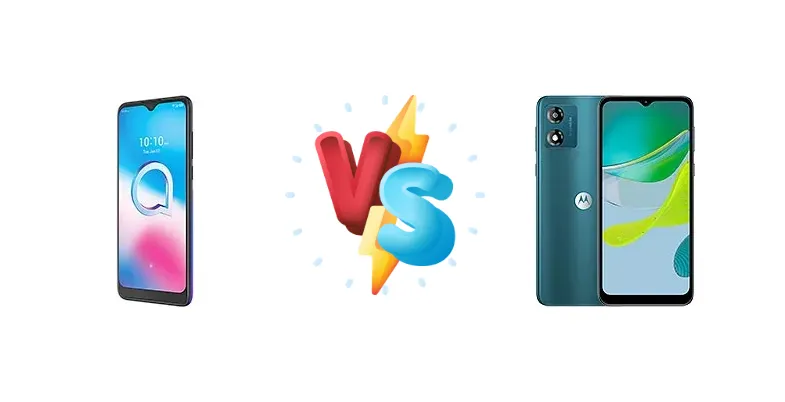
The budget smartphone market is fiercely competitive, offering incredible value for those seeking essential features without breaking the bank. Today, we're pitting two contenders against each other: the Alcatel 3L (2020) and the Motorola Moto E13. Let's dive into a detailed comparison to see which phone emerges as the winner.
🏆 Quick Verdict
The Motorola Moto E13 edges out the Alcatel 3L thanks to its more modern chipset and slightly improved performance. While both offer basic functionality, the E13's Cortex-A75 cores provide a noticeable boost in responsiveness, making it a better choice for everyday tasks and light gaming.
| Network |
|---|
| 2G bands | GSM 850 / 900 / 1800 / 1900 | GSM 850 / 900 / 1800 / 1900 |
| 3G bands | HSDPA 850 / 900 / 1900 / 2100 | HSDPA 850 / 900 / 2100 |
| 4G bands | 1, 3, 5, 7, 8, 20, 28, 38, 40 | 1, 3, 5, 7, 8, 28, 38, 40, 41 |
| Speed | HSPA 42.2/5.76 Mbps, LTE Cat4 150/50 Mbps | HSPA, LTE |
| Technology | GSM / HSPA / LTE | GSM / HSPA / LTE |
| | - | 1, 3, 5, 7, 8, 20, 28, 38, 40, 41 |
| Launch |
|---|
| Announced | 2020, January. Released 2020, May | 2023, January 24 |
| Status | Discontinued | Available. Released 2023, February 13 |
| Body |
|---|
| Build | Glass front, plastic back, plastic frame | Glass front, plastic frame, plastic back |
| Dimensions | 158.7 x 74.6 x 8.5 mm (6.25 x 2.94 x 0.33 in) | 164.2 x 75 x 8.5 mm (6.46 x 2.95 x 0.33 in) |
| SIM | Nano-SIM + Nano-SIM | Nano-SIM + Nano-SIM |
| Weight | 165 g (5.82 oz) | 179.5 g (6.35 oz) |
| | - | Water-resistant design |
| Display |
|---|
| Resolution | 720 x 1520 pixels, 19:9 ratio (~270 ppi density) | 720 x 1600 pixels, 20:9 ratio (~270 ppi density) |
| Size | 6.22 inches, 96.6 cm2 (~81.6% screen-to-body ratio) | 6.5 inches, 102.0 cm2 (~82.8% screen-to-body ratio) |
| Type | IPS LCD | IPS LCD |
| Platform |
|---|
| CPU | Octa-core 2.0 GHz Cortex-A53 | Octa-core (2x1.6 GHz Cortex-A75 & 6x1.6 GHz Cortex-A55) |
| Chipset | Mediatek MT6762 Helio P22 (12 nm) | Unisoc T606 (12 nm) |
| GPU | PowerVR GE8320 | Mali-G57 MP1 |
| OS | Android 10 | Android 13 (Go edition) |
| Memory |
|---|
| Card slot | microSDXC (uses shared SIM slot) | microSDXC (dedicated slot) |
| Internal | 64GB 4GB RAM | 32GB 2GB RAM, 64GB 2GB RAM, 64GB 4GB RAM, 128GB 8GB RAM |
| | eMMC 5.1 | eMMC 5.1 |
| Main Camera |
|---|
| Features | LED flash, HDR, panorama | LED flash, HDR, panorama |
| Single | 8 MP, f/2.0, (wide), 1/4", 1.12µm | 13 MP, f/2.2, (wide), 1.12µm, PDAF |
| Triple | 48 MP, f/1.8, (wide), 1/2.25", 0.8µm, PDAF
5 MP, f/2.4, (ultrawide/depth sensor), 1/5.0", 1.12µm
2 MP (macro) | - |
| Video | 1080p@30fps | 1080p@30fps |
| Selfie camera |
|---|
| Features | HDR | - |
| Single | 8 MP, f/2.0, (wide), 1/4.0", 1.12µm | 5 MP, f/2.4, (wide), 1/5.0", 1.12µm |
| Video | 1080p@30fps | 1080p@30fps |
| Sound |
|---|
| 3.5mm jack | Yes | Yes |
| 35mm jack | Yes | Yes |
| Loudspeaker | Yes | Yes |
| Comms |
|---|
| Bluetooth | 5.0, A2DP, LE | 5.0, A2DP, LE |
| NFC | No | No |
| Positioning | GPS | GPS, GLONASS, GALILEO |
| Radio | FM radio | FM radio, recording |
| USB | microUSB 2.0 | USB Type-C 2.0, OTG |
| WLAN | Wi-Fi 802.11 b/g/n, Wi-Fi Direct | Wi-Fi 802.11 a/b/g/n/ac, dual-band |
| Features |
|---|
| Sensors | Fingerprint (rear-mounted), accelerometer, proximity, compass | Accelerometer, proximity |
| Battery |
|---|
| Charging | 10W wired | 10W wired |
| Type | Li-Po 4000 mAh | Li-Po 5000 mAh |
| Misc |
|---|
| Colors | Chameleon Blue, Dark Chrome, Agate Green | Cosmic Black, Creamy White, Aurora Green |
| Models | 5029Y, 5029, 5029D, 5029D_EEA, 5029Y_EEA | - |
| Price | About 150 EUR | $ 119.99 / € 104.99 |
alcatel 3L (2020)
- Potentially lower price
- Decent battery life
- Large display
- Outdated chipset
- Slower performance
- Basic camera
Motorola Moto E13
- Better performance (Cortex-A75 cores)
- Improved camera (50MP)
- Modern design
- May be slightly more expensive
- 10W charging is slow
Display Comparison
Both phones feature a 6.5-inch HD+ display, offering decent viewing angles and adequate brightness for indoor use. However, the Moto E13 might have slightly better color accuracy and a more modern panel. The Alcatel 3L's display is functional but lacks the vibrancy of newer panels.
Camera Comparison
The Alcatel 3L typically features a 13MP main camera, while the Moto E13 boasts a 50MP main camera. While megapixels aren't everything, the E13's larger sensor and image processing should result in better image quality, especially in low light. Both phones likely offer basic features like HDR and portrait mode. Video recording capabilities are likely similar, around 1080p at 30fps.
Performance
This is where the Moto E13 shines. The Unisoc T606, with its dual Cortex-A75 cores, provides a significant performance advantage over the Alcatel 3L's Helio P22. Expect smoother app launches, faster browsing, and a more responsive user experience on the E13. The Alcatel 3L can feel sluggish at times, especially with multiple apps open.
Battery Life
Both phones are expected to have a 5000mAh battery, offering all-day battery life under moderate usage. Charging speeds are identical at 10W wired, meaning a full charge will take around 2-3 hours for both devices.
Buying Guide
The Alcatel 3L (2020) is a good option for users prioritizing a very basic smartphone experience and a potentially lower price point. The Motorola Moto E13 is ideal for those needing a bit more performance for social media, browsing, and light multitasking, without spending a fortune.
Frequently Asked Questions
❓ Which phone is better for gaming?
The Motorola Moto E13 is significantly better for gaming due to its more powerful chipset. While neither phone is a gaming powerhouse, the E13 will handle basic games more smoothly.
❓ What is the difference in software?
Motorola typically offers a cleaner, near-stock Android experience, while Alcatel's software can be more cluttered. Motorola's software also tends to receive updates more frequently.