
Alcatel 1v (2019) vs Motorola Moto G7 Play: A Deep Dive into Budget Smartphone Choices
| Phones Images | |||||
|---|---|---|---|---|---|
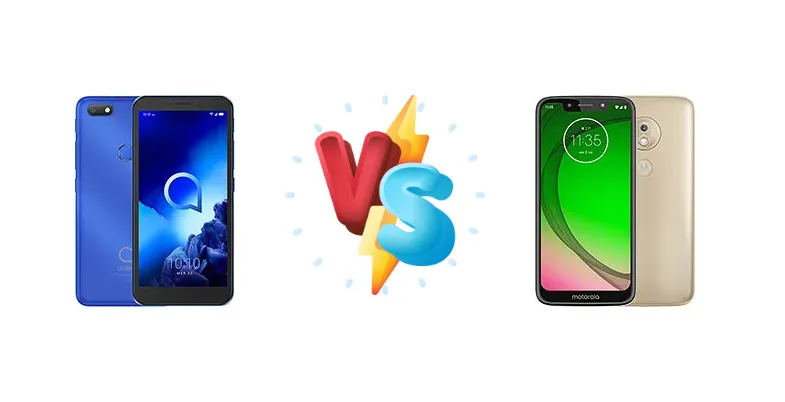
|
🏆 Quick Verdict
For most users, the Motorola Moto G7 Play is the superior choice. Its Qualcomm Snapdragon 632 chipset, built on a more efficient 14nm process, provides a noticeable performance advantage over the Alcatel 1v’s Unisoc SC9863A. While both boast similar battery endurance ratings, the G7 Play’s more capable processor translates to a smoother overall user experience.
| PHONES | ||
|---|---|---|
| Phone Names | alcatel 1v (2019) | Motorola Moto G7 Play |
| Network | ||
|---|---|---|
| 2G bands | GSM 850 / 900 / 1800 / 1900 | GSM 850 / 900 / 1800 / 1900 |
| 3G bands | HSDPA 800 / 850 / 900 / 1900 / 2100 - 5001D/5001U/5001T | HSDPA 850 / 900 / 1700(AWS) / 1900 / 2100 |
| 4G bands | 1, 3, 7, 8, 20, 28 - 5001D | 1, 2, 3, 4, 5, 7, 8, 20, 28, 38, 40, 41 - Europe |
| Speed | HSPA 21.1/5.76 Mbps, LTE Cat4 150/50 Mbps | HSPA 42.2/5.76 Mbps, LTE (2CA) Cat7 300/50 Mbps |
| Technology | GSM / HSPA / LTE | GSM / HSPA / LTE |
| 1, 3, 5, 7, 8, 20, 28, 38, 40 - 5001T | 1, 2, 3, 4, 5, 7, 8, 12, 13, 14, 17, 20, 25, 26, 29, 30, 38, 39, 40, 41, 41, 66, 71 - USA | |
| Launch | ||
|---|---|---|
| Announced | 2019, September. Released 2019, Q4 | 2019, February. Released 2019, March |
| Status | Discontinued | Discontinued |
| Body | ||
|---|---|---|
| Build | - | Glass front (Gorilla Glass 3), plastic back, plastic frame |
| Dimensions | 149.1 x 72.2 x 8.9 mm (5.87 x 2.84 x 0.35 in) | 147.3 x 71.5 x 8 mm (5.80 x 2.81 x 0.31 in) |
| SIM | · Nano-SIM· Nano-SIM + Nano-SIM | · Nano-SIM· Nano-SIM + Nano-SIM |
| Weight | 153.2 g (5.40 oz) | 149 g (5.26 oz) |
| - | Splash resistant (market dependent) | |
| Display | ||
|---|---|---|
| Protection | - | Corning Gorilla Glass 3 (market dependent) |
| Resolution | 480 x 960 pixels, 18:9 ratio (~195 ppi density) | 720 x 1512 pixels, 19:9 ratio (~294 ppi density) |
| Size | 5.5 inches, 78.1 cm2 (~72.5% screen-to-body ratio) | 5.7 inches, 81.4 cm2 (~77.3% screen-to-body ratio) |
| Type | IPS LCD | IPS LCD |
| Platform | ||
|---|---|---|
| CPU | Octa-core (4x1.6 GHz Cortex-A55 & 4x1.2 GHz Cortex-A55) | Octa-core (4x1.8 GHz Kryo 250 Gold & 4x1.8 GHz Kryo 250 Silver) |
| Chipset | Unisoc SC9863A (28 nm) | Qualcomm SDM632 Snapdragon 632 (14 nm) |
| GPU | IMG8322 | Adreno 506 |
| OS | Android 9.0 Pie (Go edition) | Android 9.0 (Pie), upgradable to Android 10 |
| Memory | ||
|---|---|---|
| Card slot | microSDXC | microSDXC (dedicated slot) |
| Internal | 16GB 1GB RAM, 16GB 2GB RAM, 16GB 3GB RAM | 32GB 2GB RAM, 32GB 3GB RAM |
| - | eMMC 5.1 | |
| Main Camera | ||
|---|---|---|
| Features | LED flash, HDR, panorama | LED flash, panorama, HDR |
| Single | 5 MP, f/2.2, 28mm (wide), 1/5.0", 1.12µm or 8 MP, f/2.2, 28mm (wide), 1/4.0", 1.12µm | 13 MP, f/2.0, 1/3.1", 1.12µm, PDAF |
| Video | 1080p@30fps | 4K@30fps, 1080p@30fps |
| Selfie camera | ||
|---|---|---|
| Features | LED flash | LED flash |
| Single | 5 MP, f/2.2, 28mm (wide), 1/5.0", 1.12µm | 8 MP, f/2.2, 1/4.0", 1.12µm |
| Video | 1080p@30fps | 1080p@30fps |
| Sound | ||
|---|---|---|
| 3.5mm jack | Yes | Yes |
| 35mm jack | Yes | Yes |
| Loudspeaker | Yes | Yes |
| Comms | ||
|---|---|---|
| Bluetooth | 4.2, A2DP, LE | 4.2, A2DP, LE |
| NFC | No | No |
| Positioning | GPS | GPS, GLONASS |
| Radio | FM radio | FM radio |
| USB | microUSB 2.0 | USB Type-C 2.0, OTG |
| WLAN | Wi-Fi 802.11 b/g/n, Wi-Fi Direct | Wi-Fi 802.11 b/g/n |
| Features | ||
|---|---|---|
| Sensors | Fingerprint (under display, optical) - market dependant, accelerometer, proximity | Fingerprint (rear-mounted), accelerometer, gyro, proximity, compass |
| Battery | ||
|---|---|---|
| Charging | - | 10W wired |
| Type | Li-Ion 2460 mAh, removable | Li-Ion 3000 mAh, non-removable |
| Misc | ||
|---|---|---|
| Colors | Anthracite Black, Metallic Blue, Metallic Gold, Metallic Rose | Deep indigo, Fine Gold, Starry Black |
| Models | 5001D, 5001A, 5001U, 5001T, 5001J, 5001D_EEA | XT1952-4, XT1952-5 |
| Price | About 80 EUR | About 160 EUR |
| SAR | - | 0.74 W/kg (head) 1.40 W/kg (body) |
| SAR EU | - | 0.84 W/kg (head) 0.85 W/kg (body) |
| Tests | ||
|---|---|---|
| Audio quality | - | Noise -90.0dB / Crosstalk -92.9dB |
| Battery life | - | Endurance rating 103h |
| Camera | - | Photo / Video |
| Display | - | Contrast ratio: 1468:1 (nominal), 3.180 (sunlight) |
| Loudspeaker | - | Voice 66dB / Noise 74dB / Ring 81dB |
| Performance | - | AnTuTu: 97230 (v7) GeekBench: 4154 (v4.4) GFXBench: 7.7fps (ES 3.1 onscreen) |
alcatel 1v (2019)
- Extremely affordable price point
- Acceptable battery endurance for basic use
- Lightweight and portable design
- Unisoc SC9863A chipset offers limited performance
- Lack of detailed specifications hinders assessment
- Potentially slower software updates
Motorola Moto G7 Play
- Qualcomm Snapdragon 632 provides smoother performance
- More efficient power management
- 10W wired charging support
- Still an entry-level device with limitations
- Camera quality likely limited by budget constraints
- May be slightly more expensive than the Alcatel 1v
Display Comparison
Both the Alcatel 1v and Moto G7 Play share the same nominal and sunlight contrast ratios of 1468:1 and 3180:1 respectively, suggesting similar viewing experiences in varying lighting conditions. However, detailed panel specifications like resolution and color gamut are missing for the Alcatel 1v. The Moto G7 Play’s display, while not exceptional, benefits from Qualcomm’s image processing capabilities, potentially offering slightly more accurate color reproduction. The lack of detailed display specs for the Alcatel 1v makes a definitive comparison difficult, but the G7 Play likely offers a more refined visual experience.
Camera Comparison
Both devices are listed with 'Photo / Video' capabilities, but lack specific details regarding sensor size, aperture, or image processing features. Given the price point, it’s safe to assume both cameras are entry-level. The absence of detailed camera specs makes a direct comparison impossible. However, Qualcomm’s image signal processor (ISP) within the Snapdragon 632 likely provides the Moto G7 Play with an advantage in image quality and processing speed, even with similar sensor hardware. The prevalence of 2MP macro lenses on both devices suggests limited utility for detailed close-up photography.
Performance
The core difference lies in the chipsets. The Motorola Moto G7 Play’s Qualcomm Snapdragon 632 (14nm) is a significant step up from the Alcatel 1v’s Unisoc SC9863A (28nm). The 14nm process node of the Snapdragon 632 translates to better power efficiency and thermal management, reducing the likelihood of performance throttling during sustained use. Furthermore, the Snapdragon 632’s CPU configuration – 4x1.8 GHz Kryo 250 Gold & 4x1.8 GHz Kryo 250 Silver – is architecturally more advanced than the Alcatel 1v’s 4x1.6 GHz Cortex-A55 & 4x1.2 GHz Cortex-A55, resulting in faster application loading times and smoother multitasking. Users who intend to run more than a handful of apps or engage in light gaming will find the Moto G7 Play far more capable.
Battery Life
Both the Alcatel 1v and Moto G7 Play achieve an endurance rating of 103 hours, indicating comparable battery life under similar usage patterns. However, the Snapdragon 632’s superior power efficiency means the Moto G7 Play can maintain that endurance with more demanding tasks. The Moto G7 Play also supports 10W wired charging, a specification absent for the Alcatel 1v, suggesting a slightly faster recharge time. While the overall battery life is similar, the G7 Play’s charging capability and processor efficiency provide a slight edge.
Buying Guide
Buy the Alcatel 1v (2019) if your primary need is an extremely affordable device for basic communication – calls, texts, and light app usage – and you prioritize absolute minimum cost above all else. Buy the Motorola Moto G7 Play if you prefer a more responsive experience, even for simple tasks, and anticipate using your phone for more than just the essentials, including occasional social media browsing or light gaming.